Asia’s chip makers have been on a monster AI-fueled rally this year.
But after months of relentless gains, some of the region’s biggest winners are tumbling as investors question lofty valuations and South Korea moves to rein in speculative trading in one of this year’s hottest stock markets.
Nowhere is the reversal more striking than at Japan’s Kioxia.
The memory chipmaker was the second-best-performing non-US stock in the MSCI All Country World Investable Market Index in the first half of the year, soaring 631%. Last month, it became Japan’s most valuable listed company.
That momentum has unraveled quickly.
Kioxia shares plunged 16% on Friday following an overnight sell-off in US-listed memory stocks. The stock has halved since its June peak, wiping about 30 trillion yen, or roughly $185 billion, off its market value.
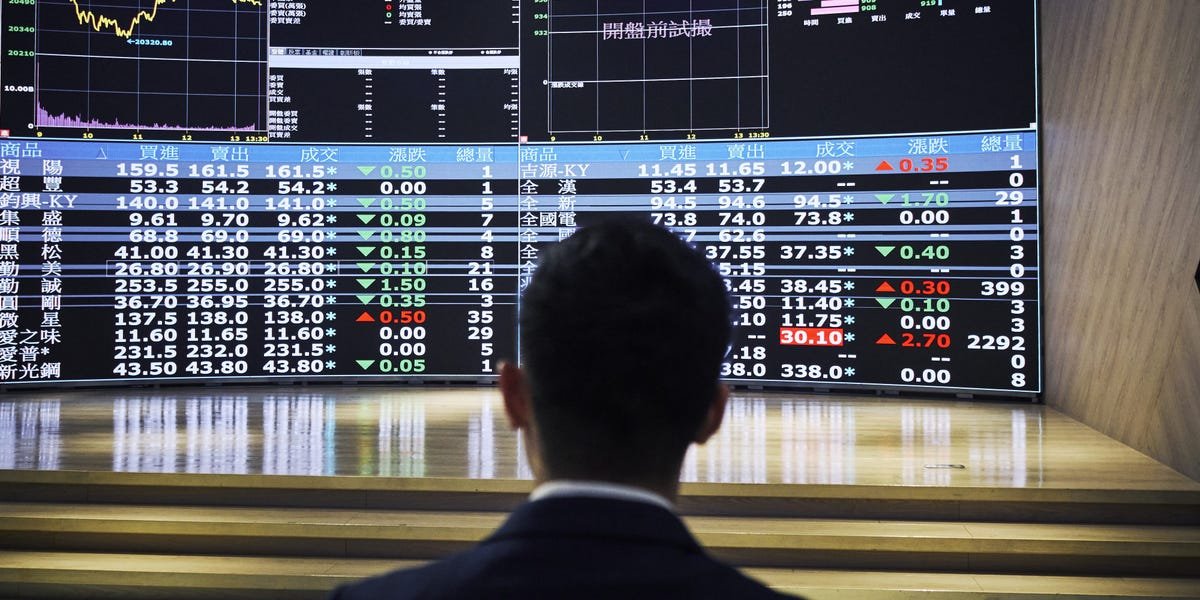
The sell-off spread across the region on Friday.
Taiwan Semiconductor Manufacturing Co., the world’s largest contract chipmaker, fell over 5% despite reporting blockbuster second-quarter earnings on Thursday, with profits surging 77% from a year earlier.
South Korea’s market was closed on Friday, but Samsung Electronics and SK Hynix have already fallen roughly one-third from their peaks this year. SK Hynix’s Nasdaq-listed shares closed 14% lower on Thursday.
The weakness followed South Korea’s decision to tighten rules on single-stock leveraged exchange-traded funds after weeks of sharp market swings. Regulators said the measures were aimed at cooling excessive speculation.
South Korea had been one of the world’s hottest equity markets this year, with the rally fueled in part by heavy retail participation and leveraged bets concentrated in AI-related names.
Top economist and former PIMCO CEO Mohamed El-Erian said South Korean authorities face a delicate balancing act: tackling inflation while heading off excessive financial volatility that could trigger “disorderly deleveraging.”
“How this plays out over the coming weeks is worth watching: It’s not an easy mix to manage, and the latter, if mismanaged, could have some cross-border spillovers,” he wrote on X on Thursday.
Read next
Huileng Tan is a senior reporter based in Singapore, covering markets, the global economy, commodities, and investing. Her reporting focuses on how shifts in money, demographics, technology, and policy are reshaping businesses, wealth, and everyday life around the world.Since joining Business Insider in 2021, she has covered everything from commodity booms and investor trends to China’s economy, the AI trade, and the forces driving global markets.Before joining Business Insider, she reported for CNBC, Dow Jones, ICIS, and The Wall Street Journal.In 2018 and 2019, she won the Singapore Exchange Orb Awards for Story of the Year – Derivatives for her reporting on the global commodities and derivatives markets.Reach her at htan@businessinsider.com.

Follow Following
Every time publishes a story, you’ll get an alert straight to your inbox!
Look out for an alert in your inbox the next time publishes a story!
Every time a new story is published, you’ll get an alert straight to your inbox!
Look out for an alert in your inbox the next time a new story is published!
By clicking “Sign up”, you agree to receive emails from Business Insider. In addition, you accept Insider’s Terms of Service and Privacy Policy.