Zhu Difeng/VCG via Getty Images
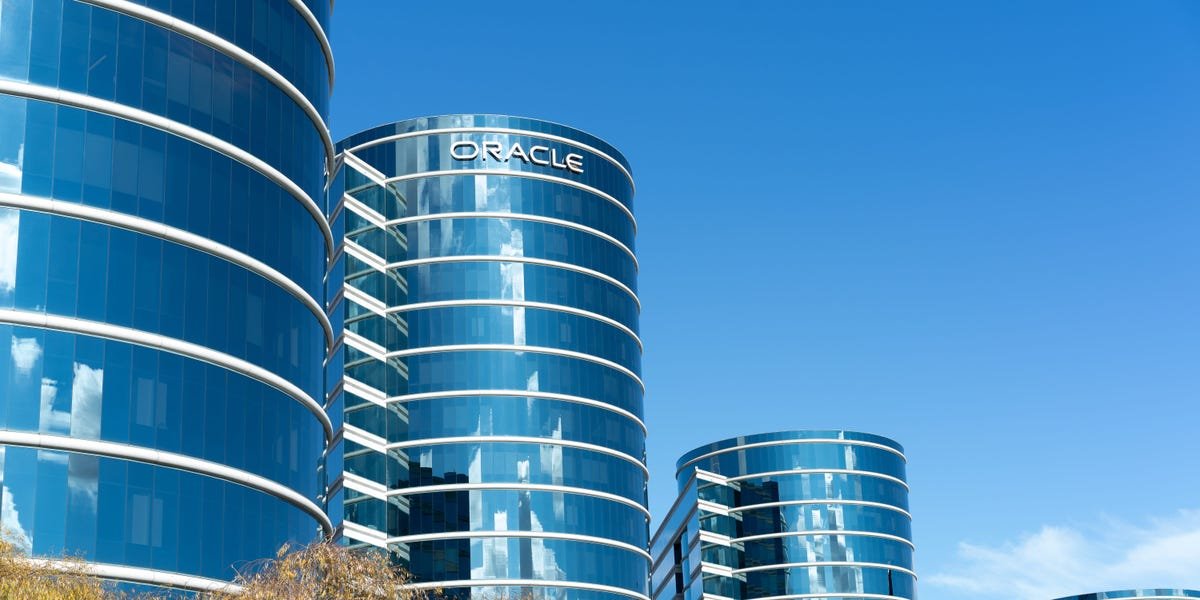
S&P Global downgraded Oracle‘s credit rating this month to BBB-, just one step above junk status. According to Tyler Richey, a technical analyst at Sevens Report Research, it could be a “canary in the coal mine” for the stock market.
The ratings agency cut Oracle’s rating from BBB, citing heavy infrastructure spending and it’s high exposure to OpenAI as risks to its ability to meet its debt obligations. While the news went relatively unnoticed in the stock market, Sevens Report says equity investors should pay attention, as it could be an early warning of bigger issues on the horizon.
“ORCL very well may turn out to be the first of the mega-cap-tech ‘Hyperscalers’ to be rolling over into what could (and is increasingly likely to) prove to be the early stages of a longer-term, cyclical bear market for equities,” Richey wrote in a July 13 client note.
Oracle’s stock has had a rough ride, falling 61% since September 2025. But the writing was on the wall for the company’s decline and downgrade, Richey said.
The harbinger was the fact that the firm’s credit default swap spreads were not tightening enough in 2025 even as the stock price rose — in other words, insurance on the company defaulting on its debt was not dropping sufficiently as the stock price soared, meaning equity investors were overlooking risk that bond investors were seeing.
Now, similar warning signs are present for the broader stock market, Richey said.
First, the ICE High-Yield option-adjusted spread has also not hit cycle lows, meaning bond investors are at least somewhat worried about default in high-risk companies. Meanwhile, the S&P 500 is less than 2% off of its record high levels.
“During the middle innings of a sustainable bull market, that has rarely been observed,” Richey said.
Second, technical measures of bond prices show that high-yield bond prices should drop going forward. When bond prices drop, their yields rise. Yields have been trending upward since the start of the year, Richey said, while stock prices have done the same.
“A higher trending junk bond yield index with stocks trading near all-time highs is a troublesome combination,” Richey said.
Yields across the bond market spectrum are moving up because investors are wary of the AI trade, Richey said. If the capex glut slows down, or if hyperscalers AI infrastructure investments don’t pay off, default risk increases.
It’s what has essentially happened with Oracle — investors have shown disapproval of their massive amounts of AI spending, and S&P Global has now done the same.
“Bottom line, the ORCL downgrade last week served as a stark reminder that critical signals from the bond market can be subtle at first, but offer both fair warning of a potential downturn, and a rare opportunity to take action to protect principle in riskier equity and bond market holdings,” Richey said.
Read next
William Edwards is a senior investing reporter at Business Insider primarily covering the US stock market and the broader economy.He’s interviewed some of the most influential voices in the market, including Joseph Stiglitz, Jeremy Grantham, Rick Rieder, Rob Arnott, Savita Subramanian, Nouriel Roubini, Ken Rogoff, Mike Wilson, Claudia Sahm, Albert Edwards, Andrew Ross Sorkin, Ben Snider, and more.William launched BI’s annual Oracles of Wall Street list (2023, 2024, 2025), highlighting top calls from strategists, economists, and analysts. He also writes BI’s Where to Invest $10,000 column, and contributes to the First Trade newsletter.Prior to Business Insider, William covered the US economy for Bloomberg News in Washington, DC and contributed to TV tech coverage for CNBC in San Francisco. He has also spent time studying or reporting in France, Germany, and Tunisia.He is based in New York.