A popular Australian investor is warning of a stock market crash of up to 50 per cent, arguing a long-running economic cycle is now entering its final stage.
Jason Pizzino runs the trading platform TIA Investor and has garnered more than 360,000 followers on YouTube for his market analysis.
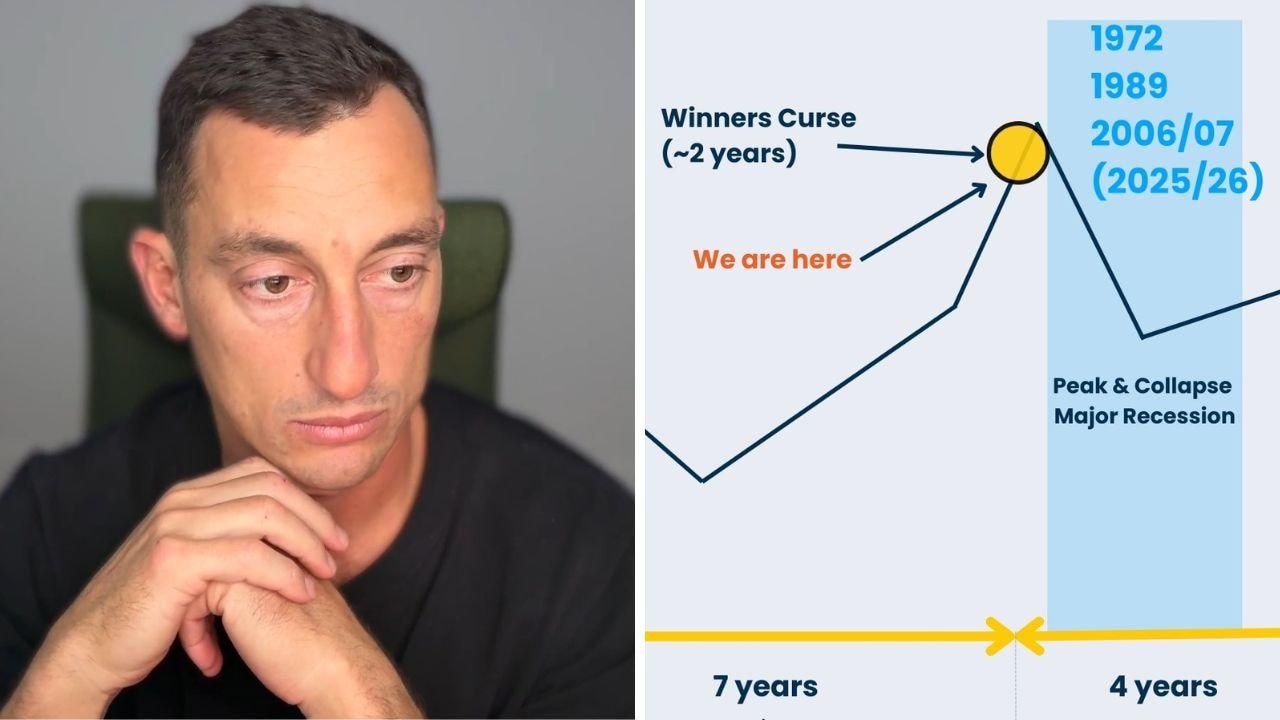
The Queenslander’s approach is unorthodox. Mr Pizzino is a proponent of the 18-year real estate cycle, a theory suggesting a repeating, long-term pattern of boom and bust.
And he argues that in 2026 – roughly 18 years after the last “crash” phase of the cycle – asset prices could be heading toward another major turning point.
“For a stock market, typically it is going to crash 30 to 50 per cent,” Mr Pizzino told news.com.au about the brutal endgame.
“When we look back at each of the 18-year cycles, the stock market in the US typically peaks after the real estate cycle has peaked. And we’ve seen that for over 120 years.
“Does it have to happen again? Of course not. But considering where we are now with the AI boom … it seems unlikely that we would just have a small correction.
“I think there’s still going to be some sort of significant correction within the US stock market, which for Australia is probably going to be something similar.”
MORE: Every Aus suburb named in home price shock
In Mr Pizzino’s telling, the previous cycle peaked in stages: US real estate topped out in 2005–06, equities followed in late 2007, and the crisis event arrived in 2008 with the collapse of the housing bubble and the onset of a global recession.
Australian markets, he suggested, have often followed the US pattern without matching it exactly.
House prices were more resilient in Australia through the financial crisis, seeing only a relatively mild correction before stagnating for several years, while the ASX 200 fared much worse, crashing more than 50 per cent.
Mr Pizzino said a similar pattern may now be taking shape.
“For the US real estate market, we’re at peaks now,” he said.
“We don’t have all of the nails in the coffin to say that the cycle has absolutely peaked. But a lot of the signs are showing that it’s probably at its latest stage. It doesn’t look like there’s much energy left in it.”
He said US stocks related to real estate construction and the broader housing market had not made new highs since late 2024.
“If the stock market’s not expecting there to be greater earnings in home construction, that’s one of the earliest signs to suggest that we’re around the peak of the real estate cycle, which then typically means the economy and the business cycle are also around that point now.”
MORE: $3bn wiped: Aus homes vanish in Albo move
He viewed investor hype around AI and semiconductors, the historic SpaceX IPO and the Australian government’s 5 per cent deposit scheme as signs of a late-cycle mania.
“At the lows, the banks are tightening their credit, the governments are not giving out the same sort of incentives to kickstart a market,” he said.
“But towards the peak of a market, they’re like, sweet, you’re a first-time buyer, you’ve got no experience in investing, how about you go 20x leverage on real estate after real estate’s been up for 10 years?
“It’s the insanity that we see at the peaks. Everyone’s been winning for so long that they forget that they need to take precautions with their portfolio and their money.”
He worried that first home buyers taking advantage of the 5 per cent deposit scheme could spend their best working years in negative equity, “leveraged to the eyeballs” and “maxed out, without spare cash to invest when the markets are down”.
Mr Pizzino said he was more heavily allocated to cash than at any other point in the past 20 years, although he still owned investment properties.
He suggested an Australian housing downturn may not arrive as a dramatic collapse in prices, but as years of stagnation while inflation eroded value.
Some suburbs, towns and cities may still offer decent buying opportunities, while the broader market could go sideways for years, he said.
Not everyone is buying it
The 18-year cycle has a dedicated following among long-term investors like Mr Pizzino, but mainstream economists view it as oversimplified and unreliable.
It violates an oft-cited warning from the American investor Peter Lynch, who argued that “far more money has been lost by investors preparing for corrections, or trying to anticipate corrections, than has been lost in corrections themselves”.
Critics of the theory in Australia include AMP chief economist Shane Oliver and Metropole founder Michael Yardney.
“I still think it’s storytelling dressed up as forecasting rather than a genuine predictive framework,” Mr Yardney told news.com.au, likening the theory to “numerology” rather than “economic analysis”.
“Real crashes, whether in the economy or particularly in the property market, need a mechanism – things like a sharp spike in unemployment so people can’t keep paying their mortgages, a credit crunch, or widespread forced selling – and calendar-based theories don’t give you any of that,” he said.
Mr Yardney believed that Australia’s housing decline in 2026 was better understood as a “fragmented, localised slowdown driven by specific factors in specific markets, rather than the broad economic conditions the cycle theory relies on”.