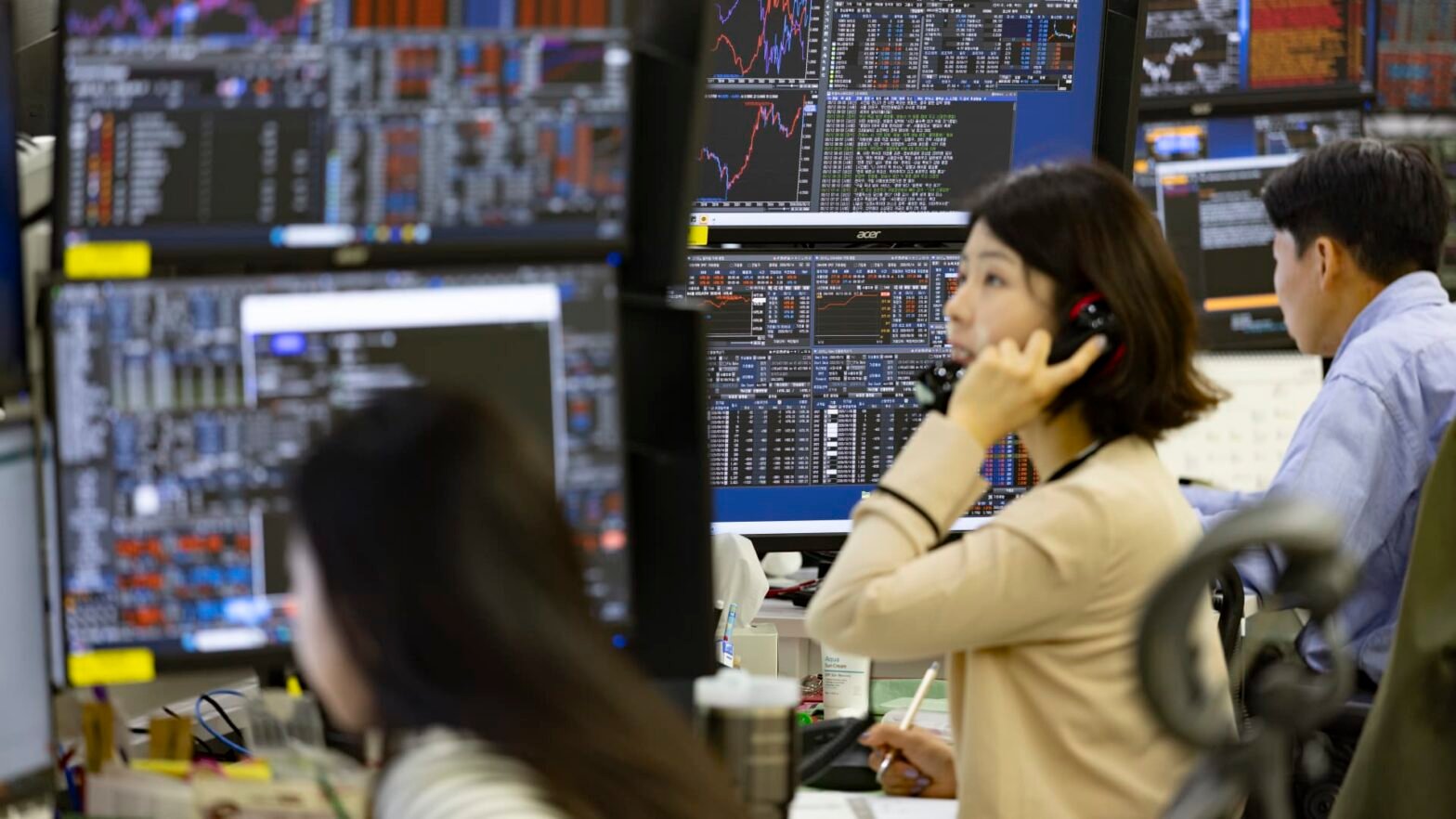
Bank employees work in front of multiple monitors at the Hana Bank dealing room in Seoul, South Korea, on May 12, 2026.
Nurphoto | Nurphoto | Getty Images
Wall Street tech moves and South Korea’s stock market are becoming increasingly intertwined as artificial intelligence spending binds together the fortunes of U.S. technology giants and Korean memory chipmakers.
The 60-day correlation between the Kospi and Nasdaq 100 recently climbed to about 0.50, its highest level since 2021, according to data provided by Rayliant.
The growing relationship reflects the increasing dominance of Samsung Electronics and SK Hynix, which together account for more than half of the Kospi index. Both companies sit at the center of the AI hardware supply chain, providing the memory chips needed for data centres operated by U.S. technology giants.
“The correlation has increased because the KOSPI has become a semiconductor index,” Rolf Bulk, analyst at Futurum Group, told CNBC via email.
Samsung and SK Hynix increasingly depend on the same hyperscaler spending that drives earnings at U.S. semiconductor and technology companies. Data-center demand rose from around 40% of global DRAM demand last year to more than half this year, according to Bulk, who expects that share to increase further. DRAM, or dynamic random-access memory, is used in AI servers.
That gives investors in Asia an early read on the strength of the global AI trade before Wall Street opens.
“Samsung and SK Hynix provide the first liquid market reaction to overnight developments affecting global AI demand,” said Jung In Yun, founder of Fibonacci Asset Management. “SK Hynix in particular has become an important barometer because of its exposure to high-bandwidth memory, which is one of the most critical components in the AI supply chain.”
Recent trading illustrates that dynamic. On July 13, the Kospi fell more than 8%, dragged by SK Hynix’s 15% plunge and record fall. The Nasdaq 100 followed suit to end 1.88% lower that day. Shares of big technology names declined that day. Micron Technology closed 4% lower, Sandisk shed 12%, Intel pulled back 6%.

Peter Kim, head of global investment strategy at KB Financial Group, said the Korean memory-chip rally began later than the Nasdaq’s advance because U.S. investors initially focused more heavily on hyperscalers. The scale and volatility of the recent rally, however, have prompted global investors to treat Korea as a bellwether for broader AI trades.
Samsung’s earnings guidance can also provide one of the first concrete signals each quarter on the state of AI demand. The company typically reports earnings about two weeks before major U.S. semiconductor companies.
Analysts cautioned, however, that Korean and U.S. technology shares are moving in tandem, rather than one consistently leading the other.
“The fortunes of U.S. tech stocks and Korean tech stocks are increasingly being driven by a common underlying factor, which is sentiment toward the AI hardware trade,” said Phillip Wool, head of research at Rayliant Global Advisors.
When AI-related news breaks while U.S. markets are closed, Samsung and SK Hynix can act as proxies for how investors may respond when Wall Street reopens. When developments occur during U.S. trading, the Nasdaq similarly offers a preview of the next Korean session.
The closer relationship also carries risks. The rising correlation erodes the diversification benefits investors traditionally sought by holding U.S. and Korean equities, echoed the industry veterans.
“Korea no longer provides diversification against U.S. tech. With half the index tied to one cyclical theme, a slowdown in hyperscaler capex would hit the Korean market harder than most other markets,” Bulk said.
He added that Korean memory stocks are also inherently more volatile than many U.S. chipmakers, with swings amplified by leveraged exchange-traded fund flows.
Wool similarly highlighted that as the AI theme increasingly becomes the dominant driver of both Korean and U.S. technology stocks, investors are losing one of the main reasons for holding both markets: geographic diversification.
“When all of these markets are essentially being driven by this one big risk factor, you find that you’ve lost the very benefit — the international diversification — that led you to seek exposure to geographically disparate markets like the US and Korea in the first place.”
That said, there could also be greater divergence over time. Micron, Samsung and SK Hynix currently benefit from the same rise in DRAM prices, but differences in capital expenditure, product mix and U.S. support for domestic chip production may eventually separate their performance, said Kim.
China’s expansion into memory chips is also another emerging risk, he added. While Chinese producers remain technologically behind their global rivals, their progress has frequently exceeded investor expectations. Shares of chipmaker Changxin Technology Group soared 466% Monday in their debut on Shanghai’s tech-heavy STAR Market, making CXMT the most valuable China-listed company.