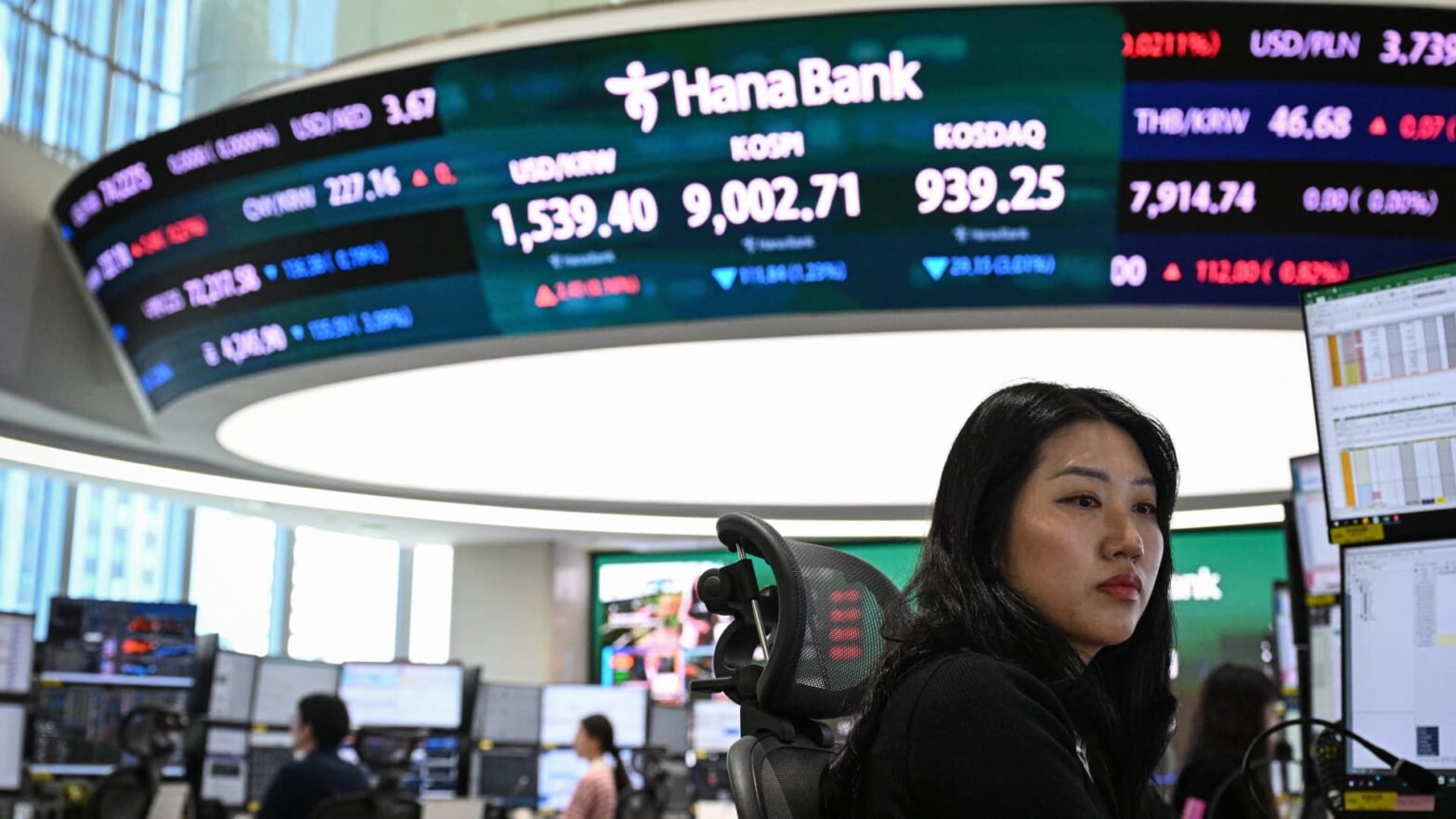
The U.S. stock market has delivered decent returns in 2026 despite persistent economic uncertainty created by tariffs and, more recently, elevated oil prices tied to the Iran war. This year, the S&P 500 (^GSPC +0.02%) has added 8% and the Nasdaq Composite (^IXIC -0.18%) has added 7%.
However, the S&P 500 recently flashed a warning last seen during the dot-com era, and it hints at big losses in the stock market over the next three years. Read on to learn more.

Image source: Getty Images.
The S&P 500 flashes a warning seen only once before
In 1988, economist Robert Shiller introduced the cyclically adjusted price-to-earnings (CAPE) ratio as means of evaluating entire stock market indexes. Whereas the traditional price-to-earnings ratio can be distorted by cyclical fluctuations in earnings, the CAPE ratio eliminates that noise by averaging inflation-adjusted earnings from the past decade.
The S&P 500 recorded an average CAPE ratio of 40.9 in June, the second straight monthly reading above 40. Not only is that well above the 20-year average of 27.6, but the last two months mark the first time since the dot-com bubble (in the late 1990s and early 2000s) that the S&P 500 recorded a CAPE ratio above 40.
Unfortunately, the index’s rich valuation hints at substantial downside in the stock market. The following chart shows the S&P 500’s best, worst, and average returns over different periods following a monthly CAPE ratio above 40.
|
Time Period |
S&P 500’s Best Return |
S&P 500’s Worst Return |
S&P 500’s Average Return |
|---|---|---|---|
|
1 year |
16% |
(28%) |
(3%) |
|
2 years |
8% |
(43%) |
(19%) |
|
3 years |
(10%) |
(43%) |
(30%) |
Data source: Robert Shiller, YCharts.
There are two important data points in the chart. First, the S&P 500 has never generated a positive three-year return following a monthly CAPE ratio above 40. Second, if the S&P 500’s future returns match the historical average, the index will drop 30% by July 2029.
Of course, past performance does not guarantee future results. The CAPE ratio did predict the dot-com crash, but the internet boom was different than the artificial intelligence (AI) boom. The internet did not reach mainstream adoption for more than a decade, but AI has achieved mainstream adoption in under five years.
In fact, AI ranks among the “fastest-adopted technologies in history, with nearly one in four American firms deploying it at scale,” according to Justin Bieman, global investment strategist at JPMorgan Chase. That means AI could become a material source of corporate profits more quickly than the internet.
So what? The CAPE ratio is a backward-looking metric, meaning it does not account for the possibility that earnings growth will accelerate. Earnings growth failed to keep pace with stock price appreciation during the dot-com bubble, which ultimately led to a market crash. The AI boom could play out differently. Earnings could grow fast enough to keep the S&P 500 moving higher while its CAPE ratio falls.
Today’s Change
Index Level
7,413.18
Wall Street expects the S&P 500 to gain 22% over the next year
S&P 500 companies reported exceptionally strong financial results in Q1 2026. At the index level, revenue increased 11.4% (the fastest growth since Q2 2022) and earnings increased 28.6% (the fastest growth since Q4 2021), according to FactSet Research.
Wall Street expects that momentum to continue. For the full year, the consensus estimate says revenue will increase 11% (the fastest growth since 2022) and earnings will increase 27% (the fastest growth since 2021). At the sector level, analysts anticipate the strongest earnings growth in the technology (65%), communication services (112%), and energy (128%) sectors.
In turn, Wall Street anticipates substantial upside in the S&P 500 over the next year. The median forecast puts the S&P 500 at 9,072 in July 2027. That implies 22% upside from its current level of 7,412. At the sector level, analysts expect the most upside in technology (24%) and communications services (27%). Investors should look closely at those sectors when searching for stocks.