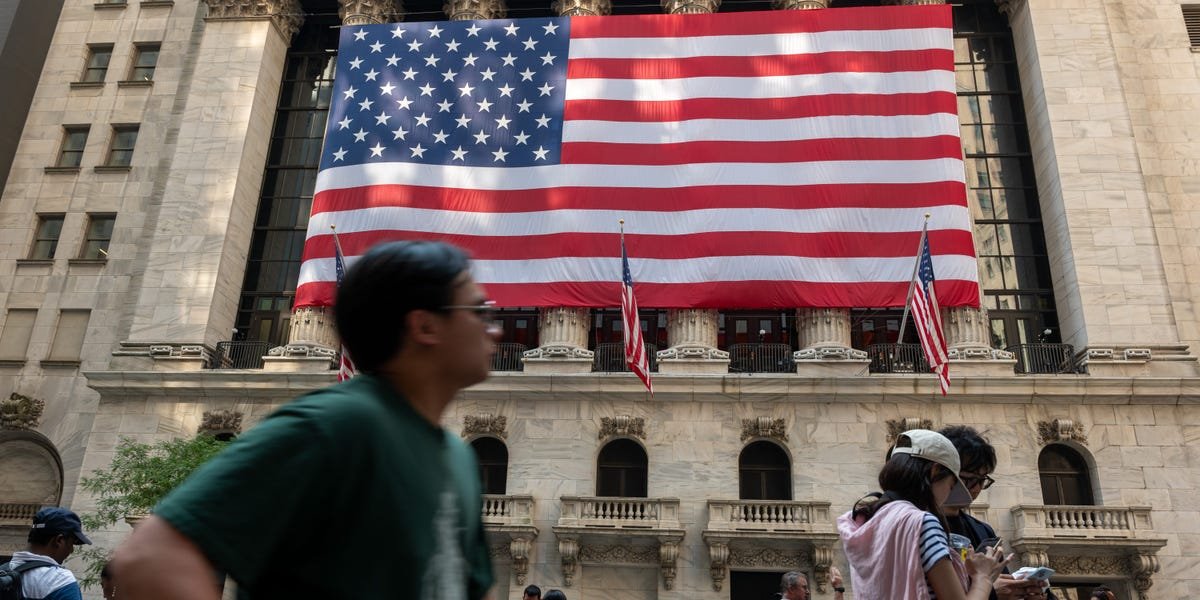
Spencer Platt/Getty Images
The US is getting on an inflation roller coaster ride, but that won’t stop the stock market from surging to records, a top JPMorgan strategist says.
Kriti Gupta, an executive director and global investment strategist at JPMorgan Private Bank, predicts the S&P 500 will rise by more than 10% over the next 12 months, with the benchmark index landing around 8,200 by the middle of next year.
That’s despite the firm’s broader view that the US is headed for a series of inflation shocks — bursts of pricing pressures that could mirror the inflation crisis in the 1970s, when consumer prices whipsawed in the middle of the decade and into the early 1980s.
Inflation appears to be coming in waves, Gupta said, with the post-pandemic surge in price growth being followed by the energy shocks from the Iran war earlier this year.
Still, the fundamental pillars holding up the bull market are still intact: Growth is strong, and AI demand is booming, she told Business Insider of her market outlook.
“We’re looking at double-digit returns again this year. And there’s still so much to go,” Gupta said. We are in the middle of the largest wealth creation in history in the United States.”
Her outlook is a rare message of optimism at a time when investors are preoccupied with mounting risks to the bull market. The preeminent fear among investors has been that higher oil prices will stoke inflation and force the Fed to raise rates.
Stocks have slipped from record highs amid a jarring rotation in the tech sector, which has sown doubts about the sustainability of the AI trade. The Nasdaq 100, which briefly shed as much as 11% from its recent peak, remains close to correctional territory.
The Fed looks likely to raise interest rates this year, with markets pricing in an 86% probability of at least one rate hike by 2026-end, according to the CME FedWatch tool. But higher rates would still be unlikely to deter stocks from their long-term uptrend, since the economy is showing signs it can withstand higher borrowing costs — particularly if rates are being raised to address a structural problem with inflation, Gupta said.
Economic growth, for one, remains steady. Real GDP grew 2.1% in the first quarter, more than expected, though growth is expected to slow to a 1.5% annualized pace for the second quarter, according to the Atlanta Fed.
The job market also continues to hold up, even if cracks appear to be forming. The unemployment rate clocked in at 4.2% in June, remaining near a historic low.
Investors also have plenty to cheer on the AI front. Despite the recent sell-off in memory and chips, demand for artificial intelligence still looks “massive,” Gupta said, with US firms seeing unmatched growth in profit margins.
Based on the companies that have reported second-quarter earnings so far, the S&P 500 is on track to net the highest net profit margin since the Great Financial Crisis, according to FactSet.
Demand for the S&P 500 also remains “off the charts” from retail and institutional investors, Gupta added.
“We’re not seeing hits to economic growth that would justify a larger pullback in the stock market at this stage,” she said.
Best opportunities
Gupta outlined the bank’s top portfolio recommendations for investors. These were the main categories:
All-in on the US. Gupta said the bank’s core portfolio is mostly composed of US stocks, given the US economy’s resilience and the unparalleled growth in corporate profits.
“That is genuinely where we believe the most sustainable growth occurs,” she said.
Financials. Financial and bank stocks are one way to catch the broadening of AI trade, given that the sector reflects broad economic growth and is likely to benefit from the broader productivity boom spurred by the technology.
“In addition to banks actually using AI for their own efficiency, we are also feeling very strongly about the ripple effect into the economy,” Gupta said.
The financials sector has been one of the best-performing sectors in the S&P 500 over the last three months, gaining 5%, according to State Street Investment Management.
Emerging markets are another way to diversify. Gupta pointed in particular to Latin America, with the region seeing a spurt of economic growth as its middle class expands.
The MSCI EM Latin America Index is up 40% this year, while the broader iShares MSCI Emerging Markets ETF is up 11%, both beating gains in the US market.
Alternative assets, for wealthier clients, are another way to diversify a portfolio, Gupta said.
Gold as a hedge. She recommended allocating up to 5% to bullion, depending on a client’s portfolio needs.
Read next
Jennifer Sor is a reporter at Business Insider. She covers financial markets and the economy, with a focus on retail investing, job trends, and the pursuit of wealth. She regularly speaks to famed forecasters and top investors in markets, including Gary Shilling, Nouriel Roubini, and Larry McDonald. Her work has also been featured in outlets such as Forbes, Bloomberg Opinion’s “Money Stuff,” and SiriusXM Business Radio. Prior to her time at BI, Jennifer covered tech and business news at the San Francisco Chronicle and Los Angeles Business Journal. She graduated from the University of California, Santa Barbara with a bachelor’s degree in economics and English.Have an interesting story to share? Please reach out to her at jsor@businessinsider.com or @jennreports.81 on the encrypted messaging app Signal. She can also be reached on LinkedIn and on Reddit at u/jenniferBImarkets. Story highlights
- ‘Culling of the herd’: Consulting could be headed for a decadelong shift that’ll make it harder to climb its career ladder
- Companies are cracking down on your AI job search
- Inside the private clubs for Gen Z and millennial traders serious about making money in markets
- Retreats, coaching, and therapy: Inside the $1 billion cottage industry cashing in on the retail-trading phenomenon
- Day traders who quit their careers and gave up school tell us their biggest regrets
- The lab-grown diamond boom is over