On the Korean peninsula, balance is a fundamental principle of everyday life.
As a cultural belief, yin and yang — eum and yang in Korean — are so ingrained in the national psyche that they are incorporated into South Korea’s national flag.
The balancing blue and red flows within a circle — the balance between positive and negative cosmic forces — explain the natural order and the cycle of life.
On the streets of Seoul and across the country, however, there is little sense of balance right now.
Fear and angst have gripped a population in the throes of the worst stock market crash in the nation’s history.
In the past five weeks, the market has collapsed, shedding almost 40 per cent, and threatening the livelihood of millions of South Koreans.
“I couldn’t breathe,” Lee Seung-ho, a 24-year-old university student, told Yahoo Finance as he watched his future disintegrate.
After borrowing heavily from a trading platform, Lee’s stock plunge had delivered a 15-fold increase in his savings over the previous year before his fortune evaporated in just four weeks.
The shock waves are spreading across the globe as investors fret the meltdown on one of the world’s most technology-intensive markets may be an omen of things to come.
Concerns are mounting globally about the stupendous, some say stupid, level of spending by the world’s leading technology firms that has begun to rattle Wall Street.
Once considered an exotic financial sideline, the South Korean Kospi has become one of the most acutely observed markets in the world; many view it as a possible harbinger for the end of a four-year boom in technology stocks.
A debt-fuelled boom
More than a million South Koreans are underwater as a result of the crash, and several hundred thousand have lost everything, and then some.
They borrowed to the hilt to take part in a frenzied splurge on technology stocks, particularly memory chip makers, in a market now experiencing a savage reversal.
Nothing, not even the stellar earnings of the country’s two biggest chip makers, has been able to stem the panic, primarily because the debt that fuelled the stock market boom is now accentuating the crash.
Many South Koreans have borrowed money to invest in tech stocks, particularly memory chip makers. (Reuters: Max A Cherney )
Repeated attempts by Seoul’s market authorities to put a handbrake on the losses by suspending trading have only made the problem worse.
The collapse, which began last month, follows an astonishing rise on the country’s market index, the Kospi, over the past 12 months.
At its peak, it had surged more than three-fold in just a little over a year.
That was the yang. Now comes the eum.
For the KOSPI, what went up is coming down. (Source: Trading Economics)
A political leg up
It began with a constitutional crisis and an attempted coup.
To divert attention in the aftermath of last year’s political upheaval, new President Lee Jae Myung encouraged citizens to invest in the local stock market in a series of fiery nationalistic speeches about South Korea’s global standing.
It was time, he said, for the “Korea Discount” to be erased and replaced, perhaps, by a “Korea Premium” and for the nation to rely less on property speculation.
“The Republic of Korea as a market remains undervalued,” he said.
“I will create an objective environment to make Korea the world’s best investment destination.”
As part of the program, rules around using debt to invest were loosened and debt-infused investment products — known as single stock leveraged Exchange Traded Funds — spurred South Koreans to plunge everything, and more, into the market.
The timing was both impeccable and tragic.
Chip makers were in hot demand as the big American tech firms, having spent trillions of dollars in the race for AI dominance, began the next phase of the boom: rolling out AI to the world.
An obscure American chip maker, Nvidia, had already shot to prominence when it was discovered that its gaming chips were ideal for developing AI platforms, and it suddenly took the mantle of the world’s most valuable corporation.
But when Silicon Valley’s tech giants — Amazon, Microsoft, Meta, Alphabet, Oracle, Apple and Tesla — began a rush to build data centres, they created an extreme shortage of ordinary memory chips, the kind used in mobile phones and laptops.
A mere handful of companies dominate this area. One is Samsung Electronics, and another is SK Hynix.
Both are South Korean giants and, three years ago, made up about a quarter of the Korean stock market.
By last month, as their earnings soared on an acute global chip shortage and their stock prices multiplied, they comprised 60 per cent of the Kospi’s total value.
As late as April, regulators, in an ill-fated move, approved further new trading methods to allow investors greater use of debt when investing in individual stocks.
On Wednesday, South Korea’s Finance Minister Koo Yun-cheol was forced to apologise after several politicians accused the government of turning the stock exchange into a casino.
When red becomes the new black
The extent of the losses is still unclear. But the damage is huge.
According to KB Financial Group, South Korean retail investors have made net purchases of around 14 trillion won ($US9.7 billion) in single-stock leveraged ETFs since their launch, with foreigners tipping in roughly 2 trillion won ($US1.4 billion).
South Korean leaders are scrambling as the worsening situation threatens further instability, with the main opposition, the People Power Party’s Lee Jongwook, going on the attack.
“When I think about it now, these products should never have been allowed on to the market. I consider this a policy failure,” Mr Lee said.
Loading
According to data from Goldman Sachs, as of a fortnight ago, more than 1.2 million retail investors who had borrowed cash to take part in the frenzy had received what is known as “margin calls”.
With losses overwhelming their collateral, they have been told to stump up extra cash to maintain their position. Of those, around 360,000 accounts have been forcefully liquidated.
South Korean media reports indicate that more than 60 per cent of liquidated investors are under 30 and have not just lost everything, but are now in debt.
By Friday, the market was roaring back after a volatile week on Wall Street saw technology giants whipsawing by the day.
Microsoft shares surged 9 per cent, Mark Zuckerberg’s Meta slumped 8 per cent and Elon Musk’s SpaceX eked out a 2 per cent gain after having shed half its post-float peak value in the few weeks it has been listed.
But a growing sense of unease surrounds the tech giants and the excesses that have accompanied the AI boom.
Volatility usually is the precursor for when red becomes the new black.
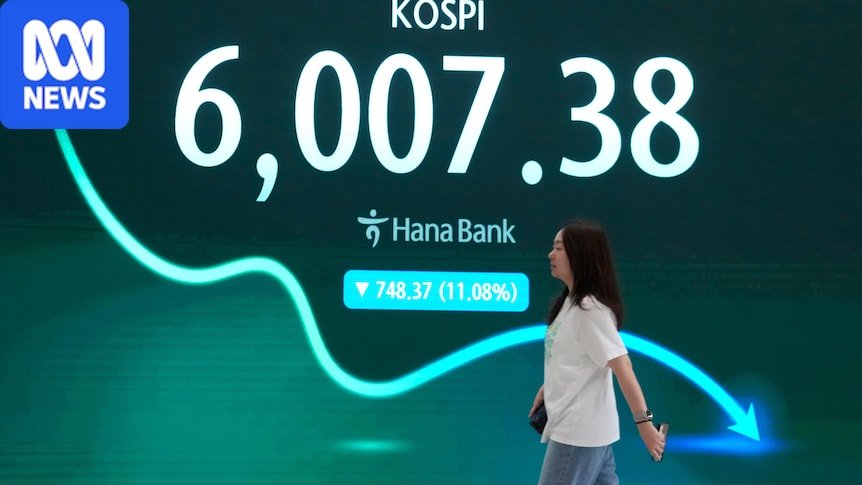
The market was roaring back by Friday, but could not shake a growing sense of unease. (AP Photo: Ahn Young-joon)