Published on
Unitree, the world’s biggest humanoid robot maker, has kicked off its public listing with a bang, with shares soaring more than 600% during its trading debut.
 ADVERTISEMENT
ADVERTISEMENT
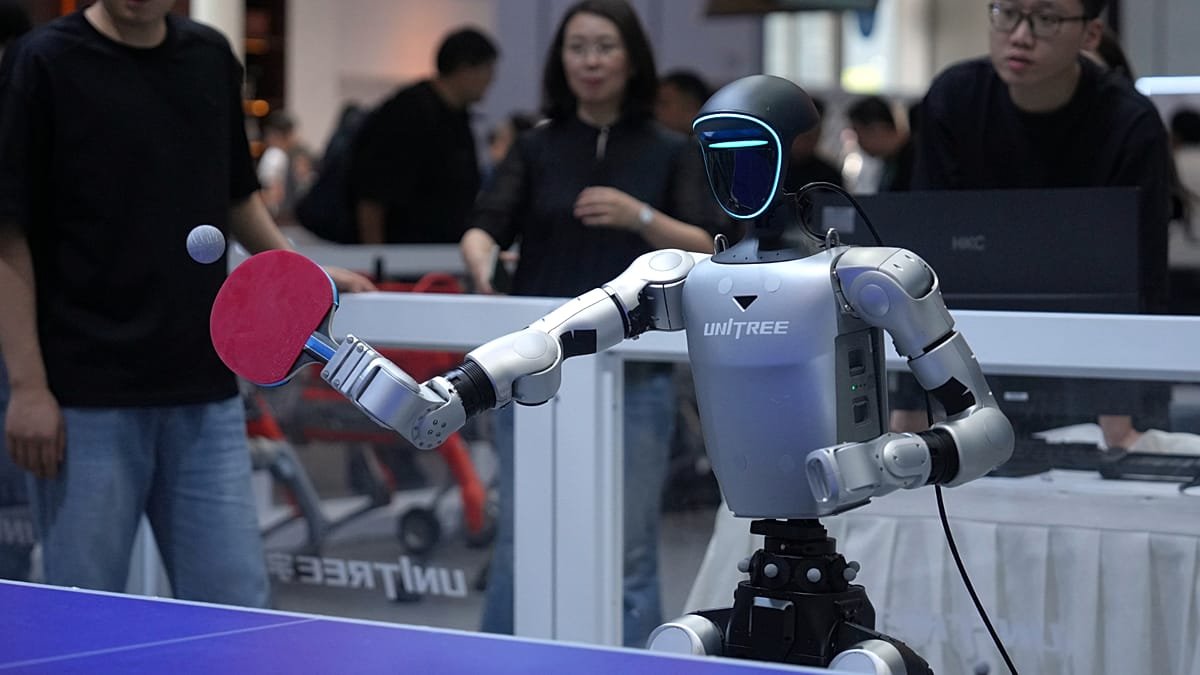
The Chinese company accrued immense worldwide popularity through viral videos of its robots acting as backup dancers for pop stars, alongside performing martial arts and extreme athletic feats. They can also rollerblade, play table tennis, and do backflips and vaults.
Shares surged from an initial public offering (IPO) price of around 150.8 yuan (€19.3) to as high as 1,100 yuan (€140.6) on Wednesday, a jump of more than 600%, although they settled at almost 500% later in the day.
Chinese retail investors formed the bulk of this extraordinary demand, with shares allocated to non-professional investors seeing demand exceed supply by thousands of times over.
Wang Xingxing, the founder of Unitree and its current CEO, still owns around a fifth of the business.
Unitree is exceptionally well-positioned to capture the rising interest in the robotics market, largely thanks to affordable hardware, such as its robot dogs and budget humanoids, which are available at a fraction of the price of their US counterparts.
This is largely down to robust local supply chains in Hangzhou, which keep manufacturing costs relatively low.
Riding on the back of spectacular demos and strong marketing, Unitree has also positioned itself as a high-volume company, ahead of several major US and European competitors. This has helped it turn a profit far earlier than most other early-stage robotics startups.
China also sees robotics as a key national priority in the effort to offset a shrinking workforce.
Robotics go global
With the global robotics industry seeing considerable advancements in recent years, investors are constantly searching for the next big winner. This is especially true given robotics’ central role in advancing artificial intelligence through physical AI.
This allows AI to use robots for real-world learning and trial and error in tasks such as walking and gripping objects. It also develops better perception and reaction skills while creating rich new data loops for feedback and training material for smarter models.
The global market for humanoid robots is likely to reach $38 billion (€32.7bn) by 2035, according to Goldman Sachs.
At present, companies such as China’s Unitree and UBTECH Robotics are among the few listed humanoid robot companies, while others such as Tesla, Xiaomi and Hyundai Motor have humanoid robot divisions of their own.
However, a few more Chinese humanoid robotics companies, such as Leju Robotics and Deep Robotics, are also making plans to go public soon.
Despite these advancements, some countries, including the US, still prefer to take a more conservative stance when it comes to importing or relying on foreign-made humanoid and quadruped robots, citing national security concerns.
Unitree has already been included on a list of Chinese military companies by the US Pentagon, which called it a “contributor to the Chinese defence industrial base,” despite the company maintaining that its robots are for civilian purposes.