Updated 1 min read
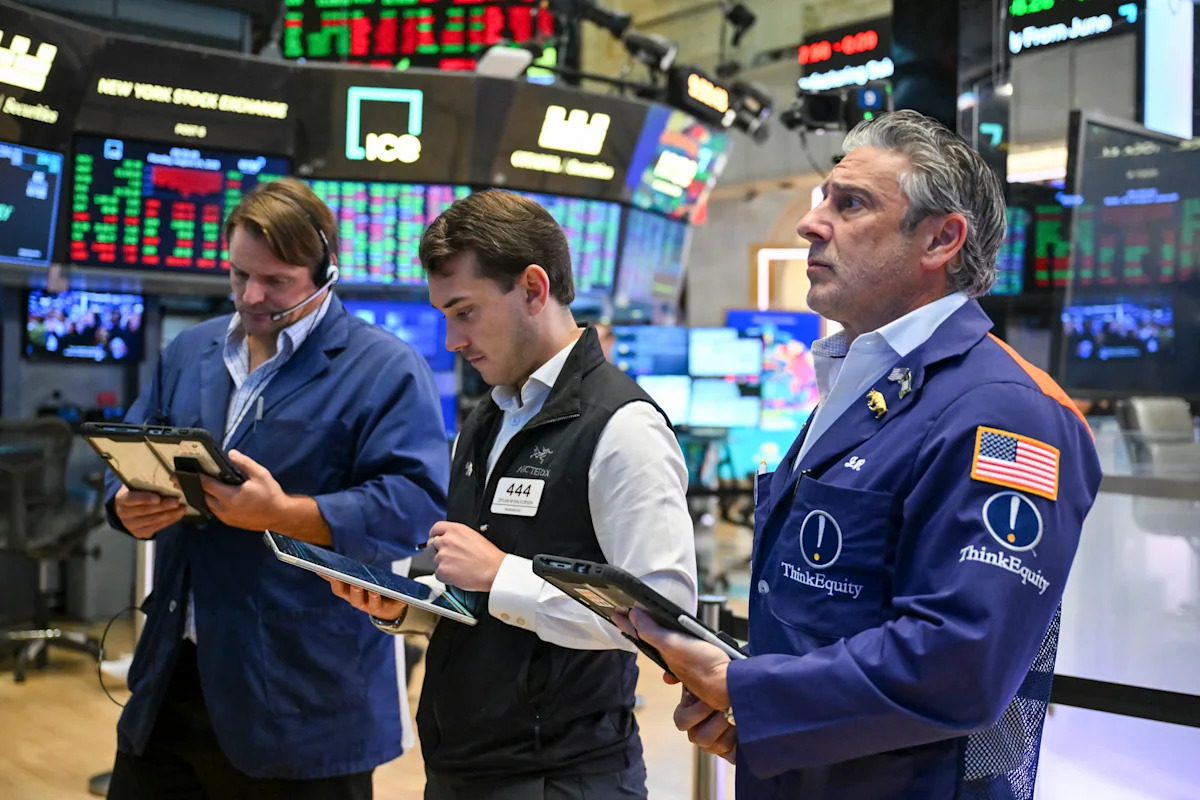
US stock futures declined on Monday after the US attacked Iran for the first time in weeks, fueling a rise in oil prices and increased bets that the Federal Reserve would raise interest rates at its September meeting.
Futures on the Dow Jones Industrial Average (YM=F) fell 0.1%, while those on the S&P 500 (ES=F) declined by 0.2%. Contracts on the Nasdaq-100 (NQ=F) dropped 0.1%, though all three major indexes were on track to post gains for the month.
Renewed hostilities in the Middle East put pressure on stocks after the US struck Iranian rocket launchers that were preparing to send mines into the Strait of Hormuz. Oil prices jumped on worries that the conflict could escalate again, with Brent crude futures (BZ=F) rising over $88 per barrel.
The ongoing war in Iran has been a key factor keeping inflation concerns alive. On Friday, Fed Chairman Kevin Warsh delivered a speech in Jackson Hole, Wyo., stating that inflation was running too hot and that the central bank has “work to do.” Over the weekend, traders lifted their bets that the Fed would raise rates by 25 basis points at its next meeting to 62%, up from roughly 40% a week ago.
With earnings season largely in the rearview mirror and Monday bringing a relatively quiet day for economic data, investors will turn their attention toward the Labor Department’s monthly jobs report on Friday.
LIVE 4 updates
-
It’s Tim Cook’s last day as Apple CEO. Investors are $4 trillion richer because of him.
Yahoo Finance’s Dan Howley reports:
Apple’s (AAPL) Tim Cook is stepping down as CEO today, turning over the role to senior vice president of hardware engineering John Ternus.
Cook will stay on at Apple as its executive chair and “assist with certain aspects of the company, including engaging with policymakers around the world,” the company said in a statement.
During his time as CEO, Cook oversaw the launch of a variety of new products, including the Apple Watch, AirPods, and, more recently, the MacBook Neo. He’s also been instrumental in increasing Apple’s Services segment revenue to more than $100 billion, the company’s second-largest business behind the iPhone.
Steve Jobs hired Cook in 1998 and promoted him to executive vice president of worldwide sales in 2002, before appointing him to COO in 2005. He later took over as CEO from Jobs in 2011.

Apple CEO Tim Cook attends the premiere of Apple TV’s “Ted Lasso” season 4 at the Academy Museum of Motion Pictures in Los Angeles, California on July 27, 2026. (VALERIE MACON / AFP via Getty Images) · VALERIE MACON via Getty Images -

Wall Street’s summer calm is colliding with the year’s most volatile stretch
Wall Street has gone quiet. The calendar says that’s about to change.
The CBOE Volatility Index (^VIX) fell to 14.13 on Friday, its lowest level of 2026. That’s a long way from the spring, when volatility briefly exploded higher with Iran war headlines before spending the summer grinding back down.
That calm tends to fade right around now.
The VIX has historically started climbing around this time of year. Its median level since 1990 sits around 16.5 in late August, rises toward 18 by mid-September, and reaches roughly 19 in early October.
Daily VIX closes in 2026 versus the historical median for each trading day from 1990 to 2025. · Yahoo Finance analysis of AlphaSpace data That doesn’t mean stocks are destined to fall.
The VIX measures the 30-day volatility implied by S&P 500 options, or roughly how much movement options traders are pricing into the market. It says nothing about which direction the movement will take.
That distinction can get lost whenever the VIX starts rising. Stocks can rally even with elevated volatility, and they can drift lower even with subdued volatility. What changes this time of year is the range of possible outcomes. It tends to get wider.
-
Good morning. Here’s what’s happening today.
-
Oil jumps as US military hits Iranian launchers
Bloomberg reports:
Oil surged after fresh fighting flared up in the Strait of Hormuz, highlighting risks to flows from the Middle East after months of conflict.
Brent for November rose above $90 a barrel, while West Texas Intermediate was near $86. The US military struck Iranian rocket launchers preparing to send mines into the waterway on Sunday, according to Captain Tim Hawkins, a spokesperson for US Central Command, ending weeks of relative calm.
Crude is wrapping up a volatile month in which Brent futures have swung in a range of almost $17 a barrel. Prices have been buffeted by stop-start efforts to bring an end to the fighting, as well as a pledge by Washington that it will try to force Tehran to capitulate by ramping up efforts to isolate and cripple Iran’s economy. Still, analysts have been underwhelmed by the US actions.
Still, even without a peace deal between Washington and Tehran, about 6 million to 8 million barrels a day of crude are moving through Hormuz, according to traders monitoring cargoes. Separately, Iran’s semi-official Mehr news agency reported that vessel traffic along a route approved by the Islamic Republic “is taking place on a limited basis,” with ships sakid to be paying tolls.