The FINANCIAL – NEW YORK — Wall Street enters September with a more complicated outlook than the record levels of the U.S. stock market might suggest. The S&P 500 has remained near record territory, corporate earnings have been strong and major investment banks continue to forecast further gains. But rising Treasury yields, persistent inflation, geopolitical tensions and expectations for Federal Reserve policy tightening have created conditions in which a sharp correction could develop. A market correction is possible. A 20% or larger crash is also possible, but current evidence does not establish that one is imminent.
The distinction matters for investors. History shows that some of the strongest long-term returns have come from continuing to invest during periods of extreme volatility rather than trying to identify the exact day of a market bottom.
Why investors are worried now
The latest warning signs are concentrated in interest rates and bond markets.
The August U.S. employment report showed 162,000 jobs were added, substantially above economists’ expectations. The stronger labor market increased expectations that the Federal Reserve could raise interest rates at its September meeting. Reuters reported that the implied probability of a 25-basis-point September increase rose to about 58% following the employment report. The Dow fell 0.51%, the S&P 500 0.38% and the Nasdaq 0.29% on Sept. 4.
Federal Reserve Governor Christopher Waller said on Sept. 3 that inflation remained meaningfully above the Fed’s 2% target, although recent data had shown some signs of disinflation. He said a September rate increase could be appropriate if the improvement in inflation proved temporary. At the same time, he said real GDP had grown at a 1.8% annual rate during the first half of 2026 and that business investment remained strong.
The San Francisco Federal Reserve similarly reported that the economy continued to expand, with real GDP growing at a 1.5% annualized rate in the second quarter and 2.1% over the previous four quarters. But it noted that inflation remained elevated, with headline PCE inflation at 3.7% in July.
That creates an unusually difficult environment for equities: economic growth remains positive, but the Fed may have less freedom to cut rates if inflation stays high.
Wall Street is still forecasting gains
Despite those risks, the major investment banks have not abandoned their bullish outlook.
Goldman Sachs raised its 2026 year-end S&P 500 target to 8,000, from 7,600, in May, citing stronger corporate earnings.
J.P. Morgan subsequently raised its target to 8,000, from 7,800, in August. The bank cited stronger corporate earnings and increasing confidence that AI investment by large technology companies would translate into faster revenue growth.
A Reuters survey of 46 strategists, analysts and portfolio managers conducted in August produced a median year-end S&P 500 forecast of 7,900. The index was at 7,677.28 on Aug. 25, according to Reuters.
Morgan Stanley’s investment-management team also maintained a constructive view, saying rising earnings expectations supported U.S. equities through the end of 2026. The firm warned, however, that higher interest rates could challenge the market’s trajectory.
The message is therefore not that Wall Street expects stocks to rise without interruption. It is that earnings growth remains strong enough, for now, to offset some of the risks from valuations and interest rates.
But a correction could be very different from a crash
Investors should distinguish between three scenarios.
A normal correction: roughly 10% decline.
A bear market: generally a decline of at least 20% from a recent high.
A crash: a rapid and unusually severe decline, often accompanied by forced selling, a financial shock or a sudden loss of confidence.
History demonstrates why predicting the exact timing is difficult.
J.P. Morgan’s historical analysis shows that the S&P 500 experienced substantial intra-year declines even during years when it ultimately produced positive returns. In 2020, for example, the index suffered a 34% intra-year decline but finished the year up 16%. In 2018, it fell as much as 20% during the year and finished down 6%. In 1998, the intra-year decline reached 19%, while the full-year return was 27%.
The 1987 crash provides an even more dramatic example. On Black Monday, Oct. 19, 1987, the Dow Jones Industrial Average fell 22.6% in one trading session, the largest one-day percentage decline in its history. Yet the market recovered much of the loss almost immediately and exceeded its previous peak within two years.
The lesson is not that every crash quickly reverses. The 2000-02 technology collapse and the 2008 financial crisis took much longer to recover from.
The lesson is that the timing of the bottom is extremely difficult to identify in real time.
When should investors buy?
The current market creates a difficult choice.
Waiting entirely for a crash can leave investors sitting in cash while stocks continue rising. Buying an entire portfolio immediately creates the opposite risk: an investor could experience a large paper loss if a correction begins soon afterward.
A more defensible approach for long-term investors is staged buying.
For example, an investor who has $100,000 available for long-term stock investments could divide the capital rather than attempting to predict the exact bottom:
- 25% initially
- 25% after a meaningful market decline
- 25% after a deeper correction
- 25% reserved for a severe sell-off or deployed gradually over time
Those percentages are an analytical framework, not a recommendation from any particular bank.
The important principle is that investors should not make the strategy dependent on identifying the exact bottom.
UBS has made a similar argument about market timing. Its research showed that a $100 investment in the S&P 500 from September 1989 through January 2026 grew to $3,617 with a buy-and-hold strategy. Missing the market’s best week reduced the ending value to $3,249, while missing the best quarter reduced it to $2,863.
Which funds make the most sense during a correction?
For investors who cannot reliably select individual companies, broad-market funds remain the simplest way to exploit a sell-off.
The primary candidates are funds tracking:
S&P 500: broad exposure to America’s largest publicly traded companies.
Total U.S. stock market: broader exposure that includes large-, mid- and small-cap companies.
Nasdaq-100: greater exposure to technology and large growth companies, but consequently greater concentration risk.
The advantage of broad index funds becomes particularly important during a crash because individual-company risk can be much greater than index risk.
Bank of America Private Bank’s 2026 outlook has emphasized portfolio strategies spanning equities, fixed income and alternatives rather than relying on a single market segment. Its research has also highlighted the impact of AI, rising yields and oil prices on the second half of 2026.
For an investor expecting volatility, the more important question may therefore be how much equity exposure to own, rather than which single stock will win.
Which stocks are still favored?
The strongest common theme across Wall Street remains artificial intelligence and the infrastructure supporting it.
Nvidia
Nvidia remains one of the central beneficiaries of the AI investment cycle. Morgan Stanley previously named Nvidia its top semiconductor stock, citing valuation and expectations for continued AI spending.
But Nvidia also demonstrates why investors should avoid treating a high-quality company as a risk-free investment. A strong business can still experience a substantial stock-price decline when expectations become too high.
Microsoft
Microsoft has emerged as another major AI and cloud beneficiary.
Bank of America analyst Tal Liani recently raised his Microsoft price target to $600, citing the company’s AI strategy, Azure growth and increasing Copilot adoption.
Microsoft is also among the large technology companies that Morgan Stanley has identified as benefiting from the broader AI investment cycle.
Amazon
Amazon remains another important AI and cloud exposure because of Amazon Web Services and the continuing expansion of AI-related infrastructure.
J.P. Morgan has previously identified Amazon among its preferred internet stocks for 2026, alongside Alphabet.
Broadcom
Broadcom is another major AI infrastructure company followed closely by Wall Street. Bank of America previously identified Broadcom, Nvidia and Lam Research among its headline semiconductor picks for 2026.
However, Broadcom’s recent earnings reaction also shows the risk in the sector: even strong AI-related revenue growth can fail to satisfy investors when expectations are exceptionally high.
Alphabet
Alphabet combines exposure to AI and cloud computing with a large established advertising business. Morgan Stanley has identified Alphabet among major technology stocks with potential upside related to institutional ownership positioning.
The case for buying after a crash
A major sell-off can create opportunities because stock prices can fall much faster than the underlying businesses deteriorate.
The 2008 financial crisis is an extreme example. J.P. Morgan’s historical data show the S&P 500 fell 38% for the year in 2008 and experienced a maximum intra-year decline of 49%. The following year, the index gained 23%.
But investors should not assume that every 30% decline represents a buying opportunity.
In 2000-02, the technology bubble produced several years of falling prices. Buying aggressively into the first decline would not have captured the eventual bottom.
That is why the best opportunities tend to appear when three conditions begin to converge:
- Stock valuations have fallen substantially.
- Corporate earnings expectations stabilize.
- Monetary or economic conditions begin improving.
The third point is particularly important. A market can be cheap and continue becoming cheaper if earnings are still deteriorating.
What could trigger a 2026 crash?
Several risks deserve particular attention.
Interest rates: A sustained rise in inflation could force the Fed to tighten policy when investors are expecting easing.
Treasury yields: Higher long-term borrowing costs can compress equity valuations and increase financing costs.
Oil and geopolitics: Energy-price shocks can simultaneously raise inflation and weaken economic growth.
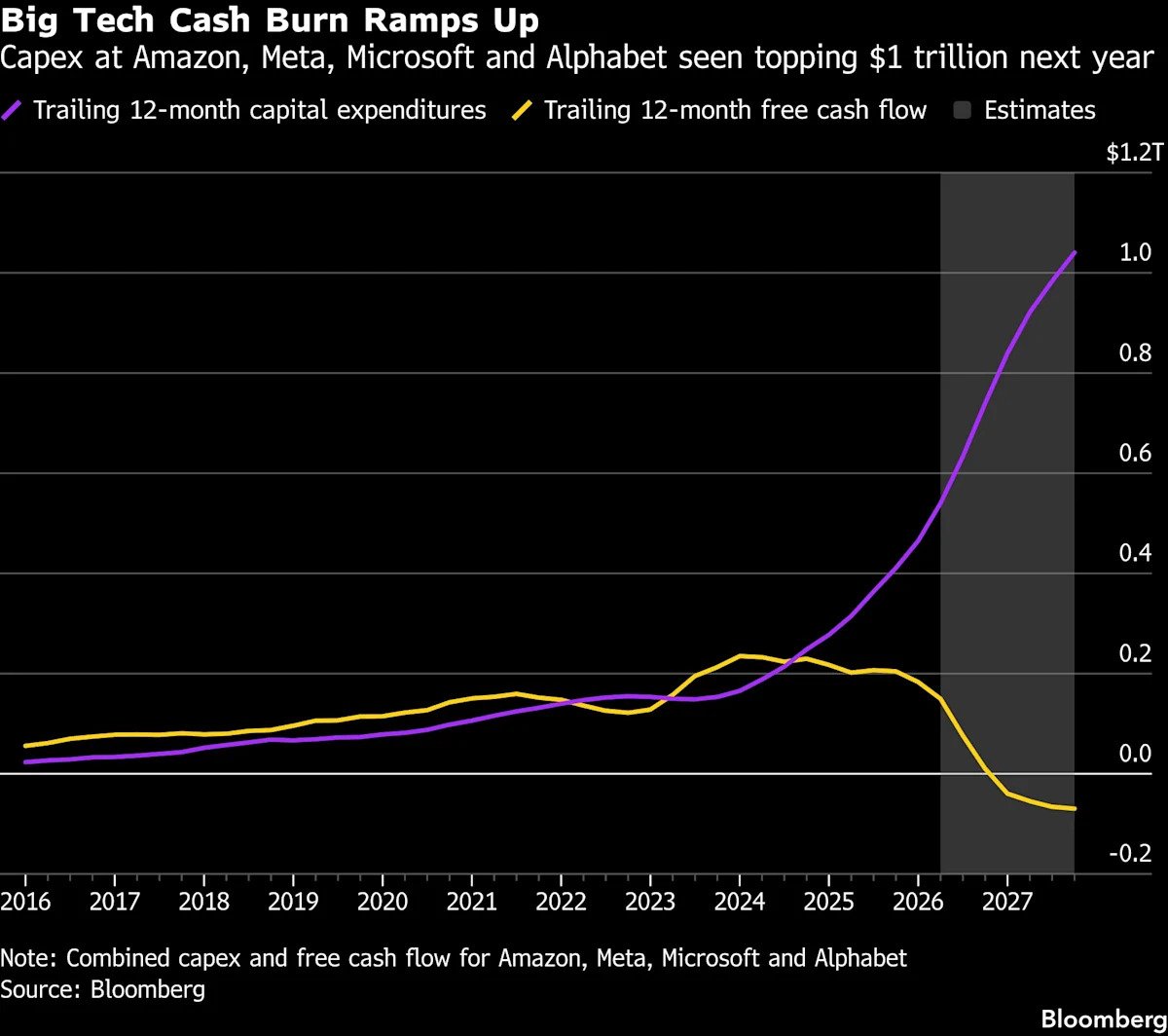
AI expectations: The market has priced in enormous future investment and earnings from AI. If corporate returns on that spending disappoint, highly valued technology stocks could fall sharply.
Market concentration: A relatively small number of very large technology companies account for a substantial portion of major U.S. indexes. A synchronized decline in those companies could therefore have an unusually large effect on the overall market. Reuters has described U.S. equity concentration as reaching historically high levels amid the AI boom.
What would change the outlook?
The most important data point in the immediate future is inflation.
Investors will be watching the August CPI and PPI reports closely before the Federal Reserve’s Sept. 15-16 meeting. Reuters reported that the market was increasingly focused on whether inflation would justify another rate increase.
If inflation falls without a sharp deterioration in employment or economic growth, the market could regain momentum.
If inflation remains elevated while Treasury yields rise and the Fed tightens, equity valuations could come under considerably more pressure.
That would increase the probability of a correction and potentially a deeper bear market.
Bottom line for investors
The current evidence does not support declaring an imminent stock-market crash.
The more immediate risk is a 10%-plus correction following a long rally, particularly if inflation, oil prices and Treasury yields continue moving higher.
At the same time, Goldman Sachs, J.P. Morgan and Morgan Stanley remain broadly constructive on U.S. equities because of corporate earnings and AI-related investment. Goldman Sachs and J.P. Morgan both currently have an 8,000 year-end S&P 500 target, while the latest Reuters strategist survey puts the median target at 7,900.
For a long-term investor, the most defensible strategy is therefore not to bet everything on either a crash or a continued rally.
Broad index funds can provide the core exposure; high-quality technology companies such as Nvidia, Microsoft, Amazon, Alphabet and Broadcom provide more concentrated growth exposure; and cash or short-duration fixed income can provide the flexibility to buy if a significant correction develops.
The key is to have capital available before the sell-off rather than trying to decide what to do after prices have already collapsed.
Investment disclaimer: This article is for informational purposes only and does not constitute personalized investment advice, a recommendation to buy or sell securities, or a guarantee of future returns. Individual stocks can lose substantial value, including permanently. Investors should consider their risk tolerance, investment horizon, tax position and diversification before making investment decisions.