A stock market crash rarely announces itself in advance. But it usually involves a single point of failure — and this one isn’t hard to identify.
Artificial intelligence (AI) is simultaneously the market’s engine and its weakest joint. And the potential risks are something investors need to pay attention to.
Where would the trouble come from?
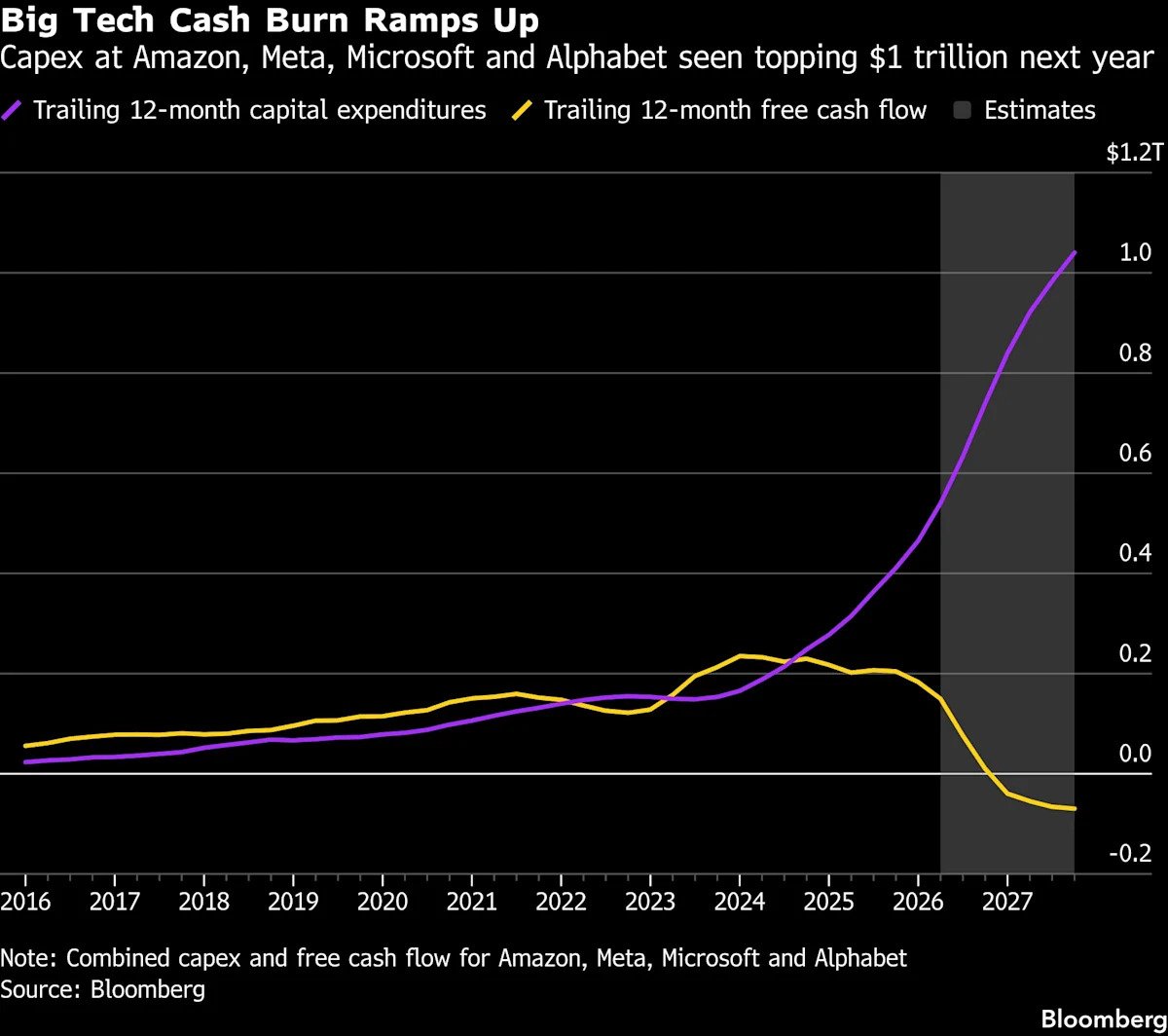
The five big US hyperscalers are on course for roughly $750bn of capital spending this year, around 38% of their combined revenue. What’s changed is how it’s funded.
Incremental debt has gone from 9% of hyperscaler capex in FY2024 to 32% by mid-2026, with about $220bn of bonds issued through 10 August alone. And they’ve also started issuing equity.
Then there’s customer concentration. OpenAI missed its revenue target in April, dragging Nvidia and Oracle down with it, and its own forecasts point to a loss of around $14bn this year.
If the hyperscalers back off their spending — or their biggest tenant wobbles — the chain reaction reaches a lot of portfolios. Last Friday (4 September) offered a preview of the mood.
Payrolls came in at 162,000 against forecasts of 55,000 — treated as a catastrophe, because it increases the chances of a rate increase later this month.
In short, the market is on edge. Good news is bad news, and consumer news is just bad.
Where to look for resilience
Steve Eisman — of Big Short fame — recently pointed at the Franklin US Low Volatility High Dividend ETF. The logic is sound: stable demand, boring cash flows, minimal AI beta.
The problem is the shopping list. Verizon sits among its largest positions on a 5.6% yield and 13 times earnings, but generates an 8.3% return on invested capital against $191bn of net debt.
I’m not buying something I dislike as a long-term holding to insure against a crash that may not arrive. Further down the list, though, is a name I do like and see as worth considering.
The one worth a look
McDonald’s (NYSE:MCD) ended last week at $255.69, fractionally above a 52-week low of $255.49. That’s a 16% fall since the start of the year.
The K-shaped economy (the technical name for rising inequality) is a genuine problem for its core customer. As a result, Q2 transactions were soft even as global comparable sales rose 1.3%.
From a long-term perspective however, the company has some incredibly important strengths. The first is its business model.
Costs have been rising recently. But the company’s franchised margins have held steady at around 82% – it’s the franchisees that are dealing with the pressure.