Key Points
-
The S&P 500’s Shiller Cyclically Adjusted Price-to-Earnings ratio has only been higher than its current level at the peak of the dot-com bubble.
-
Earnings per share for U.S. companies are growing rapidly, but this is not sustainable.
-
Diversification is key to surviving any boom-and-bust cycle in the stock market.
Every day, the financial media bombards the world with debates about whether the artificial intelligence (AI) bull market has turned into a bubble. Pundits will go on TV and loudly support one side or the other in this argument, often with little fundamental analysis to back them up. This can leave viewers with few ways to assess the stock market’s condition outside of vibes.
But how exactly can you quantitatively define when the stock market is overvalued? The best metric to use might be the Shiller Cyclically Adjusted Price-to-Earnings ratio, otherwise known as the Shiller CAPE ratio. And that metric just hit its most expensive level since the dot-com bubble’s peak in late 1999 and early 2000.
Missed Nvidia in 2009? This Rare Signal Is Flashing Again.In 2009, a “Double Down” signal flashed for a little-known chipmaker called Nvidia. For the first time in years, that same “Total Conviction” signal is flashing for a company 1/100th the size of Nvidia. Continue »
Here’s what that could mean for the AI bull market.
What is the CAPE ratio?
Unlike the traditional P/E ratio, which simply takes a company’s current stock price and divides it by trailing earnings per share (EPS), the CAPE ratio takes a longer-term view to measure earnings and valuation through economic cycles.
Specifically, the CAPE ratio can be applied to something like the S&P 500 index. The numerator of the ratio will remain the same: the combined share price of all the stocks in the index, weighted by market capitalization. But the denominator will be the average EPS — adjusted for inflation — over the last 10 years, rather than just the trailing 12 months.
The primary reason investors focus on the market’s CAPE ratio instead of its simple P/E ratio is that it’s designed to smooth out earnings over a business cycle, where one year may run hot (for example, 2026) and others may run cold (for example, 2020 during the pandemic lockdowns).
The S&P 500 index now trades at a CAPE ratio of over 41, its highest level in history outside of the period at the end of the dot-com bubble in late 1999 and early 2000. This should give even an ultra-bullish investor pause when weighing the question of whether AI stocks are in a bubble.
Earnings growth and free cash flow
In 2026, S&P 500 earnings have soared due to rising spending on semiconductors, memory, and AI software, and the rising valuations of start-ups like OpenAI and Anthropic. When big tech companies invest in OpenAI and OpenAI’s value climbs in a quarter, those investment gains register as earnings for that quarter. These are one-time benefits that are unrelated to their underlying businesses, though, and they are a key reason analysts estimate that the S&P 500’s overall earnings grew by 52% year-over-year in Q2. However, this type of growth is not sustainable and inflates the trailing P/E figure.
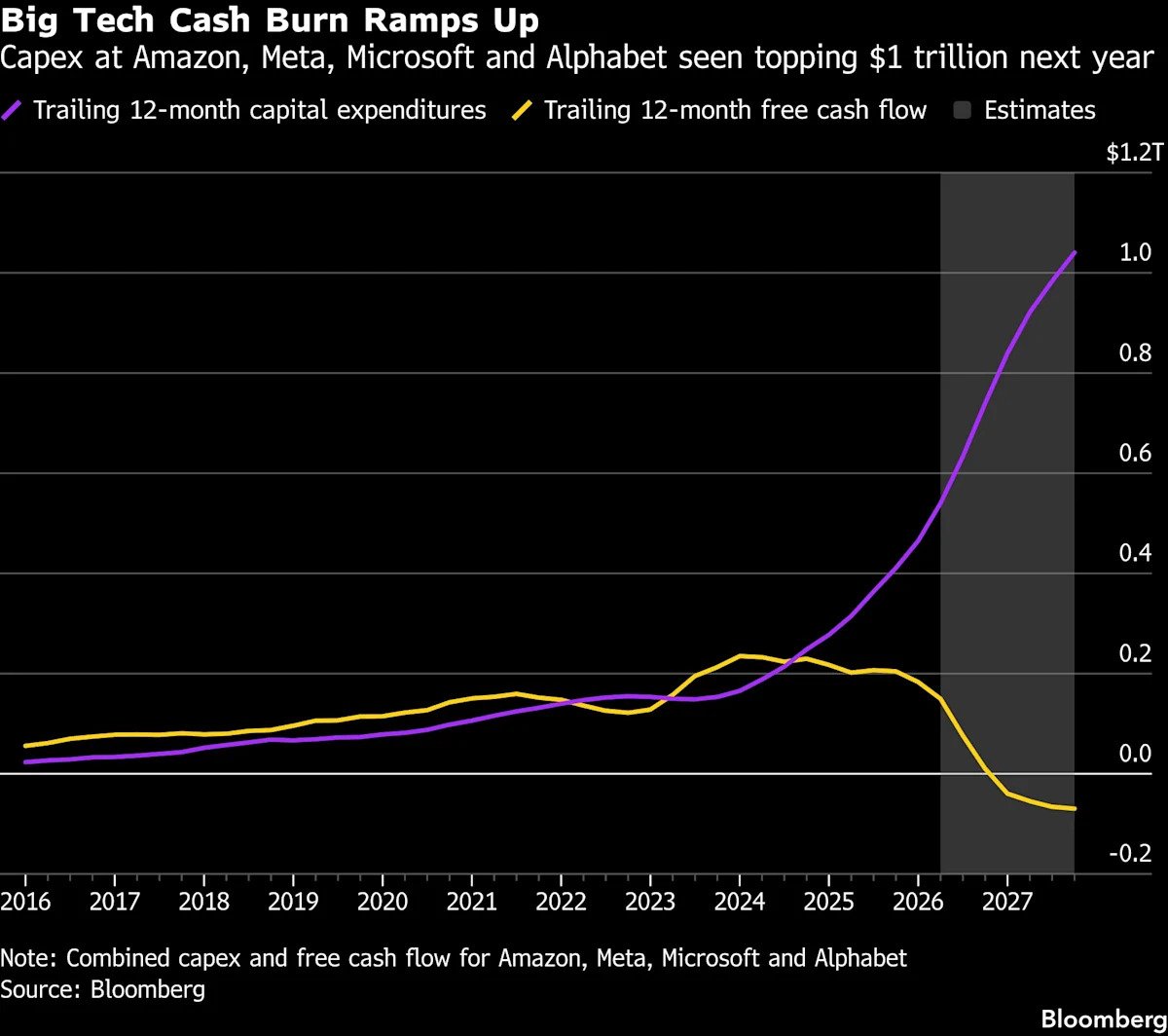
True free-cash-flow generation will drive value for the S&P 500 over the long-term, funding stock buybacks and dividend payments for shareholders. And free cash flows are declining among some of the world’s largest companies. Big players like Amazon, Alphabet, and Microsoft are close to generating zero in free cash flow if they continue with their current torrid rates of capital expenditures. That also adds some precariousness to this bull market mania.
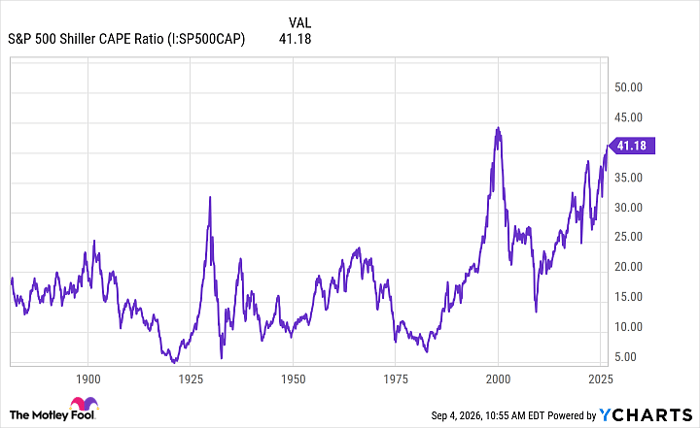
S&P 500 Shiller CAPE Ratio data by YCharts.
Here’s what investors should do
Given the factors laid out above, it is possible that AI stocks are in a bubble. When bubbles pop, drawdowns of as much as 80% can wipe out years of gains for investors — which is what happened in the aftermath of the dot-com bubble. The current Shiller CAPE ratio certainly suggests that the bubble scenario is underway. Or, super-intelligent AI systems may be on the immediate horizon that could lead to a rapid acceleration in economic growth and EPS growth. This could be the only way for the S&P 500 to keep performing well over the long haul.
As an individual investor, you should not put all your chips into one side of the argument. It would be foolish to put 100% of your portfolio in risky AI stocks, but it would also be risky to go 100% in bonds or other low-risk assets, as that strategy would limit your long-term upside.
Diversification remains a key tool for helping your portfolio perform adequately, and preserving your wealth through the market cycle.
Should you buy stock in S&P 500 Index right now?
Before you buy stock in S&P 500 Index, consider this:
The Motley Fool Stock Advisor analyst team just identified what they believe are the 10 best stocks for investors to buy now… and S&P 500 Index wasn’t one of them. The 10 stocks that made the cut could produce monster returns in the coming years.
Consider when Netflix made this list on December 17, 2004… if you invested $1,000 at the time of our recommendation, you’d have $421,997!* Or when Nvidia made this list on April 15, 2005… if you invested $1,000 at the time of our recommendation, you’d have $1,413,876!*
Now, it’s worth noting Stock Advisor’s total average return is 978% — a market-crushing outperformance compared to 213% for the S&P 500. Don’t miss the latest top 10 list, available with Stock Advisor, and join an investing community built by individual investors for individual investors.
*Stock Advisor returns as of September 7, 2026.
Brett Schafer has no position in any of the stocks mentioned. The Motley Fool has positions in and recommends Alphabet, Amazon, and Microsoft. The Motley Fool has a disclosure policy.