There’s no doubt about it: We have entered one of the most expensive markets in Wall Street’s history.
That’s not a reason to panic or a signal to take cover, run for the hills, and start hoarding gold. It’s the price investors are paying today to access the long-term gains that the stock market has historically delivered.
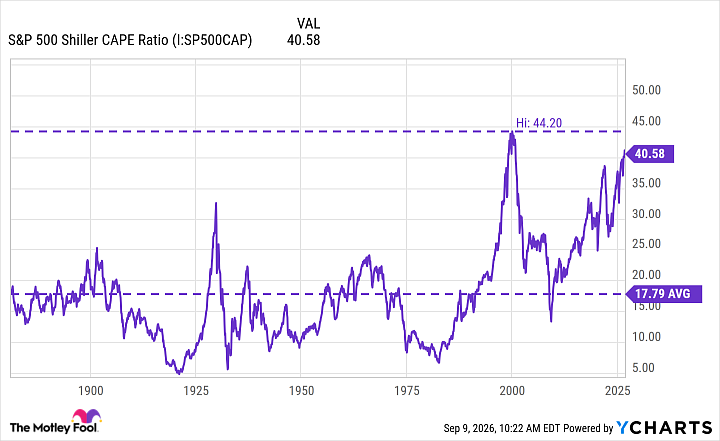
We’ll come back to that. First, a signal from the stock market: A traditionally reliable metric, the CAPE ratio, has reached its second-highest level in history, at about 41. The chart shows annual CAPE readings, highlighting today’s valuation.
Data by YCharts.
The CAPE is one of the most efficient ways to compare the S&P 500’s valuation with its predecessors, yet many investors remain unaware of it. Essentially, it averages the last decade of S&P 500 (^GSPC +0.86%) earnings to smooth out recessions and abnormally strong earnings. The late-’90s dot-com market saw the highest CAPE reading of all time, peaking at 44. Today’s market is at its second-highest reading, with a monthly figure above 40.
A high CAPE doesn’t mean a market crash or recession is on the way. That’s a common misinterpretation based on confusing correlation with causation.
More likely, a high CAPE signals that investors expect massive growth from S&P 500 companies. If earnings growth doesn’t arrive as big as expected, major disappointment could lead to the kind of crash seen in 1929 or 2000.
That doesn’t mean a crash is coming: This isn’t a doom-and-gloom signal. Today’s market is different than previous ones, and with the advent of app-based, commission-free trading, stocks are theoretically accessible to more investors than in the past. Greater participation could support valuations that, historically speaking, could look high.

Image source: Getty Images.
How investors should proceed in September 2026 and beyond
So what should investors do? Probably less than you think. As mentioned, a high CAPE isn’t a cause to abandon ship; rather, it’s a reminder to be highly selective about what you buy.
So here’s what I would do: I would favor companies with strong balance sheets, durable earnings, and valuations that don’t require extreme perfection. I would keep diversifying my holdings, especially outside the market’s most expensive sectors, and resist the urge to chase after the next “big thing.” In short, I would invest as much as you always have, just with a little more caution and discipline.
Most importantly, keep investing. If valuations come down, many great stocks could go on sale, offering long-term investors an opportunity to buy.