
It’s been a tumultuous couple of weeks for the stock market.
AI doomsday fears sent tech stocks tumbling amid renewed concerns around a bubble. Oil prices continue to drive up inflation. And, most recently, the 10-Year Treasury yield reached its highest level since 2007, triggering new recession worries.
The S&P 500 (^GSPC -0.45%), Dow Jones Industrial Average (^DJI -1.21%), and Nasdaq Composite (^IXIC -0.01%) are each down around 2% over the past month, and around 40% of investors expect the market to fall further in the next six months, according to the latest weekly survey from the American Association of Individual Investors.
Fortunately, history says the right strategy can protect your investments even if a market crash is looming.

Image source: Getty Images.
A long-term outlook all but guarantees stock market success
Perhaps the single best move investors can make right now is to stay focused on the long term.
Bear markets and recessions are a normal part of the market’s cycle, and trying to predict when the next drawdown will occur is next to impossible. But the longer you can stay invested, the less likely it is that you’ll lose money.
Since 1919, every single one of the S&P 500’s 20-year periods has ended in positive total returns, according to analysis from Crestmont Research. In other words, if you’d invested in the S&P 500 at any point over the last century and simply held your investment for two decades, you’d have made money.
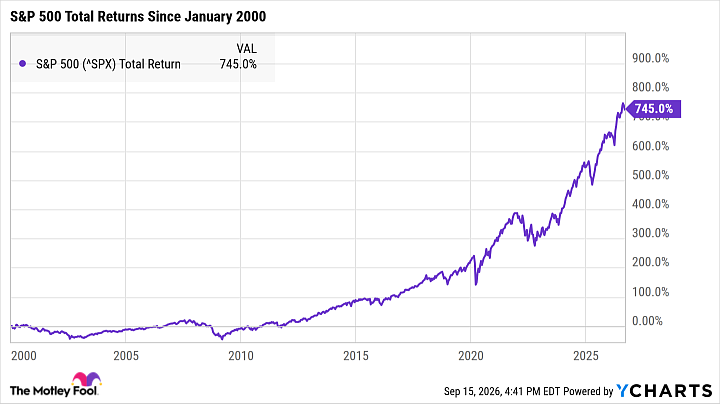
The market has experienced no shortage of volatility, either. Since 2000, the stock market has survived the longest bear market on record (the dot-com bubble burst), the most severe economic downturn post-WWII (the Great Recession), and the fastest market decline in history (the COVID-19 crash).
Yet if you’d invested in an S&P 500 ETF or index fund in January 2000, you’d have earned total returns of 745% — turning a $10,000 investment into around $84,500.
One critical caveat to building long-term wealth
Staying invested for the long haul is key to riding out periods of volatility, but it’s equally important to invest in strong stocks that can handle economic rough patches.
Recessions and bear markets will test a company’s strength and resilience. If a company has unreliable revenue streams, a leadership team with a questionable decision-making history, or a weak competitive advantage, it’s more likely to struggle during a downturn. The weakest of these stocks may not survive at all.
Healthy companies with solid underlying business fundamentals have the greatest potential for significant long-term returns. The more of these stocks you own, the less you’ll need to worry about how a market crash or recession will affect your portfolio.