
September has historically been the S&P 500‘s (^GSPC +1.11%) weakest month, and this year’s looks no different. As of this writing on Sept. 15, the S&P 500 is down over 100 points since the start of the month, a roughly 1.3% decline.
The market index has still been up over 15% since last September and has notched an 11% gain since the start of 2026. Still, something seems to be stirring investors’ fears, whether it’s war, inflation, or rising Treasury yields.
Amid this uncertain background, is it really safe to invest in the market right now? For most investors, history offers a surprisingly clear answer: Waiting for the turbulence to end might be riskier than investing through it. Here’s what that means.
Today’s Change
Index Level
7,635.31
Drawbacks, corrections, and bear markets are nothing new
Stock sell-offs are part of investing; in the grand scheme of things, they are common and routine. Many experienced investors have come to expect them; they know that a pullback can feel urgently bad in the moment. At the same time, they also know that a sell-off is usually brief compared to the decades over which their investments are meant to compound.
The S&P 500, for example, has experienced at least 60 drawdowns of 5% or more since 1957, according to a Reuters analysis of data from Yardeni Research. Within that same period, 22 reached 10%, and 10 declined at least 20%. A $10,000 investment from 1957 until today, however, would have grown to $1.6 million.
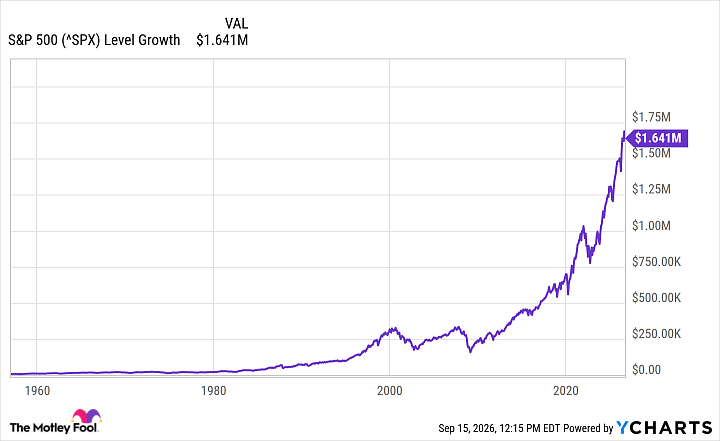
Data by YCharts
Since 1929, the S&P 500 has experienced 56 market corrections, with 22 of those eventually becoming bear markets. The average correction declined about 14% and lasted about 115 days. Still, since 1928, the average annual return of the S&P 500 has been roughly 10%.

Image source: Getty Images.
Staying invested is likely the best course of action
It might seem counterintuitive, but the best thing to do right now is probably nothing.
I say “probably” because not every investor is in the same boat. Money that’s needed soon, for instance, probably shouldn’t be tied up in stocks. Likewise, a portfolio heavily weighted toward one sector, like tech, could use some diversification to become less exposed if that one sector takes a hit.
On the other hand, if you’re invested in the S&P 500 and won’t need that money for at least several years, you should probably leave it where it is. Selling now with the hope of buying low before the next bull market may seem smart, but it rarely works out the way you expect. Indeed, as research from Hartford Funds points out, around three-quarters of the market’s best days occur during bear markets, or within two months of a new bull market.
That last point highlights the (potentially) frustrating thing about sell-offs: They’re often over before investors feel comfortable that the danger has passed. Instead of trying to time the market, it’s best to maintain a disciplined investing plan. History favors that approach.