
The past few years have been lucrative for the stock market. The Nasdaq (^IXIC +0.48%) hit a new all-time high this week, while the S&P 500 (^GSPC +0.51%) is less than 1% away from another record. In the last six months alone, the two indexes are up by around 23% and 18%, respectively.
However, the headwinds have been coming in strong lately. Nearly half of U.S. investors believe stock prices will fall in the next six months, according to the latest weekly survey from the American Association of Individual Investors, compared to around 33% who believe stocks will continue climbing.
The bad news is that a downturn is inevitable, since no bull market can last forever. The good news is that Warren Buffett has some timeless advice for preparing for a stock market crash.

Image source: Getty Images.
Risky stocks may be hiding in plain sight
When Berkshire Hathaway published its 2007 letter to shareholders, the U.S. was a few months into the Great Recession, and investors were rattled. In the letter, Buffett shared some insights into how the financial crisis materialized.
“[J]ust about all Americans came to believe that house prices would forever rise,” he noted. “Today, our country is experiencing widespread pain because of that erroneous belief. As house prices fall, a huge amount of financial folly is being exposed. You only learn who has been swimming naked when the tide goes out.”
In other words, it’s crucial to choose your investments wisely. When the market is surging, it can be tough to tell which companies have earned that growth and which are simply riding the waves of hype. But market crashes are stress tests for businesses, and tough times will separate strong stocks from weak ones.
History has a brutal lesson for investors
Right now, the market has been on an unstoppable run, valuations are reaching new heights, and there’s an increasing risk that some stocks are overvalued.
For those who survived the dot-com bubble, that may sound familiar. Between 1995 and 1999, the S&P 500 climbed by nearly 200% — fueled primarily by excitement around internet companies.
But many of those companies were built on shaky foundations, with unprofitable business models, poorly managed finances, or inexperienced leadership teams that couldn’t navigate the bear market following the bubble. Hundreds of tech stocks crashed and burned, and many never recovered.
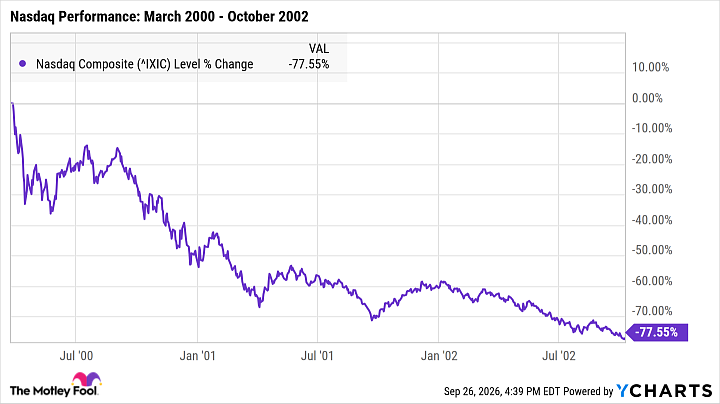
There’s still good news, though: Many stocks went on to thrive after the dot-com bubble, despite severe short-term volatility.
Microsoft, for example, fell by more than 60% during the dot-com bear market. Apple lost more than 50% of its value in a single day in 2000. And Amazon sank by close to 95% between 1999 and 2001. Now, all three of those companies are industry-leading behemoths.
If history proves just one thing, it’s that the key to investing is not buying or selling at precisely the right moment. It’s buying quality stocks with strong fundamentals and holding them for the long haul. When the tide eventually goes out, those are the companies that will stay afloat.