
The S&P 500 (^GSPC -0.17%) has been working overtime the last few years, earning total returns of nearly 18% over the last 12 months alone — far above its historic average of around 10%.
Advancements in artificial intelligence (AI) can be credited for much of the market’s recent success. The technology sector within the S&P 500 has surged by a whopping 46% over the last six months, while all other industries combined have a total return of around 11% in that time.
However, here lies the risk for investors. As company valuations surge, the largest stocks are making up a historically significant portion of the broader market. When those stocks are thriving, they can lift the market to new heights. But if they stumble, they might bring the rest of the market down with them.

Image source: Getty Images.
AI stocks are dominating the market
As of this writing, the S&P 500 in total is valued at around $70.4 trillion. The top 10 stocks alone account for $27.4 trillion of that, or around 39%. They include: Nvidia, Apple, Alphabet, Microsoft, Amazon, Meta Platforms, Broadcom, Tesla, Micron Technology, and Berkshire Hathaway, in that order.
The last time the S&P 500 was this concentrated was in 1965, according to data from S&P Global. Back then, however, the top holdings included names like AT&T, General Motors, IBM, and DuPont. In other words, there was more variety among the industries.
Nearly all of the S&P 500’s top stocks are either heavily or tangentially focused on AI development. Amazon, Meta, Microsoft, and Alphabet collectively spent over $300 billion building out data centers in the first half of 2026, and those four companies alone are expected to account for nearly half of global AI infrastructure spending this year.
It’s still anyone’s guess whether all that spending will eventually pay off. New analysis from Goldman Sachs estimates that hyperscalers will need to generate at least $300 billion in AI revenue over the next few years just to break even, and $1 trillion per year for healthy profit margins. These companies may pull that off, but if they don’t, it could have a ripple effect on the entire market.
History offers a warning — and a silver lining — for investors
The last time the market saw a sudden spike in concentration was during the dot-com bubble. Between June 1994 and June 2000, the S&P 500’s top 10 holdings jumped from 17% of the index’s value to more than 26%.
Since the current bull market began in late 2022, S&P 500 concentration has spiked again from around 26% to 39%.
At the same time, the market is reaching historic valuation levels. The S&P 500 Shiller CAPE Ratio currently sits at over 40, inching closer to the record high of 44 set during the dot-com bubble. This metric measures the market’s long-term valuations, with a higher ratio suggesting that stocks are trading at a premium.
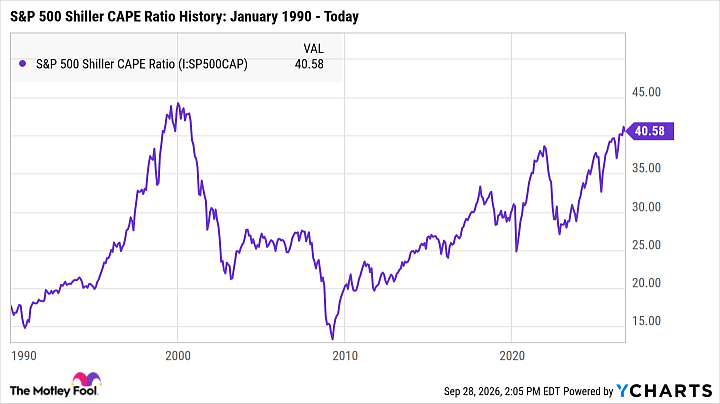
S&P 500 Shiller CAPE Ratio data by YCharts
For S&P 500 investors, the combination of higher valuations and increased concentration could create a sneaky risk. When the tech sector imploded after the dot-com bubble burst, the S&P 500 lost nearly half of its value over the following two years.
To be clear, no two bear markets are identical, and even the strongest market indicators can’t predict the future. However, given that the S&P 500 is more saturated with tech stocks now than it was during the dot-com bubble, the market is leaning even more heavily on a handful of companies.
The good news is that if we do face a pullback, the S&P 500 has repeatedly proven it can recover from even the most severe volatility. Since early 1999, when valuations began to soar and the market developed into a bubble, the index has earned total returns of nearly 1,000%.
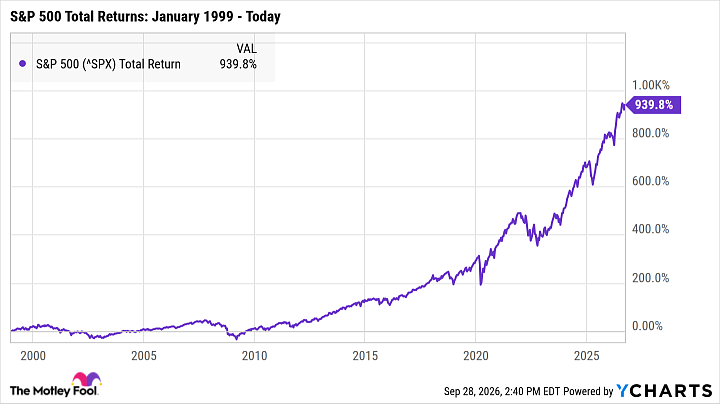
Long-term investors have the most to gain, no matter what the market does in the coming years. While no one can say for certain whether an AI bubble is on the horizon, staying invested for the long haul has been a historically proven way to protect your portfolio.
Katie Brockman has no position in any of the stocks mentioned. The Motley Fool has positions in and recommends Alphabet, Amazon, Apple, Berkshire Hathaway, Broadcom, International Business Machines, Meta Platforms, Micron Technology, Microsoft, Nvidia, and Tesla. The Motley Fool recommends General Motors. The Motley Fool has a disclosure policy.