The stock market has been on an extraordinary run over the last few years. Since the bear market bottomed out on Oct. 12, 2022, the S&P 500 (^GSPC +0.67%) has risen 118% while the Nasdaq Composite (^IXIC +0.67%) has rocketed 165%. The Dow Jones Industrial Average (^DJI +1.01%) has also surged at an impressive rate. This rally roughly started with the beginning of the generative artificial intelligence (AI) revolution following ChatGPT‘s public launch in November 2022.
AI has helped Nvidia become the world’s most valuable company and fueled hundreds of billions of dollars in spending on data centers, semiconductors, and power infrastructure. Naturally, the enthusiasm around AI is creating uncomfortable comparisons with the dot-com bubble.
What if AI is a bubble and stocks crash? Warren Buffett spent nearly 60 years offering investors answers that sound almost too simple: the smartest thing you can do is stay invested through volatility and uncertainty.

Image source: Getty Images.
Warren Buffett doesn’t try to time the markets
During an interview with CNBC back in March 2009, Buffett acknowledged that he didn’t know where the stock market would bottom. More importantly, he said he had “no idea” what the stock market would do tomorrow, next week, next month, or next year.
That’s a sobering admission from arguably the world’s most famous investor, but it explains the philosophy behind Berkshire Hathaway. Buffett never tried to predict whether stocks would rise by next Tuesday. Instead, he did his best to determine what a business is worth and whether owning it at today’s price could produce attractive returns over many years.
Maybe AI stocks will crash in 2027. Or maybe they will rally for another five years. Investors who sell everything because they are convinced a crash is on the way will have another problem: they eventually need to decide when to get back in. Getting one timing decision right is difficult, but getting both right consistently is nearly impossible.
The dot-com crash provides a valuable lesson
During the dot-com boom, the S&P 500 peaked at 1,527 on March 24, 2000. By Oct. 9, 2002, the index had fallen to 777 — a brutal decline of roughly 49%. It didn’t surpass its old record until May 30, 2007. The length of that recovery is enough to make buy-and-hold investing sound terrifying.
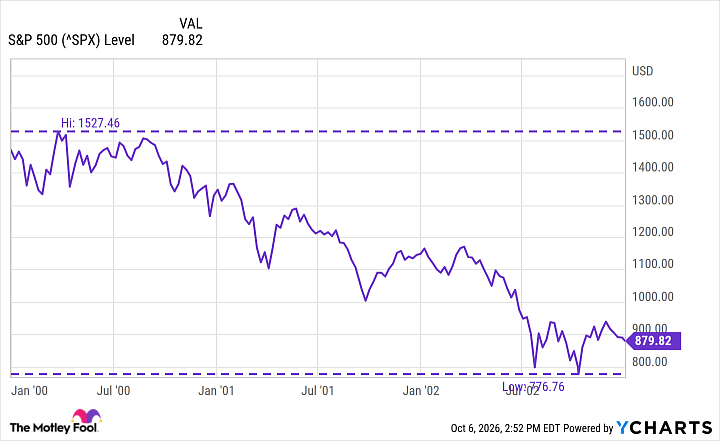
The S&P 500 now sits around 7,800. This means that investors who bought near the absolute peak of the dot-com bubble — the seemingly worst possible moment — still watched the index increase roughly fivefold.
Along the way, those investors endured the dot-com collapse, the global financial crisis, the Covid-19 crash, the 2022 bear market, inflation, wars, recessions, banking scares, and countless predictions of the next catastrophe.
The lesson here isn’t that stock prices can’t fall. It’s that long-term investing doesn’t require you to predict every crash on time. America’s largest companies should continue generating profits, reinvesting capital, developing new products, and adapting to change. Over long periods, those fundamentals matter far more than whether you perfectly predict the next bear market.
Staying invested is not a license to buy anything
The dot-com era is a good case study showing what can happen when investors abandon valuation and business fundamentals. Many speculative internet companies disappeared entirely after the market crashed. While an index eventually recovers, individual companies that go bankrupt do not. This is why building a diversified portfolio matters.
For those choosing individual stocks, Buffett’s investment framework is useful: look for durable competitive advantages, strong balance sheets, capable management teams, and healthy cash generation that is used to reward shareholders through dividends or buybacks.
Ultimately, Buffett’s approach isn’t based on believing the stock market never crashes. It’s based on accepting that downturns are inevitable and admitting that no one can consistently predict when they’ll happen. Investors who remain diversified, avoid speculative momentum trades, and own high-quality businesses for decades at a time rather than days or weeks don’t need to predict the next market-turning event. They just need patience to survive it.