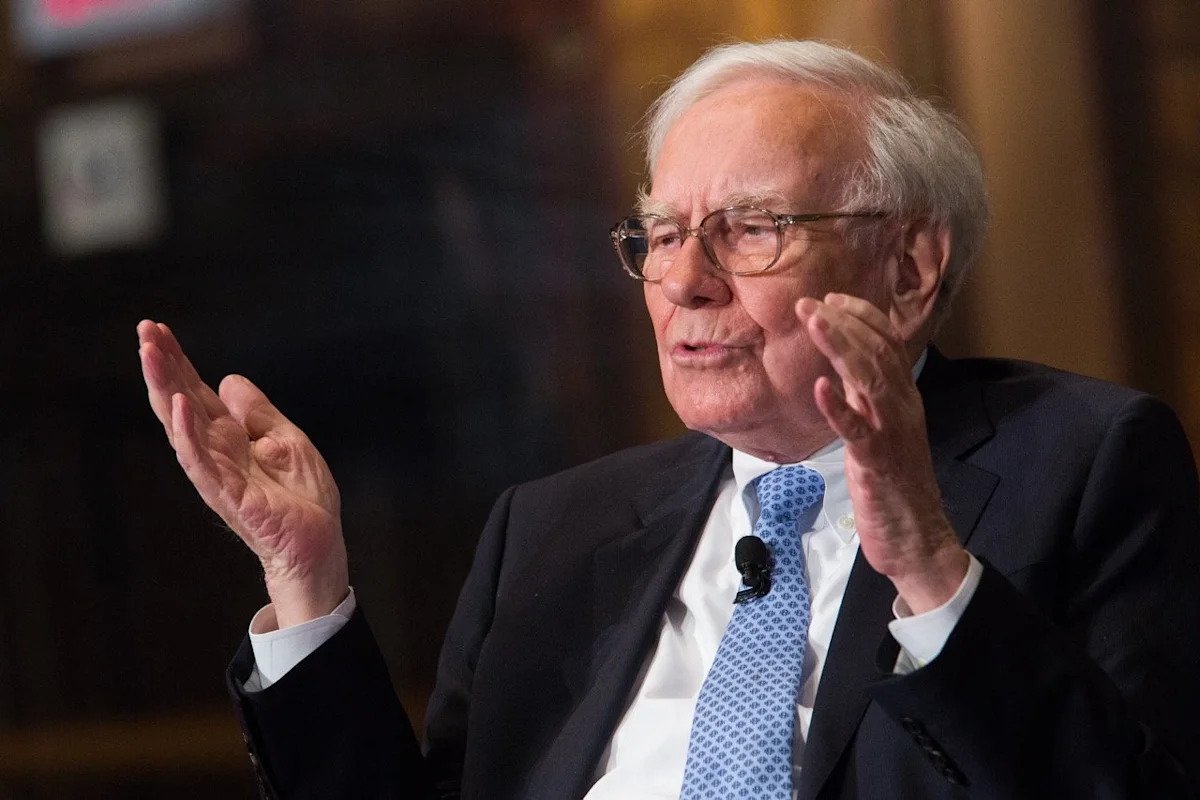
Warren Buffett has spent decades warning equity investors about the risks posed by interest rates and how they can significantly influence the direction of stock prices. He’s offered two quotes in particular that illustrate this.
In a 1999 Fortune article, Buffett explained: “These act on financial valuations the way gravity acts on matter: The higher the rate, the greater the downward pull.” At Berkshire Hathaway‘s 2013 meeting, he said: “Interest rates are to asset prices, you know, sort of like gravity is to the apple.”
Missed Nvidia in 2009? This Rare Signal Is Flashing Again. In 2009, a “Double Down” signal flashed for a little-known chipmaker called Nvidia. For the first time in years, that same “Total Conviction” signal is flashing for a company 1/100th the size of Nvidia. Continue »
For most of the past several decades, this hasn’t been a problem. Since the early 1980s, rates have mostly been either falling or at incredibly low levels. Both scenarios reduced the attractiveness of fixed income and gave investors an incentive to own stocks.
But now with the long-term Treasury yields above 5%, investors have to think twice about the risk/reward trade-off for the first time in years.
Why take equity risk right now when you can buy a (theoretically) risk-free Treasury that pays you more than 5%?
Buffett’s “gravity” argument is getting more worrisome
To be clear, just because long-term yields are above 5% doesn’t make them a buy. With durations of 10 to 30 years, these are still heavy bets on the direction of interest rates. And with inflation still a primary macroeconomic risk, it’s certainly possible that rates could rise to 6%, creating significant losses for these bonds.
But there is a real risk to owning stocks here. The Shiller cyclically adjusted price-to-earnings (CAPE) ratio, which measures the S&P 500‘s (SNPINDEX: ^GSPC) stock prices against 10-year inflation-adjusted earnings, is currently at 41.9. That’s the second-highest level it’s ever been.
With this ratio in the 20s, which it was at as recently as 2022, and long bonds yielding closer to 2%, owning stocks was much easier to justify. But with valuations near all-time highs and yields above 5%, there’s suddenly very little room for error.
Resetting your expectations for the S&P 500 going forward
Investors have gotten used to double-digit annual returns by investing in the S&P 500. That’s probably not a realistic expectation anymore.
Generally speaking, higher starting valuations for stocks tend to correlate with lower forward-looking returns. That’s not a prediction for a bear market or an imminent crash. It’s just a reminder that the law of averages tends to catch up over time.