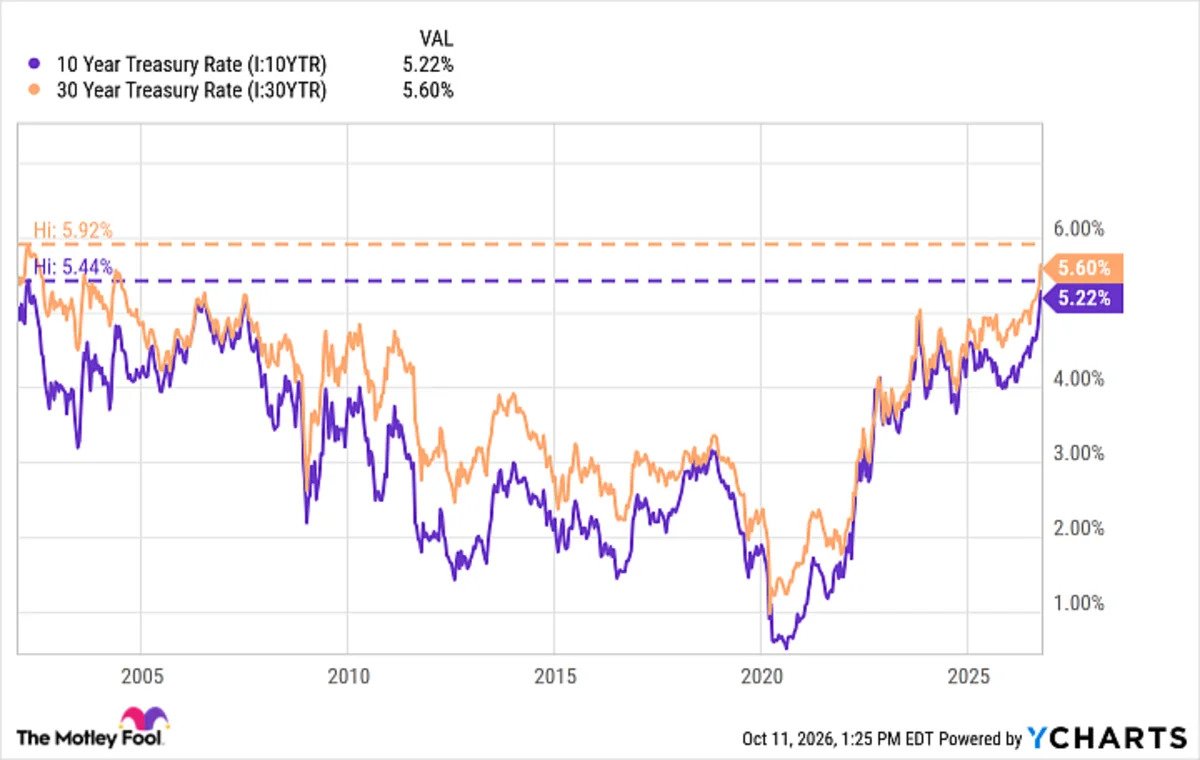
Bond yields are going up.
Along with a recent Federal Reserve hike in short-term interest rates in September, longer-term U.S. Treasury bond yields recently reached their highest levels in decades. Yields for the 10-year and 30-year bonds are both at their highest since 2002, at well over 5%.
Missed Nvidia in 2009? This Rare Signal Is Flashing Again. In 2009, a “Double Down” signal flashed for a little-known chipmaker called Nvidia. For the first time in years, that same “Total Conviction” signal is flashing for a company 1/100th the size of Nvidia. Continue »

What do higher bond yields mean for stock prices? They could be bad news; sometimes rapid spikes in yields lead to a stock market crash.
But the bond market moves for all kinds of complex reasons, and it’s not always automatically connected to what happens next with stocks. When central banks raise interest rates, newly issued bonds must offer higher coupon (interest) rates to attract investors. This immediately pushes the overall yield on new debt higher. As a result, existing bonds with lower interest rates become less attractive. As investors sell them, their market prices drop.
Higher bond yields could put pressure on stock prices in the short run, but they shouldn’t be cause for panic. Higher yields mean that when old bonds mature, the returned principal can be reinvested into new, higher-yielding bonds, increasing long-term income.
Let’s look at the big picture of what higher yields might do to the stock market — and what long-term investors should do next.
Higher bond yields: bad news for stocks?
There are a few reasons higher bond yields can be bad for stocks. As already noted, when yields rise, bond investors can earn higher income by buying bonds. This makes stocks a little less attractive. As a result, demand for stocks might go down — and stock prices would follow. Also, when bond yields go up, interest rates rise, too, raising borrowing costs. This can be seen in higher rates for mortgages, car loans, and business loans.
The cost of money rises with higher interest rates, making it harder for companies to refinance debt, take on new debt, or invest in expansion plans. Higher bond yields (and higher interest rates) can slow economic growth and reduce investment. That’s typically bad for stock prices.
Why stock investors shouldn’t worry about higher bond yields
Will higher bond yields lead to a stock market crash? Not necessarily. The S&P 500 (SNPINDEX: ^GSPC) is still up 14% in 2026, despite these recent increases in interest rates. The market seems to be taking higher rates in stride … for now. Not all increases in interest rates are equally bad for the stock market.