NEW YORK (AP) — A sell-off for artificial-intelligence stocks is hitting Wall Street again Thursday after whipping around the world on worries about how much longer the AI frenzy will last.
The S&P 500 fell 0.5% and is on track for a sixth loss in the seven days since setting its all-time high. The weakness for AI stocks dragged the Nasdaq composite down a market-leading 1.2%, but other kinds of stocks held up better. The Dow Jones Industrial Average was up 251 points, or 0.5%, as of 9:35 a.m. Eastern time, and the majority of U.S. stocks were rising.
The swings came as another report signaled inflation has worsened by even more in the United States than economists expected. Part of the reason prices keep rising so quickly is that customers are continuing to buy things despite them, and a separate report on Thursday said U.S. retailers made more money last month than economists expected.
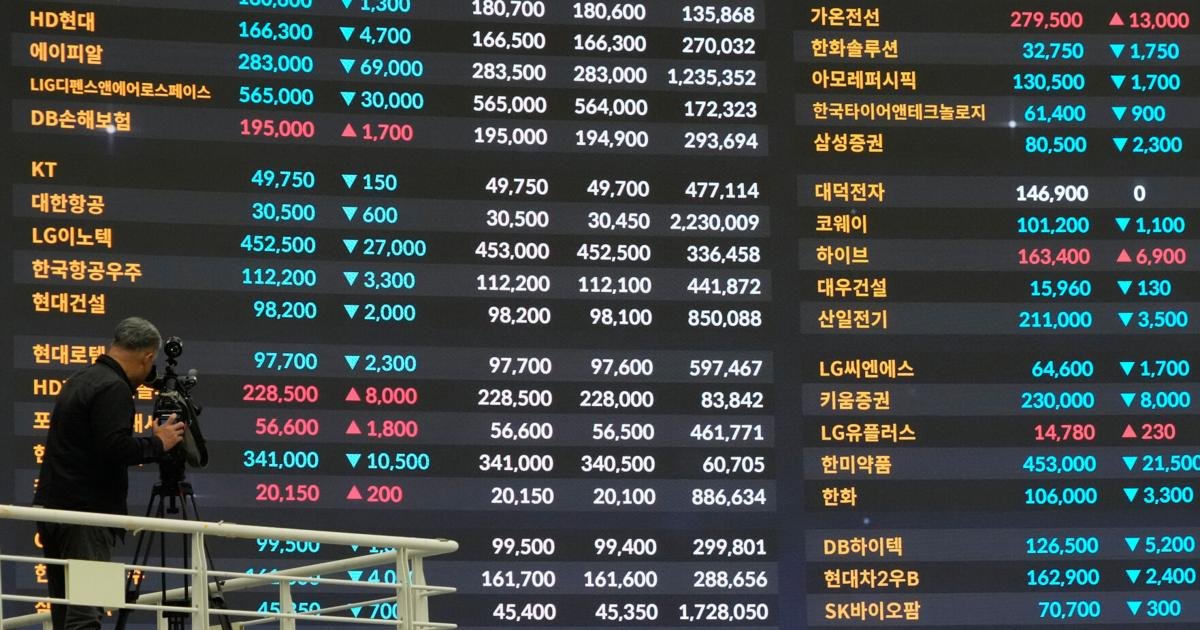
For AI stocks, the sharp drops started on Wall Street Wednesday and then sent South Korea’s Kospi down 7.6% and Japan’s Nikkei 225 down 4.9% before whipping back to the United States.
It’s their latest stunning swing after they led the market for years. Companies are pouring money into AI in hopes of bigger profits and improved productivity. But data centers and AI chips cost money, and many companies have been borrowing the cash to get them.
Now, after yields in bond markets worldwide hit their highest levels in years, worries are rising about how resilient that boom in spending can be. Many AI-related companies have already taken on debt to build out their aspirations, and their stocks are struggling under those debt loads as well.
CoreWeave, which offers AI computing power to customers over the cloud, fell 7% a day after tumbling 15.5%. It said in the summer that it had $4.41 billion in principal payments still to make on its debt over the second half of this year and another $6.18 billion in 2027. It had more than $5.5 billion in cash, as of June 30.
High yields in the bond market also generally make investors less willing to pay high prices for stocks, particularly those seen as the most expensive.
Nvidia, the chip company that’s ridden the AI boom to become Wall Street’s most valuable company, fell 3.1% and was the heaviest weight on the S&P 500. It came into the day with a nearly 1,415% gain since the end of 2022.
The losses came despite a strong profit report from a bellwether of the AI industry. Taiwan Semiconductor Manufacturing Co. reported a profit for the latest quarter that topped analysts’ high expectations, and Chief Financial Officer Wendell Huang said it expects strong demand to continue in the final three months of 2026.
Its stock that trades in the United States fell 4.4%.
A day earlier, another bellwether for the AI industry likewise delivered a strong profit report that failed to stir excitement for the industry. Christophe Fouquet, the CEO of ASML in the Netherlands, said demand has been so strong because of AI that some customers are talking about placing orders for as far out as 2029 or even 2030.
Treasury yields actually fell in the bond market on Thursday, which means investors were willing to buy U.S. government bonds at higher prices. Treasurys have a reputation as a safer investment, one with less risk of the borrower going bankrupt, and investors often flock to them when feeling nervous.
The yield on the 10-year Treasury fell to 5.05% from 5.19% late Wednesday. It had topped 5.30% earlier this month and touched its highest level since 2002 because of worries about high inflation, signals of a strong U.S. economy and other factors.
The drop in yields came despite several reports on the U.S. economy that were stronger than expected, which would typically push yields upward. Besides the report on U.S. retail sales, another report said that fewer U.S. workers applied for unemployment benefits last week than economists expected. That could be a signal of limited layoffs across the country.
In stock markets abroad, South Korea’s loss was the headliner. Its Kospi index is dominated by two chip companies, Samsung Electronics and SK Hynix, and it fell to its worst day since July. It has dropped 39% since setting a record in June.
AP Business Writers Chan Ho-him and Matt Ott contributed to this report.
Copyright 2026 The Associated Press. All rights reserved. This material may not be published, broadcast, rewritten or redistributed without permission.