Happy Friday, investors. Hot wholesale inflation and another rough day for AI and chip stocks are keeping the breadth story top of mind to close out the week.
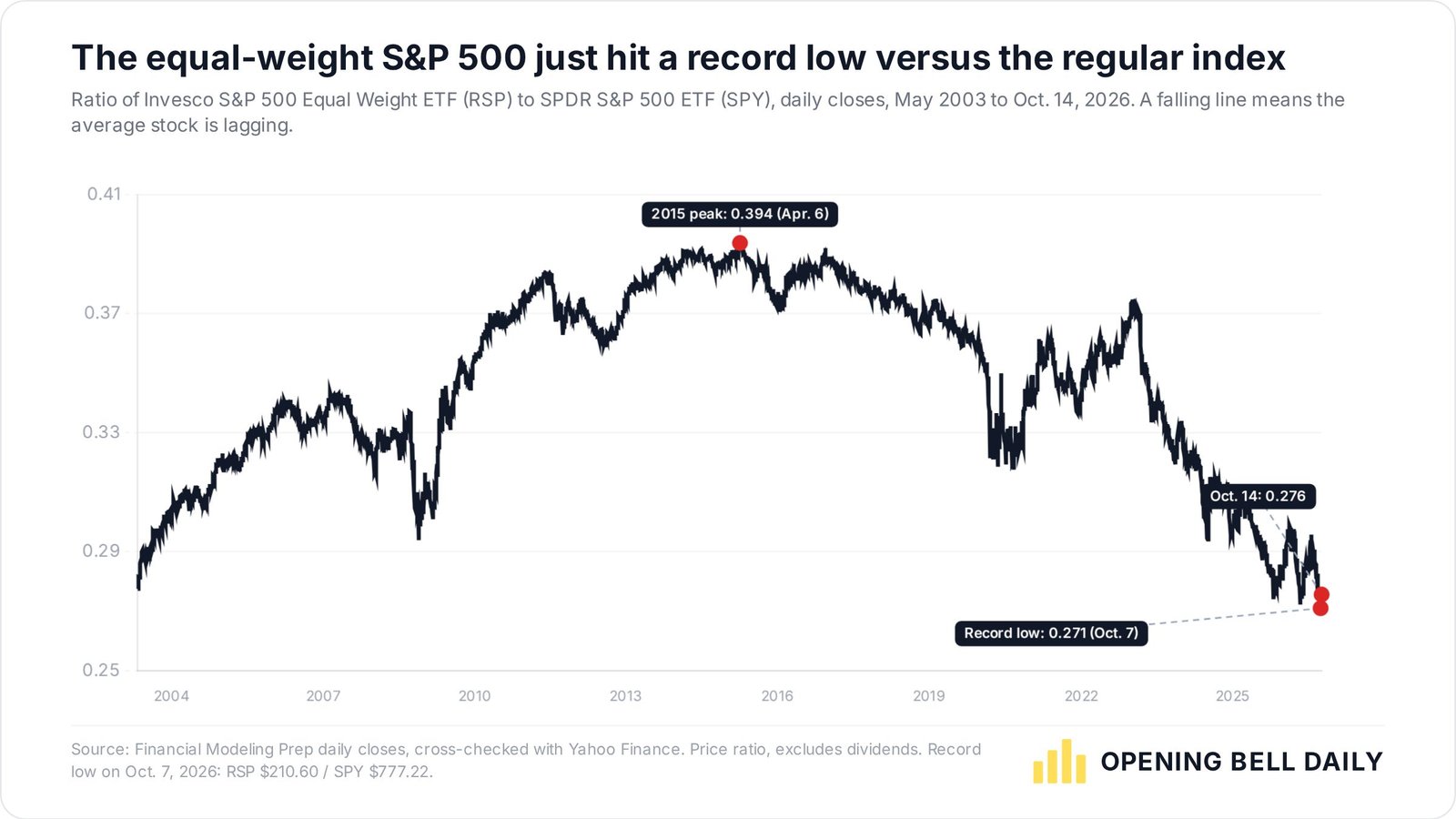
Today we’re unpacking why most stocks in the index still can’t keep up with it.
Stock pickers faced long odds in 2000 and then had a great run.
Today’s setup looks familiar. As of Thursday, 185 S&P 500 stocks were down in 2026 even as the index sits 13% higher year-to-date.
Only 191, or about 38%, are currently beating the benchmark.
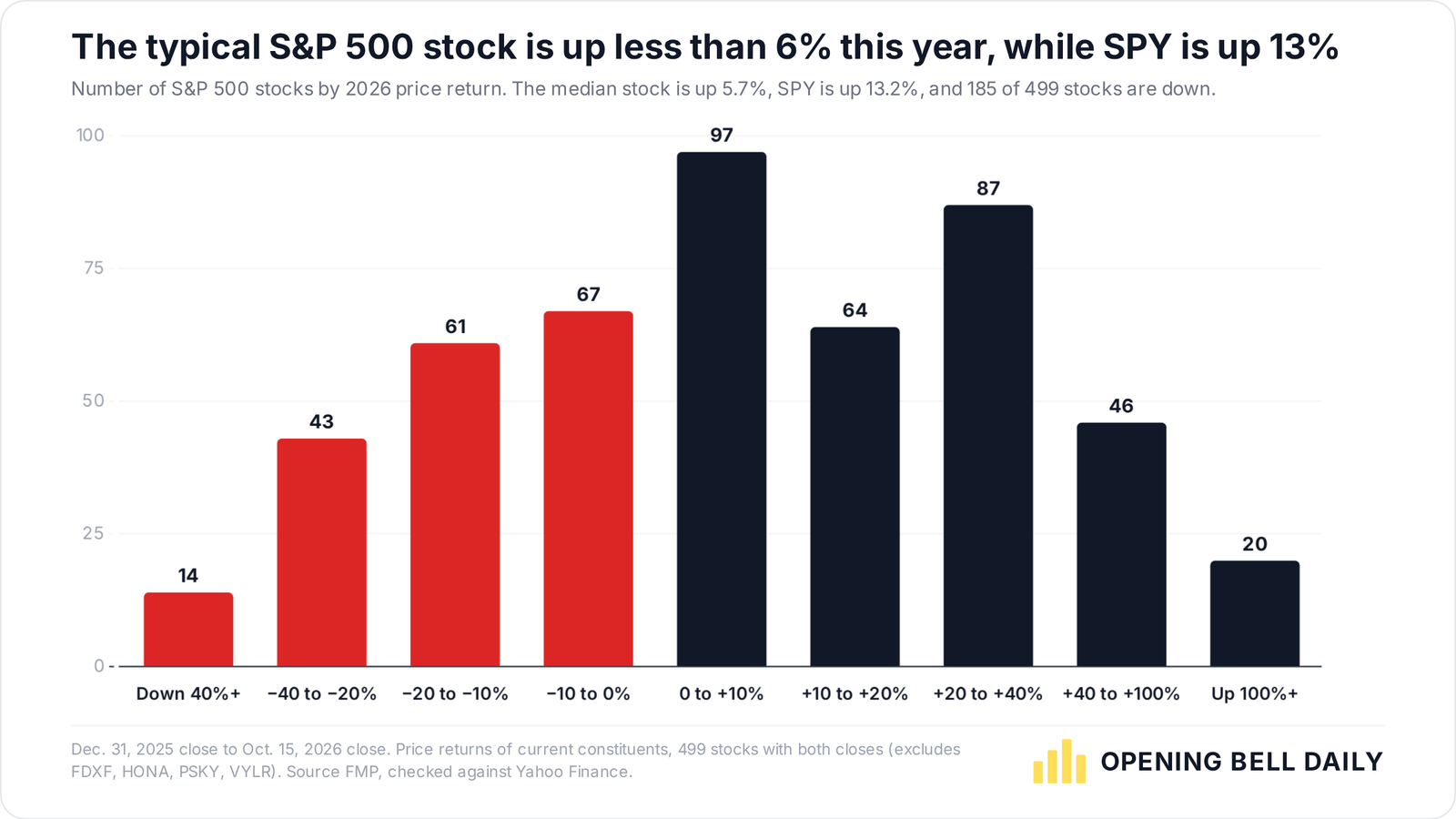
Each bar counts S&P 500 stocks by their 2026 price return. Red bars are losers.
Another way to put it is that the median S&P 500 stock is up just 5.7% this year, less than half of the S&P 500’s gain.
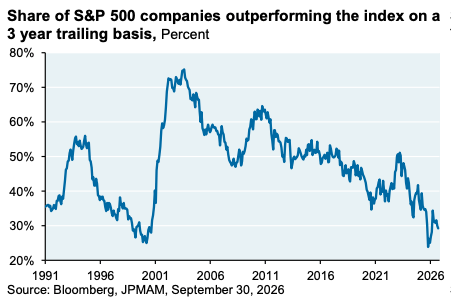
Now, this pattern is not as novel as it might sound. In a note last week, JPMorgan strategist Michael Cembalest noted that just 30% of stocks are outperforming the market for one of the lowest figures since 1991.
The line below from Cembalest tracks the share of index members beating the S&P 500 over rolling three-year periods.
Much of the gap can be explained by AI.
A basket of 42 AI stocks “accounts for 60%-80% of all S&P earnings growth, price returns and capital spending since Jan 2024,” according to JPMorgan’s calculations.
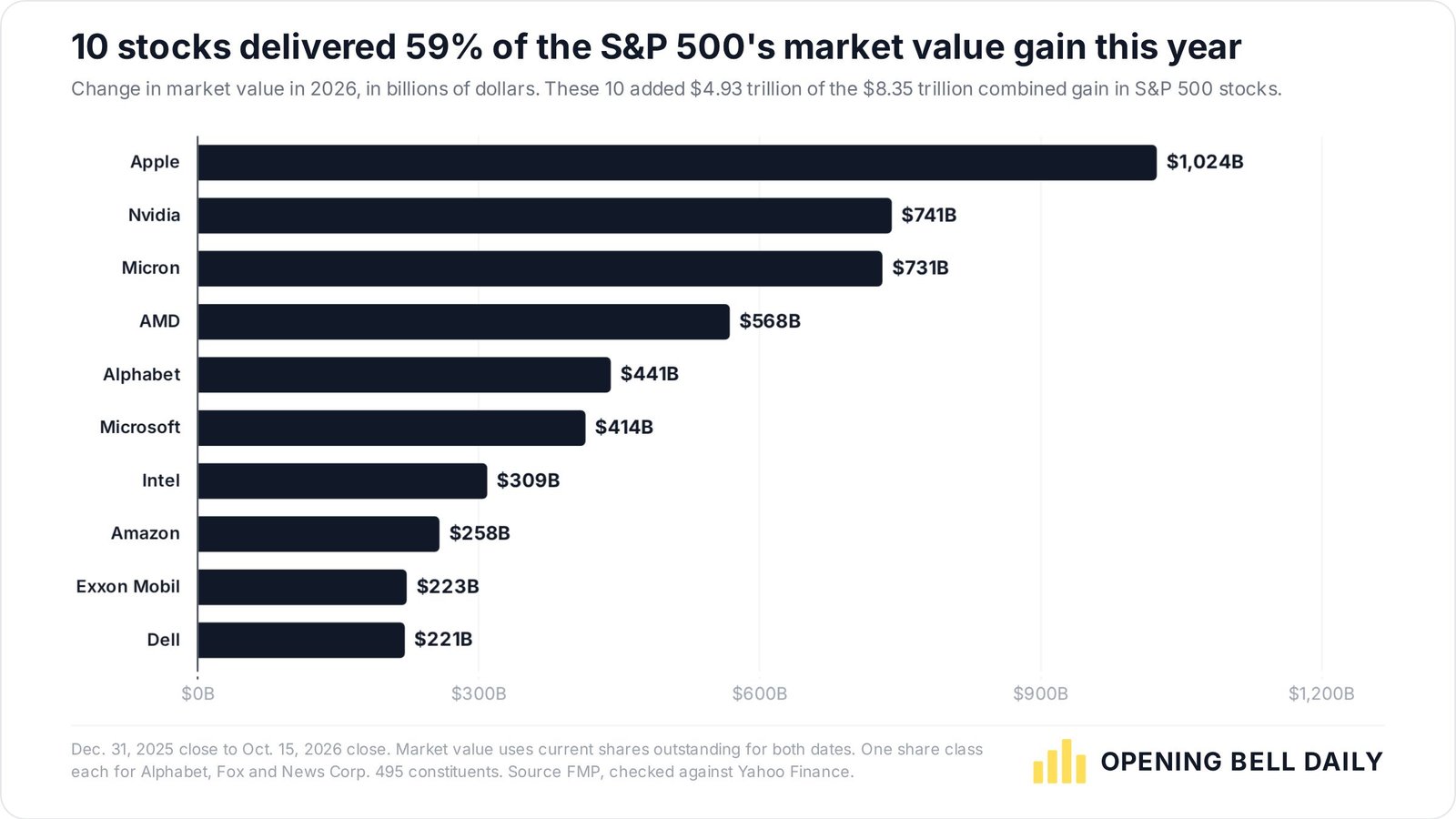
Indeed, ten stocks added $4.93 trillion in market value this year, 59% of the combined market-value gain in S&P 500 stocks.
When a few dozen names do that much of the work, it’s only natural for the other 460 or so lag behind.
And yet history does point somewhere hopeful.
As the chart at the top illustrates, the share of stocks beating the index over the prior three years bottomed around 26% in 2000, then surged to roughly 75% by 2003.
That swing lined up with the collapse of the dot-com leaders.
Once the giants stopped carrying the index, ordinary stocks finally had room to beat it.
Picking stocks went from a losing game to a winning one in about three years.
At risk of stating the obvious, 2026 isn’t 2000. But it’s worth remembering that today’s AI leaders are producing more profits than investors have ever seen through any cycle in history.
And it doesn’t seem impossible to believe that breadth can improve without a rerun of the dot-com crash.
The rest of the market just has to keep up with the giants. That could come from earnings catching up outside tech, or from AI spending finally paying off for the companies that use it.
Either way, the math only flips when leadership changes.
Until then, the index keeps winning by default.
The odds seem terrible, but they’ve rarely stayed that way.
A message from Direxion

Get focused exposure to a single stock through an ETF designed to help you express your market view.
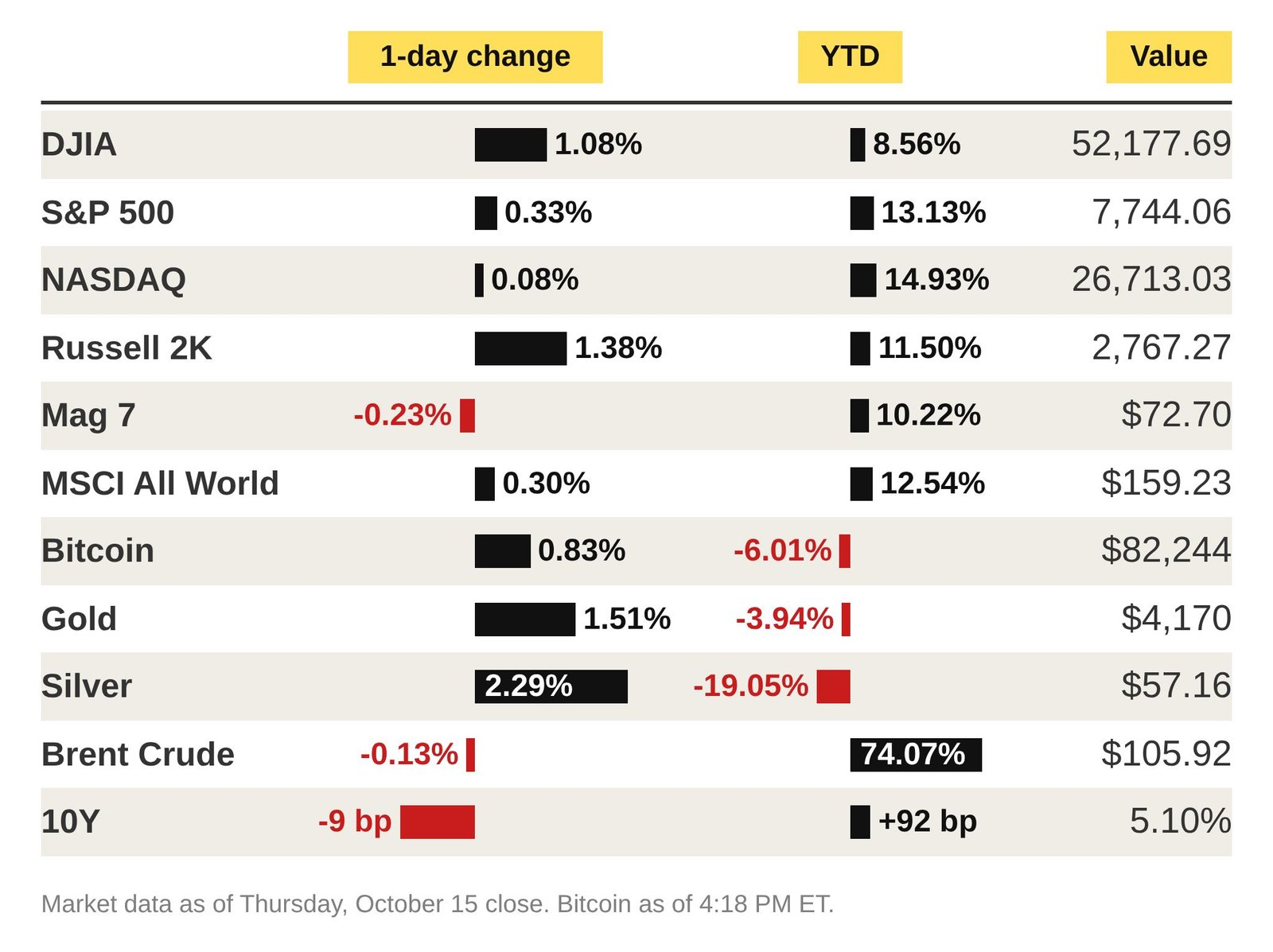
📈 Wholesale prices jumped the most since 2022. September PPI for final demand rose 1.3% for the month and 6.3% from a year earlier, with goods up 2.6% and energy up 10.8%. (CNBC)
🛍 Consumers kept spending but gas did much of the work. September retail and food-services sales rose 0.8% to $745.0 billion, while sales excluding gas stations were up just 0.2%. (Census)
📉 AI and chip stocks kept selling off as funding worries deepened. Twenty of the most valuable global AI and semiconductor stocks have shed more than $1 trillion so far this week, with Nvidia, AMD, Intel and Dell all lower. (CNBC)
Kai Wu is founder and CIO of Sparkline Capital. We sat down to discuss the AI bubble, the K-shaped market, and why he likes AI early adopters over the supply chain.
-
Schwab posted adjusted EPS of $1.69 and record core net new assets of $190.4 billion (Schwab)
-
US Bancorp earned $1.34 a share on record net revenue of $7.97 billion (U.S. Bank)
-
PNC reported earnings that beat estimates despite a slight revenue miss (PNC)
-
Retail sales rose 0.8% in September but sales excluding gas stations rose just 0.2% (Census)
-
Twenty of the biggest AI and chip stocks have shed more than $1 trillion so far this week (CNBC)
🗓 October 16, 1990. Harry Markowitz, Merton Miller and William Sharpe won the Nobel Prize in Economic Sciences for pioneering work in financial economics across portfolio theory, the Capital Asset Pricing Model, and corporate finance.
💡If you find this newsletter valuable, you can help shape its future by taking our 2-minute reader survey. Your feedback directly influences our content.
[DIREXION MRVU DISCLAIMER NEEDED — official newsletter disclaimer for MRVU not yet received from Direxion / Partnerships Manager. Phil: paste the approved disclaimer here and delete this note. Do not send until replaced.]