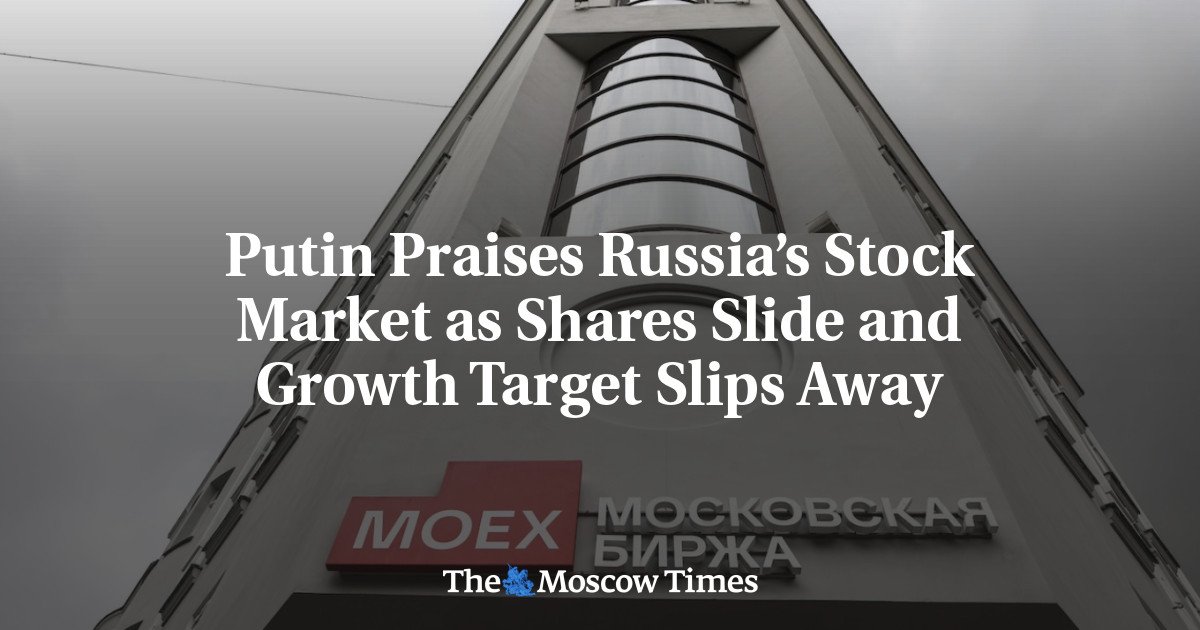
President Vladimir Putin said Russia’s stock market was stable and functioning reliably on Thursday, despite steep losses and officials’ acknowledgment that a national target for expanding the market is out of reach.
Speaking at a meeting with the Delovaya Rossiya business association, Putin acknowledged that the market had fallen short of the government’s ambitions but said it was strengthening, Interfax reported.
His comments came after officials acknowledged that Russia would not be able to meet his goal of raising stock market capitalization to 66% of gross domestic product by 2030.
The benchmark MOEX Index has fallen 13.6% this year and 37% since the end of 2021. Earlier this year, it posted a record 19 consecutive weeks of declines.
At around 2,400 points, the index is back near levels seen in early 2019. Consumer prices have risen 71% since then.
Russian stocks were the worst-performing domestic investment category over the first nine months of 2026, the preceding 12 months and the period since the start of 2022, according to Central Bank calculations.
Even including reinvested dividends, Russian equities lost 11.3% in January-September and 10.5% since the start of 2022, the bank calculated. Losses were substantially greater after accounting for inflation.
The stock market’s value relative to GDP has nearly halved during more than four years of war, according to calculations by rating agency Expert RA and the Center for Macroeconomic Analysis and Short-Term Forecasting.
Economist Viktor Tunev estimated the ratio at about 20% this summer, saying stock market capitalization was plumbing new lows relative to the size of the economy.
Several of Russia’s largest listed companies have suffered particularly steep declines.
Shares in state-controlled lender VTB hit a record low this year and now trade at roughly one-twelfth of their price at the bank’s 2007 initial public offering, which was heavily marketed to ordinary Russians.
Gazprom shares fell in July to their lowest level since November 2008, during the global financial crisis.
During that crisis, the government allocated 175 billion rubles ($2.1 billion) from the National Wealth Fund to buy shares and bonds in major Russian companies.
Sberbank, Russia’s most valuable listed company, now has a market capitalization only slightly larger than that of Italian luxury carmaker Ferrari.
Economist Vladislav Inozemtsev has pointed to sharp market rallies whenever hopes of peace emerge. The continuing war, however, has left Russian equities largely cut off from foreign investment, with Russian retail investors accounting for about two-thirds of trading turnover.
Authorities have sought to attract household savings by improving the terms of individual investment accounts and introducing a long-term savings program with limited government matching contributions.
But retail investors cannot replace foreign institutional funds in large share offerings, Expert RA has warned.
A growing wave of state takeovers, including of publicly traded companies, has also undermined investor confidence. Central Bank Governor Elvira Nabiullina and Finance Minister Anton Siluanov have repeatedly stressed that trust is essential to a stable market.
Companies have meanwhile faced successive tax increases as the government seeks to finance a budget swollen by military spending.
Authorities imposed an additional mineral extraction tax on Gazprom in 2022, followed by a windfall profits tax and an export duty linked to the ruble’s exchange rate in 2023. The corporate profit tax rose from 20% to 25% in 2025.
Another windfall tax, targeting nonferrous metals producers, is set to follow next year.
Individual investors also face higher taxes. Starting next year, income from securities trading will be included in the general personal income tax base and taxed at rates of 13% to 22%, depending on total income. Currently, it is taxed separately at 13% or 15%.
This article was translated with the help of artificial intelligence and was reviewed by a Moscow Times editor before publication. Learn more about our newsroom’s AI policy here.
Read this article in Russian at The Moscow Times’ Russian service.