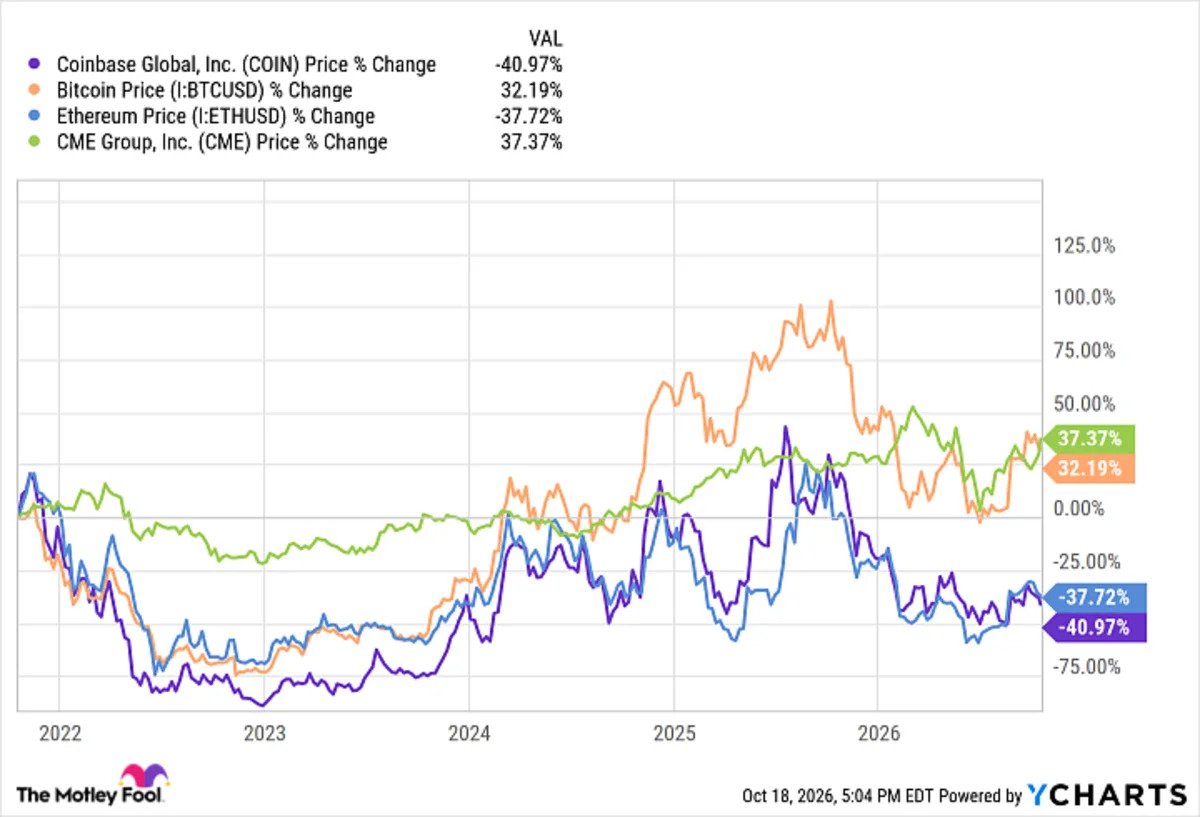
The battle for financial infrastructure is heating up as traditional exchanges and crypto platforms collide. Investors must choose between the steady stability of CME Group (NASDAQ:CME) and the high-growth volatility of Coinbase Global (NASDAQ:COIN).
CME Group operates the world’s largest derivatives marketplace, providing essential risk management tools for global institutions. Coinbase Global serves as the primary gateway for retail and institutional crypto trading. While both companies benefit from market volume, they operate in distinct regulatory environments, offering different profiles for growth and risk.
The case for CME
CME Group operates as a central hub for global derivatives trading, selling contracts that allow clients to manage price risks. Its marketplace covers major asset classes including interest rates, energy, and agricultural products. The company maintains exclusive license agreements with S&P Global (NYSE:SPGI) and Nasdaq (NASDAQ:NDAQ) for popular index products.
Strategic partnerships also drive its expansion into new technology and retail spaces. The exchange maintains a 10-year technology migration agreement with Alphabet (NASDAQ:GOOGL) (NASDAQ:GOOG) for its cloud infrastructure. Additionally, a joint venture with Flutter Entertainment (NYSE:FLUT) subsidiary FanDuel provides prediction markets for retail customers.
In its latest annual report, filed for fiscal 2025, revenue reached nearly $6.5 billion, up 6.4%. Net income was close to $4 billion, which resulted in a net margin of 62%. This high level of profitability demonstrates the scaling power of a global exchange platform as volumes increase.
As of CME’s December 2025 balance sheet, the debt-to-equity ratio is roughly 0.1. This ratio compares total debt to shareholder equity, indicating the company uses very little borrowed money. The current ratio is approximately 1.0, meaning it has enough short-term assets to cover its immediate obligations.
Free cash flow, which is cash from operations minus capital expenditures, was approximately $4.2 billion. Because stock-based compensation accounted for only 2.2% of operating cash flow, CME does not rely heavily on non-cash compensation. This strong cash generation supports its ability to pay dividends and reinvest in market technology.
The case for Coinbase Global
Coinbase Global provides a comprehensive platform for individuals and institutions to trade Bitcoin (CRYPTO:BTC) and other digital assets. The company generates revenue through transaction fees, subscription services, and its partnership with Circle (NYSE:CRCL) for stablecoin management. It also serves roughly 245,000 ecosystem partners across more than 100 countries.