Daniel Miller, The Motley Fool
5 min read
Investors might know General Motors (NYSE: GM) as an automotive giant hailing from Detroit, but the company could also be confused with a magic show with the way GM is making its shares disappear. General Motors has spent tens of billions on share repurchases that have significantly reduced its shares outstanding, in turn boosting earnings per share. Let’s take a look at just how much GM has repurchased in recent years, and why investors might want to pay attention to what happens next.
Disappearing act
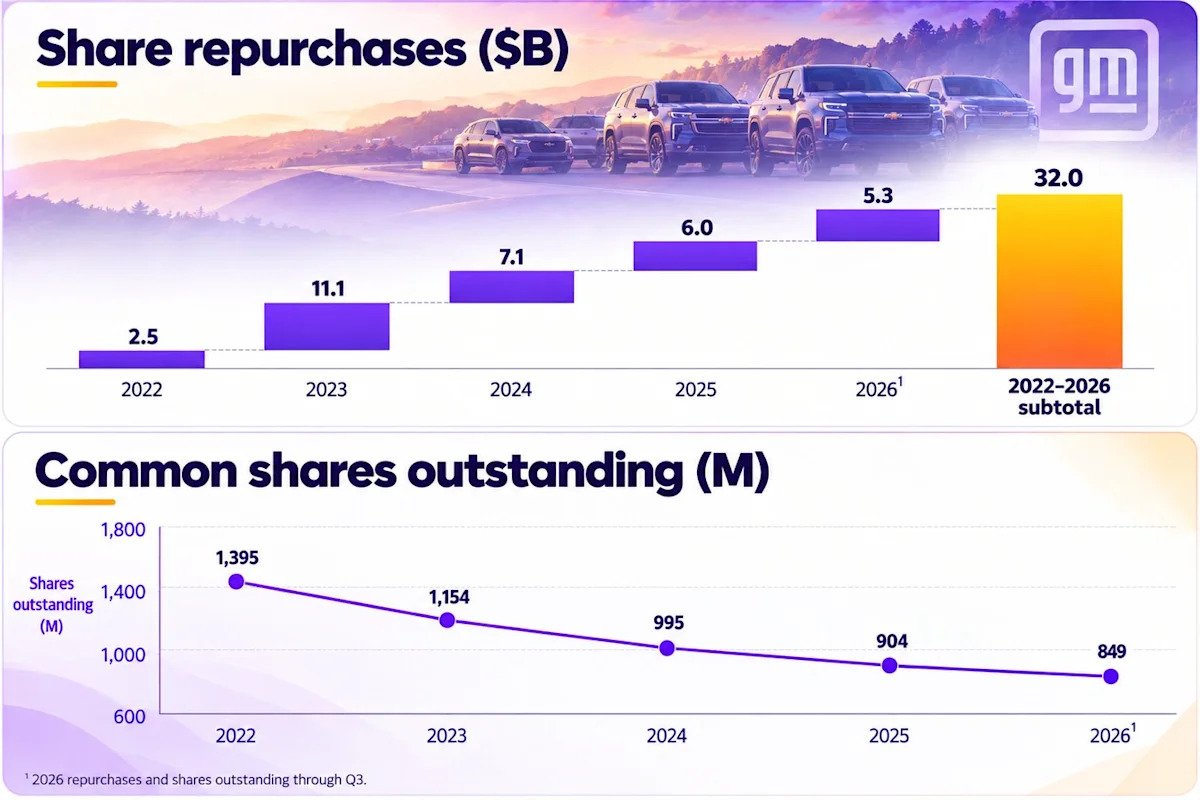
Below you can see just how impressive GM’s share-disappearing act has been, particularly since 2023.
Missed AI’s “Act 1”? Act 2 Could Be 14x Bigger. Most investors think they missed the AI boat because they didn’t buy Nvidia in 2005. But according to our analysts, we’re only at the end of “Act 1″—the R&D phase. “Act 2” is the global rollout. Continue »
If that graphic wasn’t compelling enough, consider this: Since the beginning of 2023, GM has reduced its shares outstanding from roughly 1.395 billion down to 849 million as of the third quarter — a near 40% reduction.
While share buybacks don’t guarantee a higher stock price, reducing the share count gives existing investors a larger ownership stake in the business and can help bolster earnings per share, potentially making the stock more attractive. It’s not a coincidence that since the beginning of 2023 GM’s stock price has soared almost 130%, which is even more meaningful when you compare it to rivals Ford Motor Company (NYSE: F) and Stellantis (NYSE: STLA).

For GM’s next trick
Investors tuning into General Motors’ third-quarter report may have been surprised at the size of the new multiyear $20 billion share repurchase authorization. Let’s take that a step further and do a very basic and simple exercise: Assume that General Motors’ earnings will remain flat and the $20 billion will be spent repurchasing shares at an average of $80 per share.
That has the potential to reduce its current 849 million shares outstanding down to a hypothetical 599 million shares. If you do the math, that 29.4% reduction in shares could, in this basic exercise, increase earnings per share by 41.7%. To be clear, this is hypothetical potential and not a forecast, as markets, financials, or other things could change, or GM could find better ways to invest its excess cash flow for higher returns.
To be fair, announcing a massive $20 billion share repurchase program is one thing, and generating the cash flow to execute it is another. The good news is that General Motors is practically printing money in large part thanks to lucrative and high-volume sales of its full-size trucks, as well as keeping incentives below the industry average. GM generated $5.9 billion in adjusted automotive free cash flow during the third quarter and ended the period with just over $23 billion in cash and cash equivalents. Further, management also raised its full-year 2026 adjusted automotive free cash flow guidance from a range of $9.5 billion-$11.5 billion to a range of $11.5 billion-$12.5 billion.