Robinhood Markets (NASDAQ: HOOD) operates an investing platform where its clients buy and sell stocks, options contracts, futures contracts, cryptocurrencies, and even event contracts in prediction markets. Its stock hit an all-time high of $152.46 last year, but it has since plummeted by 40% as investors worry about the sustainability of the company’s growth.
Buying and holding a diversified portfolio of at least 50 stocks is a surefire way to build wealth over the long term, but many of Robinhood’s clients are more focused on short-term trading, which often leads to steep losses.
Missed Nvidia in 2009? This Rare Signal Is Flashing Again. In 2009, a “Double Down” signal flashed for a little-known chipmaker called Nvidia. For the first time in years, that same “Total Conviction” signal is flashing for a company 1/100th the size of Nvidia. Continue »
In fact, the commissions Robinhood earned from options trading activity was three-times higher than the commissions it earned from stock investing during the third quarter (ended Sept. 30), and history suggests this will create a serious issue for its business in the near future. Here’s what could happen next.
The high-risk behavior of Robinhood’s clients isn’t sustainable
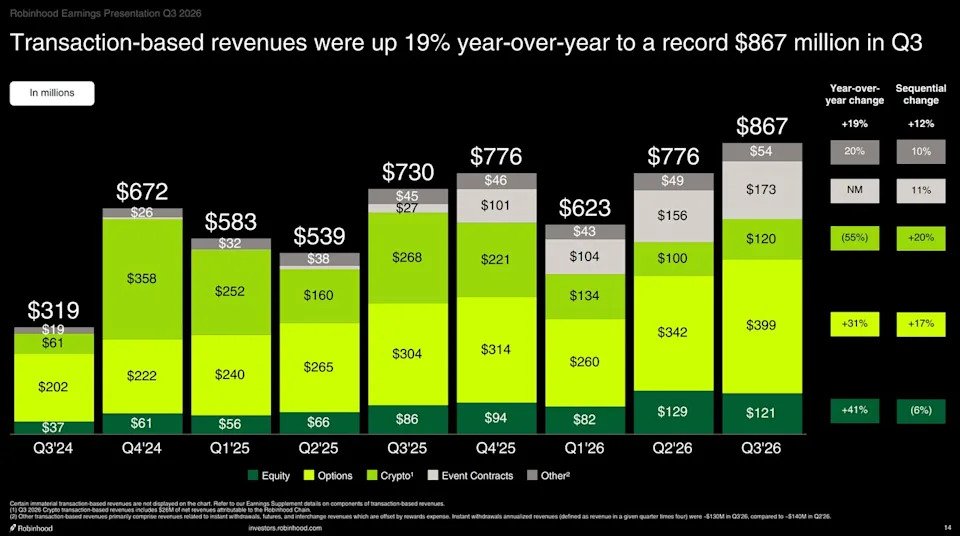
Robinhood generated $1.4 billion in revenue during the third quarter, a modest 12% increase from the year-ago period. Transaction-based revenue accounted for $867 million of that total, while net interest income contributed $415 million.
Transaction-based revenue is the money Robinhood generates from its core business, which involves processing trades on behalf of its clients. Options trading was the single largest contributor in the third quarter at $399 million, a 31% increase from the year-ago period. Cryptocurrency trading revenue, on the other hand, plummeted by 55% to $120 million, as steep corrections in most major coins and tokens kept investors sidelined.
Retail traders often use options to make short-term all-or-nothing bets on the direction of an index like the S&P 500, or an individual stock. This can be fruitful during a bull market because so many stocks are carrying significant upward momentum, but severe losses can ensue when things turn around. In fact, several studies have found that most retail investors lose money over time when trading these risky derivatives.
Robinhood has been here before. In the second quarter of 2021, which was near the peak of the last bull market, the bulk of the company’s transaction revenue came from the risky options and crypto markets. But just one year later in the second quarter of 2022, options revenue was down 31%, while crypto revenue suffered a 75% collapse. This led to a staggering 90% decline in Robinhood stock.