Food ingredient solutions provider Ingredion (NYSE:INGR) met Wall Street’s revenue expectations in Q3 2026, but revenue fell by 1.3% year on year to $1.79 billion. Its non-GAAP profit of $2.28 per share was 12.2% below analysts’ consensus estimates.
For more on Ingredion, read the full research report.
Ingredion (INGR) Q3 2026 highlights:
- Revenue $1.79 billion vs S&P analysts’ consensus estimates of $1.8 billion (1.3% year-on-year decline, in line)
- Adjusted EPS $2.28 vs S&P analysts’ consensus estimates of $2.60 (12.2% miss)
- Adjusted EPS guidance Management lowered its full-year adjusted EPS guidance to $9.48 at the midpoint, a 10.6% decrease
- Operating margin 11.2%, down from 13.7% in the same quarter last year
- Free cash flow margin 9.1%, similar to the same quarter last year
- Constant currency revenue fell 3% year on year (-4% in the same quarter last year)
- Market capitalization $6.14 billion
“For Texture & Healthful Solutions, net sales volume growth was a bright spot again this quarter. Volume grew for the tenth consecutive quarter, supported by continued strong demand for clean label globally as customers reformulate for simpler labels, affordability and nutrition. However, higher tapioca costs and manufacturing input cost inflation negatively impacted profit growth in the segment. In Food & Industrial Ingredients—LATAM, stronger volume from brewing and beverage customers in Mexico and Brazil was offset by foreign exchange impacts from a stronger Mexican peso and the impact to our Andean operations from the August earthquake in Colombia.”
Revenue growth
Examining a company’s long-term performance can provide clues about its quality. Even a bad business can perform well for one or two quarters, but a high-quality one grows for years.
With $7.19 billion in revenue over the past 12 months, Ingredion is one of the larger consumer staples companies and benefits from a well-known brand that influences purchasing decisions. However, its scale is a double-edged sword because there are only so many big store chains to sell into, making it harder to find incremental growth. To accelerate revenue growth, Ingredion likely needs to optimize its pricing or focus on new products and international expansion.
Ingredion struggled to generate demand over the last three years. Its revenue dropped by 4.4% annually.
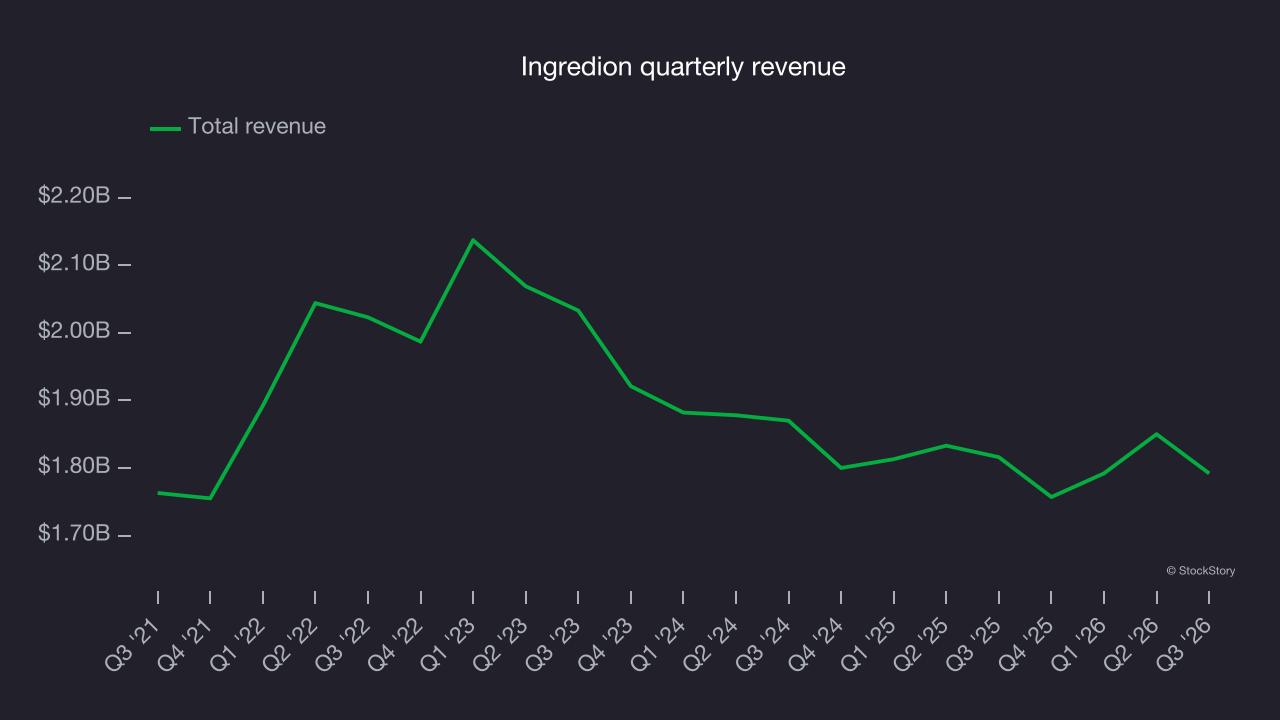
This quarter, Ingredion reported an uninspiring 1.3% year-on-year revenue decline to $1.79 billion, in line with Wall Street’s consensus estimates.
Looking ahead, sell-side analysts expect revenue to grow 1.4% over the next 12 months, according to S&P. Although this projection suggests its newer products will drive better revenue performance, it is still below the sector average.
Free cash flow
Free cash flow isn’t a prominently featured metric in company financials and earnings releases, but it’s telling because it accounts for all operating and capital expenses, making it difficult to manipulate.
Ingredion has shown decent cash profitability, giving it some flexibility to reinvest or return capital to investors. The company’s free cash flow margin averaged 6.2% over the last two years, slightly better than the broader consumer staples sector.
Ingredion’s free cash flow margin dropped by 2.8 percentage points over the last year. Continued declines could signal it is in the middle of an investment cycle.
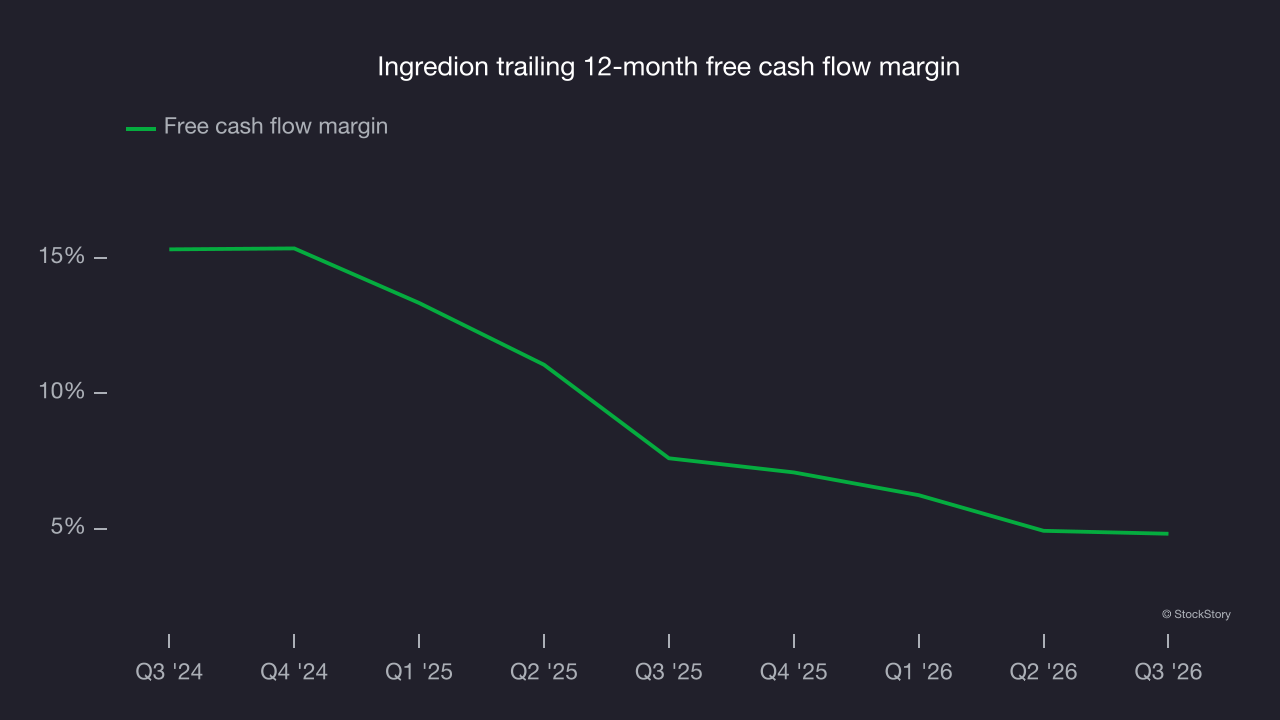
Ingredion’s free cash flow was $163 million in Q3, equivalent to a 9.1% margin. This cash profitability was in line with the comparable period last year and above its two-year average.
Key takeaways from Ingredion’s Q3 results
Ingredion’s Q3 results offered few positives: gross margin missed expectations and EPS fell short of Wall Street’s consensus estimates, making this a weaker quarter overall. Shares tumbled 7.5% to $90.19 immediately after the release.
Ingredion underperformed this quarter. When assessing the stock’s investment potential, the latest results matter, but not as much as longer-term business quality and valuation. Read the full research report here (it’s free).