The S&P 500 galloped higher over the past three calendar years, climbing 78%, and generally carried the momentum into 2026. Investors were excited about the development of artificial intelligence (AI) and rushed to get in on early winners in the field, from chip designers to cloud computing giants. These developers and sellers of AI had already started generating significant revenue growth amid the boom and predicted that much more would follow over the long run.
All of this sent AI stocks, as well as other growth players, soaring, and the weight of tech players in major indexes pushed the indexes higher too. On top of this, many other companies, often those benefiting from the use of AI, saw their shares advance too. Though certain headwinds such as geopolitical and economic uncertainties have weighed on the movement at some points this year, the overall direction has been positive.
As a result, the stock market is doing something witnessed only two times in 155 years. And history is crystal clear about what happens next.

Image source: Getty Images.
The potential of AI
So, first, let’s take a closer look at the path of the S&P 500 over the past few years and through today. As mentioned, investors have focused on the area of AI — and for good reason. AI has the potential to increase efficiency, lower costs, and even drive innovation. For example, AI may help pharma companies more quickly identify better drug candidates. All of this should boost corporate earnings, and as AI is applied more frequently and deeply to real-world problems, the gains could become significant.
Investors bought shares of companies directly involved in this revolution as well as those that may benefit down the road. Though the AI developers are in the tech industry, the users of AI might be in any industry — as I noted with the pharma example above.
Of course, the movement hasn’t been completely smooth. This year, in particular, some headwinds have emerged. One has been rising inflation, something that weighs on companies’ costs and the budgets of customers. The Federal Reserve recently raised interest rates in an attempt to tame inflation, and more hikes could be on the way. With the Consumer Price Index increasing more than expected in October, adding to the inflationary picture, the Fed may lift rates during its December meeting.
The AI infrastructure build-out
Investors also have worried about the pace and depth of spending on AI infrastructure. Leaders in the field, from Amazon to Alphabet, are investing hundreds of billions of dollars in the AI build-out to serve the demand that has already exceeded supply.
All of this has weighed on the market at times this year as some investors have become more cautious, though the S&P 500 continues to march higher. And this brings me to what the market has only done twice in 155 years of history.
The S&P 500 Shiller CAPE ratio has surpassed the level of 40, something it’s only done one other time: during the dot-com bubble.
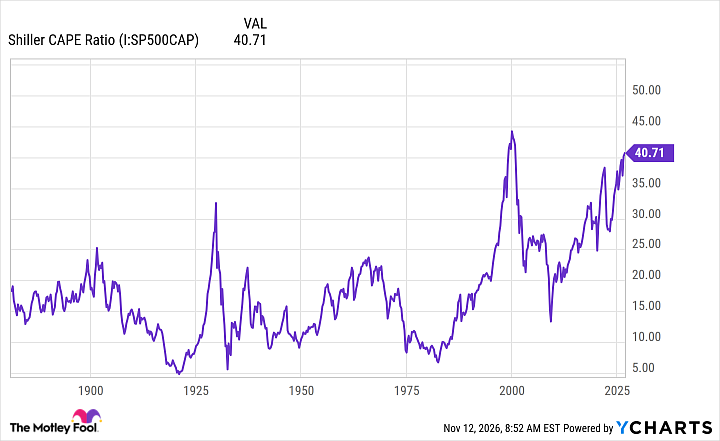
Shiller CAPE Ratio data by YCharts
This level indicates stocks are historically expensive. The Shiller CAPE ratio offers us a clear picture of valuation as it compares price with earnings per share over a decade, and this means it accounts for shifts in the economy.
So, we know that stocks are expensive. But what happens next? History is crystal clear. The S&P 500 has done the same thing every time valuation reaches a peak: It’s dropped.
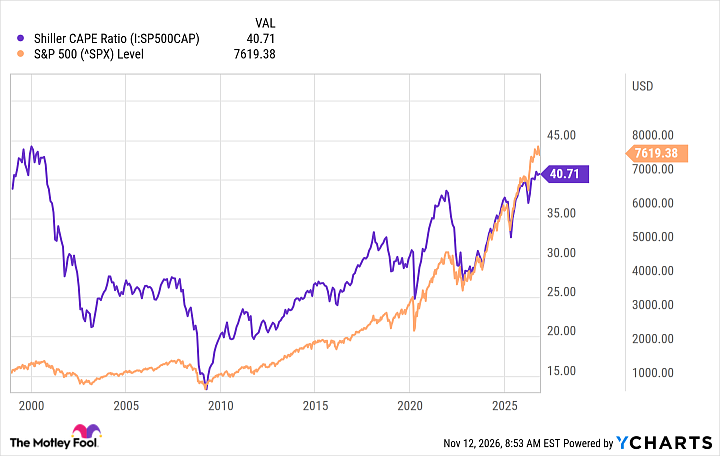
Shiller CAPE Ratio data by YCharts
All of this means that today, with stocks trading at a high and uncertainty circulating, the S&P 500 could be heading for a decline.
Now here’s some good news for investors. The S&P 500 and quality stocks have always recovered following tough times, meaning that if you hold onto positions you believe in, you’re likely to win over the long term.
Where to invest $1,000 right now
When our analyst team has a stock tip, it can pay to listen. After all, Stock Advisor’s total average return is 823%* — a market-crushing outperformance compared to 209% for the S&P 500.
They just revealed what they believe are the 10 best stocks for investors to buy right now, available when you join Stock Advisor.
*Stock Advisor returns as of November 16, 2026.