
The S&P 500 (SNPINDEX:^GSPC) fell 4.4% on Nov. 5, its worst day since April 2025. It was another reminder of how quickly stocks can tumble.
However, when stocks fall, not all tumble as much. Research from Hartford Funds, using Ned Davis Research data, shows that since 1973 the stocks that held up better in big declines have been dividend payers. In market drawdowns of 10% or more, dividend-paying stocks fell 14.4%, versus 28.2% for non-dividend-paying stocks. That’s about half as much.
Missed Nvidia in 2009? This Rare Signal Is Flashing Again. In 2009, a “Double Down” signal flashed for a little-known chipmaker called Nvidia. For the first time in years, that same “Total Conviction” signal is flashing for a company 1/100th the size of Nvidia. Continue »
Here is what to look for in a dividend stock to help cushion the blow of a future stock market slump.

Image source: Getty Images.
What the data shows
Hartford Fund’s analysis covers every S&P 500 drawdown of 10% or more from 1973 through 2025. In those periods, dividend-paying stocks fell an average of 14.4%. The equal-weighted S&P 500, a good proxy for the average stock, fell 19%. Meanwhile, stocks that didn’t pay dividends tumbled 28.2%.
In other words, dividend payers lost about half as much as non-payers during a stock market correction. While they still lost money, they helped preserve more wealth during a market downdraft.
Why dividend payers hold up better
Hartford suggested two reasons why dividend stocks tend to hold up much better than non-payers during a market downturn. Many dividend stocks tend to be concentrated in industries less sensitive to the economic cycle. For example, most consumer staples and utility stocks pay dividends because companies in these industries generate stable cash flow due to resilient demand.
Additionally, a company typically needs to have a track record of profitability and relatively predictable cash flow before it initiates a dividend. That business maturity would also make a company’s stock price less volatile.
One type of dividend stock stands out
While dividend payers have historically delivered higher total returns with less volatility than non-payers, one group of dividend stocks stood out from the pack:
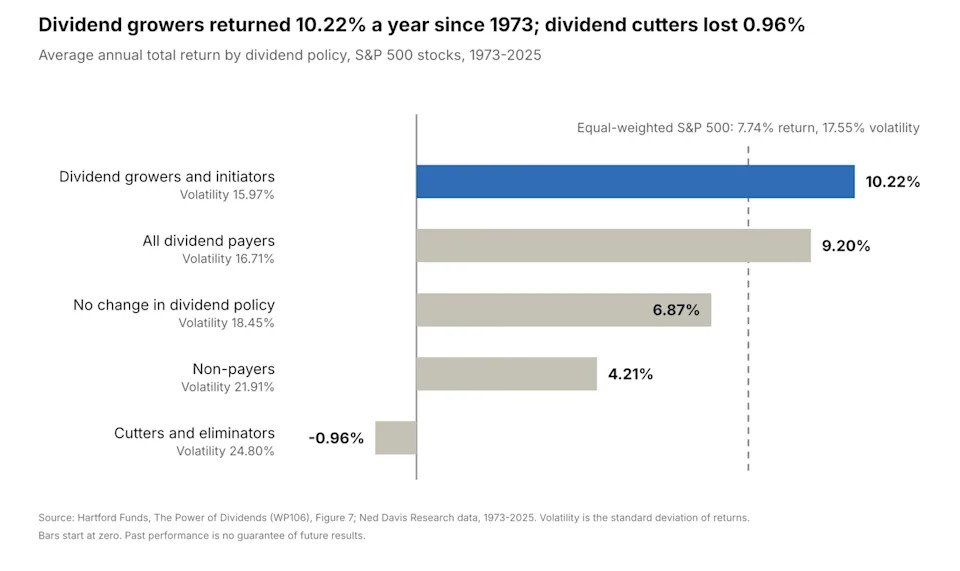
Image source: The author.
Companies that grew their dividends outperformed the average dividend stock and had lower volatility. Companies that cut or eliminated theirs lost money on average, with the most volatility of any group.
Hartford also found that the highest yields haven’t been the best bet. Since 1930, stocks with the highest payout ratios (which typically have the highest yields) outperformed the market about half the time, similar to companies with much lower payout ratios. However, the sweet spot was companies with an average dividend payout ratio of 49%. These companies prioritized dividend payments while maintaining plenty of flexibility to continue growing their dividends even during more challenging times.