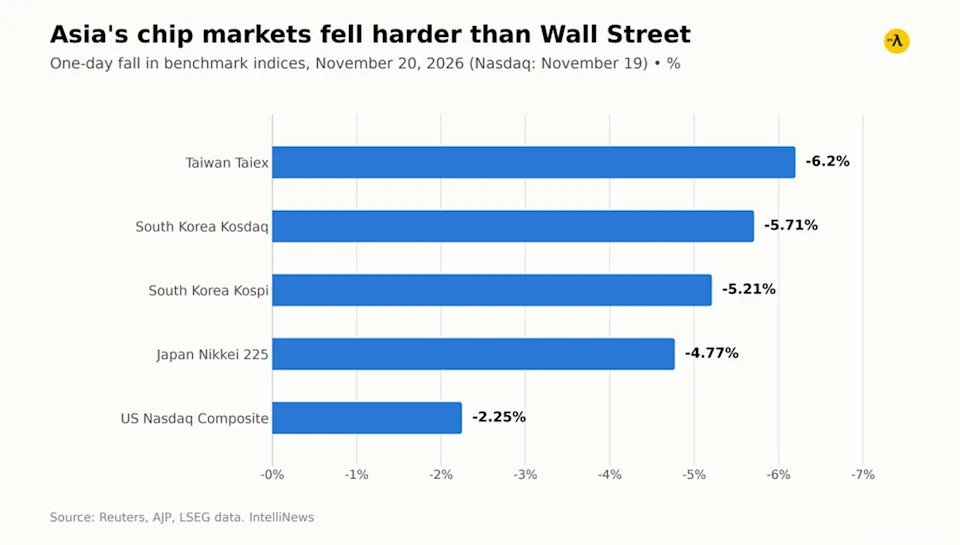
Taiwan’s stock market lost 17.5% in the week to November 20, its worst five days since 1990, as investors dumped AI-linked chip shares across emerging Asia, Reuters reported.
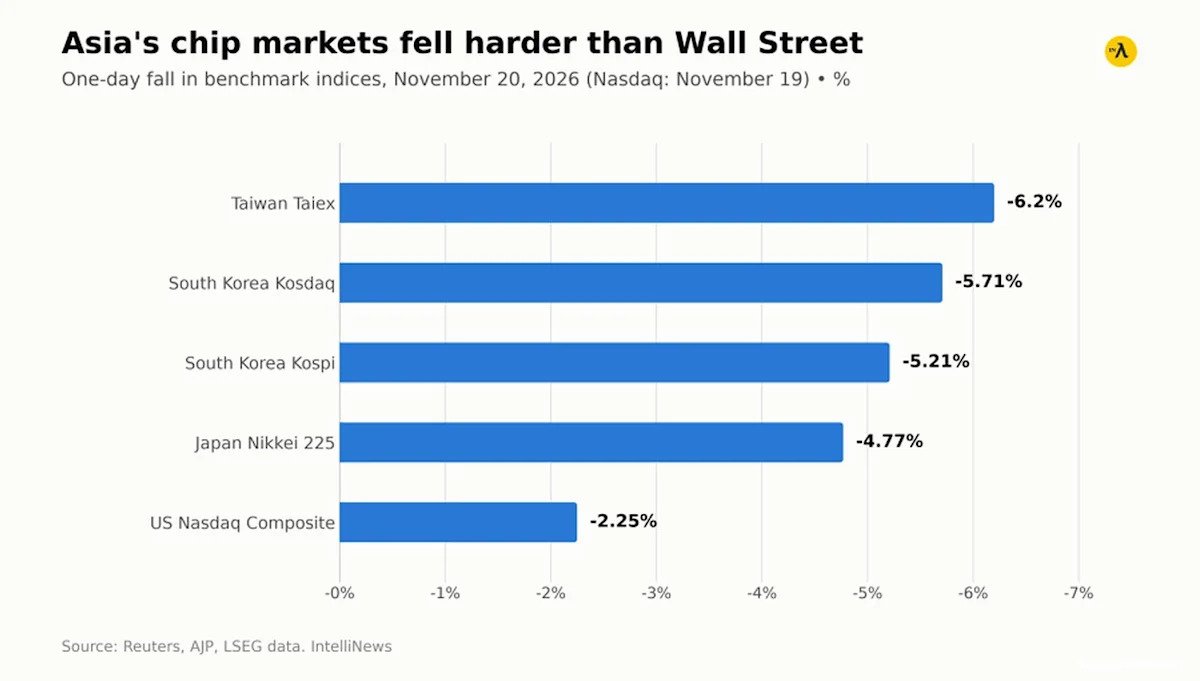
The benchmark Taiex fell 6.2% on the final day of the week to its lowest close since mid-April. It has shed $1.12 trillion in value, or nearly 28%, since it set an all-time high on October 6, according to LSEG data cited by Reuters. MSCI’s emerging-market Asia index lost nearly 9% over the week, heading for its worst week since mid-March 2020.
The AI boom made Taiwan and South Korea the stars of emerging-market equities this year, and both markets are built on a handful of chipmakers: TSMC in Taipei, Samsung Electronics and SK hynix in Seoul. Foreign funds bought heavily on the way up. Now they are selling, and because the money is leaving the country as well as the stock, the equity rout is turning into pressure on currencies from Seoul to Jakarta.
South Korea’s Kospi fell 5.21% on November 20 to 4,869.96, closing below 4,900 for the first time in 10 months, AJP reported. The index is down 48.1% from its intraday peak of 9,385.59 on June 19, and its gain for the year has shrunk to under 20% from 116.3% in late June. Samsung Electronics dropped 7.01% to KRW183,100 ($137) and SK hynix 5.92%.
Foreign investors sold a net KRW1.132 trillion ($845mn) of Kospi shares that day and institutions a further KRW951.3bn ($710mn), while retail investors bought a net KRW1.595 trillion ($1.19bn). The selling triggered five-minute halts on programme sell orders on both the Kospi and the junior Kosdaq, which fell 5.71%.
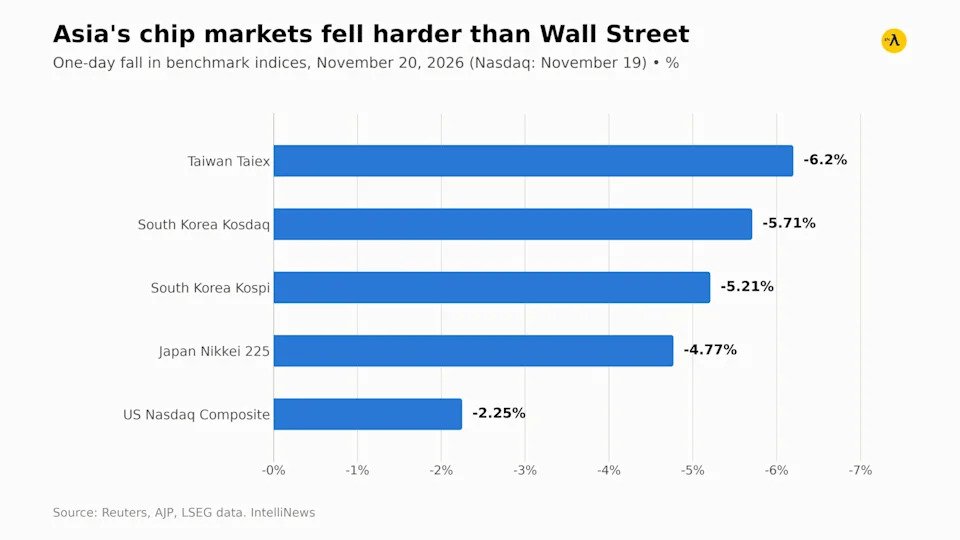
Source: Reuters, AJP, LSEG data. IntelliNews
The trade has been hit by worries over valuations, the debt raised to build data centres, local opposition to new ones and the fallout from Jensen Huang’s departure from Nvidia, according to Reuters. A Hunterbrook Media report that newer AMD firmware had turned up in servers made by IEIT Systems, a Chinese company on a US trade blacklist, knocked 7.72% off AMD on November 19; the report did not establish any breach of US export law and AMD said it complies with export controls. Even Anthropic’s stock market debut that day failed to lift the mood: the shares opened at $111.50 against an $83 offer price and closed at $97.17. The same worries about AI debt had already knocked 8% off the Kospi in a single session on October 15.
In Taiwan the outflow has been building for weeks. Foreign institutions pulled about $10bn from the island in the first 10 days of November after net withdrawals of roughly $28bn in October, and their net share sales over eight sessions to November 9 came close to TWD800bn ($24.3bn). Central bank Governor Yang Chin-long has blamed foreign profit-taking for the Taiwan dollar’s 3% slide this year, and the bank stepped in when the US dollar briefly traded above 33 Taiwan dollars earlier this month. The Financial Supervisory Commission restricted short selling on November 19 after the Taiex fell 4.4% in a day. The currency closed at 32.936 to the dollar on November 20, Focus Taiwan reported.