Stocks are plunging, but history says the right strategy can protect your portfolio.
By Katie Brockman –
Key Points
-
The S&P 500, Nasdaq, and Dow all entered correction territory last week after a brutal tech sell-off.
-
It’s unclear right now whether the market is headed toward a deeper drawdown.
-
The safest strategy during volatile periods is simpler than many investors may expect.
It’s been a tumultuous week for stocks. After many months of gains, the S&P 500 (^GSPC +4.73%), Dow Jones Industrial Average (^DJI +3.01%), and Nasdaq Composite (^IXIC +6.51%) have all entered correction territory after falling more than 10% from their recent peaks.
It’s a tough time to be an investor, and if you’re feeling unnerved by all this volatility, you’re not alone. The Fear and Greed Index, which measures investor sentiment on a scale from 0 to 100, currently sits at just 10 – firmly in the “extreme fear” category. The VIX Volatility Index (^VIX -25.83%) also reached its highest point since March 2025, signaling that investors expect more turbulence.
The promising news is that the market is no stranger to volatility, and history shows that one strategy stands above the rest when it comes to protecting your portfolio.

Image source: Getty Images.
This downturn could be short-lived
If history proves just one thing, it’s that the best move investors can make is to stay in the market. That may sound counterintuitive as stock prices plunge. However, the market’s short-term performance is unpredictable, and patient investors always win out.
The last several years have seen multiple instances of prices sinking only to rebound almost immediately. In March 2020, for example, the S&P 500 experienced its fastest crash in history after losing roughly one-third of its value in a matter of weeks. A few months later, it was reaching record highs.
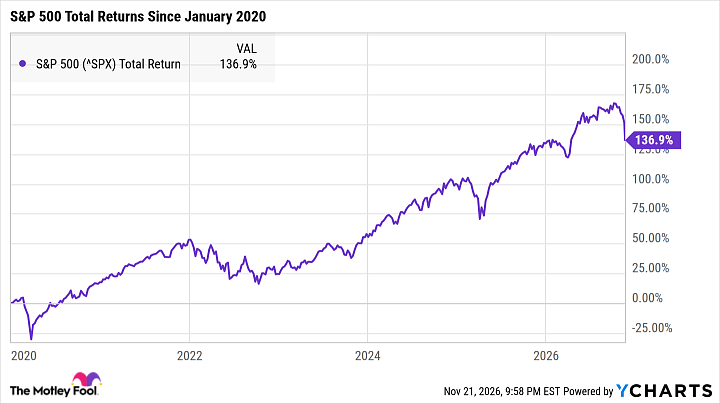
Similar volatility occurred in April 2025 and March 2026, due to the “Liberation Day” tariffs and the beginning of the Iran war, respectively. In all three of these instances, many investors feared the worst and sold in a panic, only for prices to quickly bounce back.
Typically, the worst move investors can make is to sell after prices have already plunged. For one, that risks locking in losses by selling stocks for less than you paid for them. But also, if stocks immediately rebound, you may be forced to pay higher prices to reinvest in the stocks you just sold.
The market’s long-term future is always bright
No two downturns are identical, so it’s impossible to say whether the market will rebound just as quickly this time around. Volatility in the tech sector is the primary driver of this recent sell-off, and with persistent concerns about an AI bubble, there’s always a chance stocks could continue to fall.
Even if that is the case – which, at this point, is still a big “if” – history still has good news for investors. The average bear market lasts around 340 days, according to analysis from Yardeni Research, and healthy stocks have always managed to come out the other side stronger than ever.
The last two decades have seen particularly brutal recessions, too. The dot-com bubble burst made history as the longest bear market on record, lasting 2.5 years, and the 2008 financial crisis was the most severe economic downturn since the Great Depression.
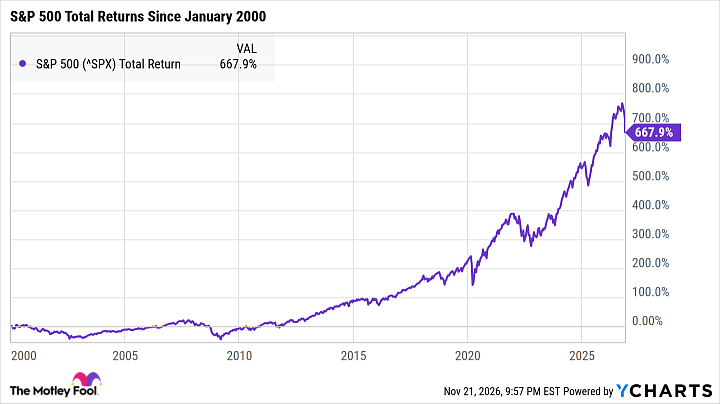
Yet since January 2000, the S&P 500 has earned total returns of close to 700%. In other words, if you’d invested $10,000 in an S&P 500 ETF or index fund immediately before two of the worst recessions in history, you’d have nearly $77,000 by today.
Since 1929, the S&P 500 has experienced 22 bear markets. That’s roughly one bear market every four years, on average. Even if yet another historic downturn is coming, the market has proven time and again that it will bounce back – likely within a year or two.
The investors best positioned to reap the greatest rewards are those who avoid the temptation to sell at the first sign of trouble and instead use this opportunity to load up on quality stocks at discounted prices.
Where to invest $1,000 right now
When our analyst team has a stock tip, it can pay to listen. After all, Stock Advisor’s total average return is 719%* — a market-crushing outperformance compared to 192% for the S&P 500.
They just revealed what they believe are the 10 best stocks for investors to buy right now, available when you join Stock Advisor.
*Stock Advisor returns as of November 24, 2026.