Chip concentration, foreign selling amplify losses as investors question earnings sustainability
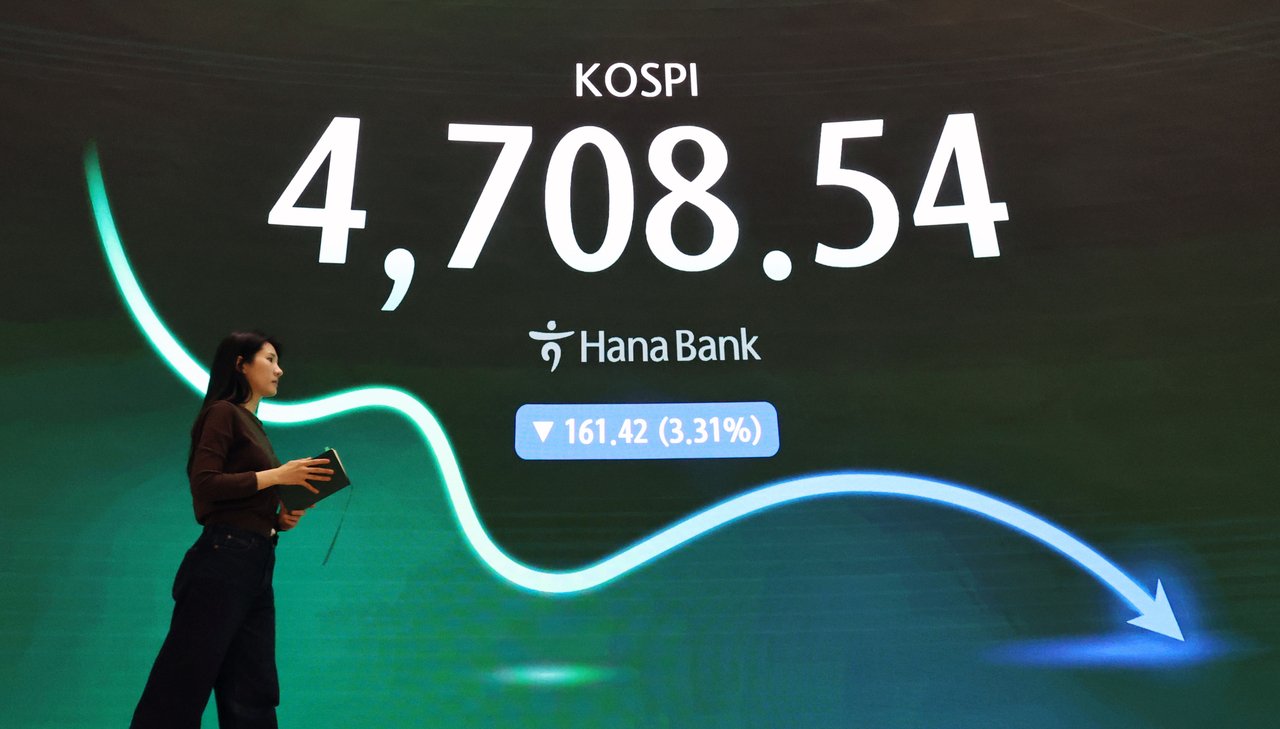
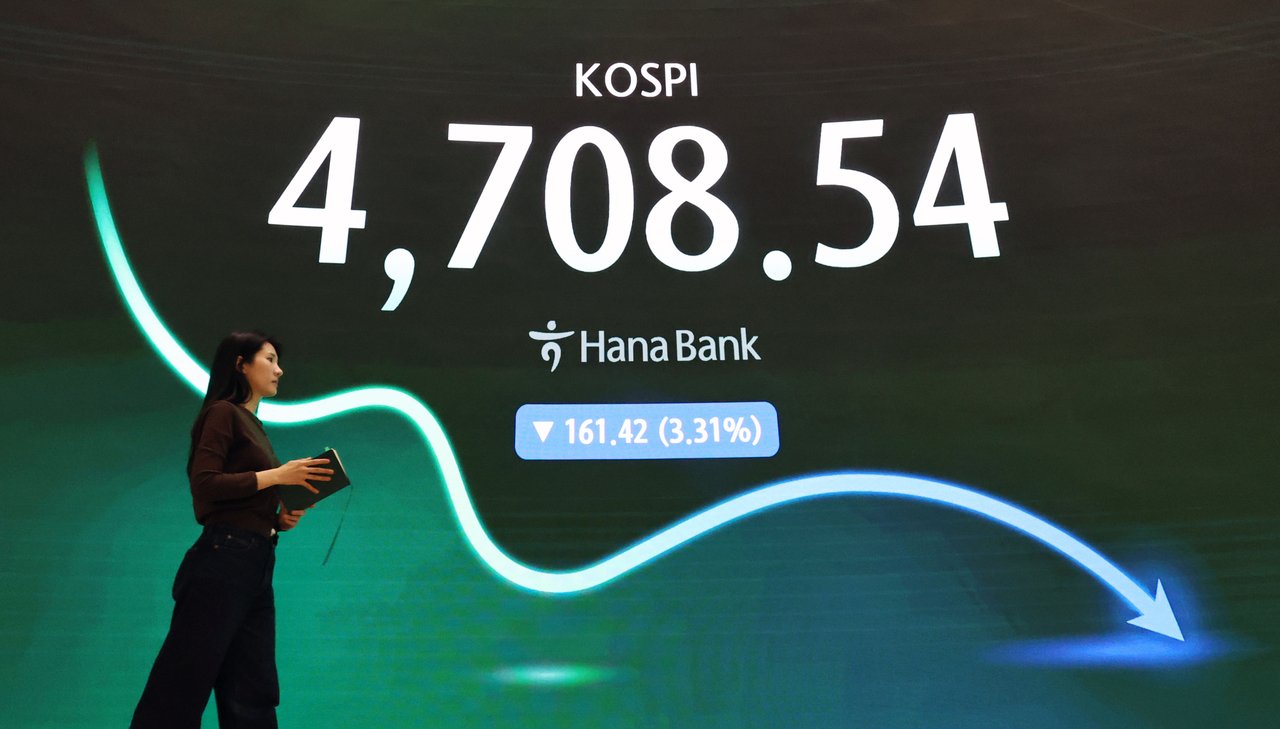
South Korea’s stock market has lost nearly half its value in five months, as doubts about returns on artificial intelligence investment expose the risks of its heavy reliance on semiconductor stocks.
The Kospi, which closed at a record 9,114.55 points on June 22, fell to an intraday low of 4,586.80 on Monday. It rebounded 6.32 percent Tuesday to reclaim the 5,000 mark after Nvidia CEO Jensen Huang’s return, then slid back into the 4,700 range Wednesday morning.
The decline has come in three waves. Concerns about AI profitability and rising interest rates triggered a sell-off between late June and July. Fresh doubts about AI companies’ revenue growth drove another round of selling in October. That was followed by regulatory uncertainty, credit risks and turmoil surrounding Nvidia’s leadership that deepened losses in November.
“The recurring issue was the sustainability of AI investment, with semiconductor concentration and foreign selling amplifying the declines,” said Lee Kyoung-min, head of research at Daishin Securities.
The financing behind the AI expansion has also come under scrutiny. Nvidia has invested in customers and guaranteed some of their financing, raising questions about how they would fund further growth if its support waned. CoreWeave, an Nvidia-backed AI cloud provider, saw its bond yields exceed 15 percent in October as investors grew wary of its debt-funded data center expansion.
For Korean chipmakers, a slowdown in AI infrastructure spending could threaten the earnings growth built into forecasts.
Korea’s concentration risk
The AI sell-off has hit markets globally, but Korea’s losses stand out. As of Friday, the Kospi had fallen about 47 percent from its peak, compared with 18 percent for the Nasdaq and 12 percent for the S&P 500.
Samsung Electronics and SK hynix, the two stocks that powered Korea’s first-half rally, accounted for nearly half the Kospi’s market capitalization as of Friday. That was down from a peak of 59 percent, but still roughly double their combined share in June last year. Industry estimates put their share of the Kospi’s market capitalization decline from its peak at nearly 70 percent.
Their weight leaves investors with fewer places to shelter within the market. As stocks across the AI supply chain move more closely together, weakness in the two chipmakers reverberates more widely.
Foreign selling has compounded the losses. Overseas investors have sold more than 220 trillion won ($164 billion) in Kospi-listed shares this year. Profit-taking and portfolio rebalancing drove much of the initial selling, according to Mirae Asset Securities strategist Yoo Myoung-gan. More recently, high volatility has kept foreign investors withdrawing despite historically low valuations.
The VKOSPI volatility index averaged 59 this year through early November, nearly triple its average over the previous two decades. The average correlation between Kospi 200 constituent stock returns rose from a historical level of 0.2 to 0.67 in October, reducing the benefits of diversification.
“The rise in stock price correlation and concentration in Korea’s market contributed significantly,” Yoo said.
Daishin’s Lee said thinner trading has made the market more sensitive to foreign selling, even as the pace of those sales has eased. “With trading so thin and little buying support at home, even a few hundred billion won in foreign selling can now push the market down.”
Diverging prices and earnings
The downturn stands in stark contrast to improving corporate earnings expectations. From its June peak through Friday, the Kospi lost nearly 47 percent, while its 12-month forward earnings per share rose 35.7 percent. Its forward price-to-earnings ratio fell to just over three, roughly half its trough during the 2008 global financial crisis.
The gap reflects doubts about whether chipmakers can sustain those projected profits beyond the current boom. “During an upcycle, chipmakers cannot prove they will keep earning well when the cycle slows,” Lee said.
The damage has spread beyond chips, with 81 percent of Kospi 200 constituents down at least 40 percent from their respective highs, according to Hana Securities.
Low valuations suggest investors expect earnings to weaken, even as forecasts keep rising, analysts say, with doubts over chip profits leaving the market vulnerable to further swings.
“With volatility in the two companies’ shares likely to dictate volatility across the Kospi, the market’s volatility index is unlikely to fall quickly,” said Lee Jae-man, a strategist at Hana Securities. “A rebound from such steep losses will require a catalyst.”
jwc@heraldcorp.com