Are many investors making things more difficult on themselves than they need to? The data says it’s certainly a possibility. There’s an easier, simpler way to make good money than saving up cash and then investing it when it looks like the right opportunity has surfaced. It’s called dollar-cost averaging, and surprisingly enough, it works best with something as simple as an index fund meant to mirror the performance of the S&P 500 (SNPINDEX:^GSPC).
But what is it? In simplest terms, dollar-cost averaging is a recurring investment of a specific dollar amount in a particular investment. Regardless of the market environment at any given time, you keep plugging away, committing just as much capital to the effort in good times and bad.
Missed AI’s “Act 1”? Act 2 Could Be 16x Bigger. Most investors think they missed the AI boat because they didn’t buy Nvidia in 2005. But according to our analysts, we’re only at the end of “Act 1″—the R&D phase. “Act 2” is the global rollout. Continue »
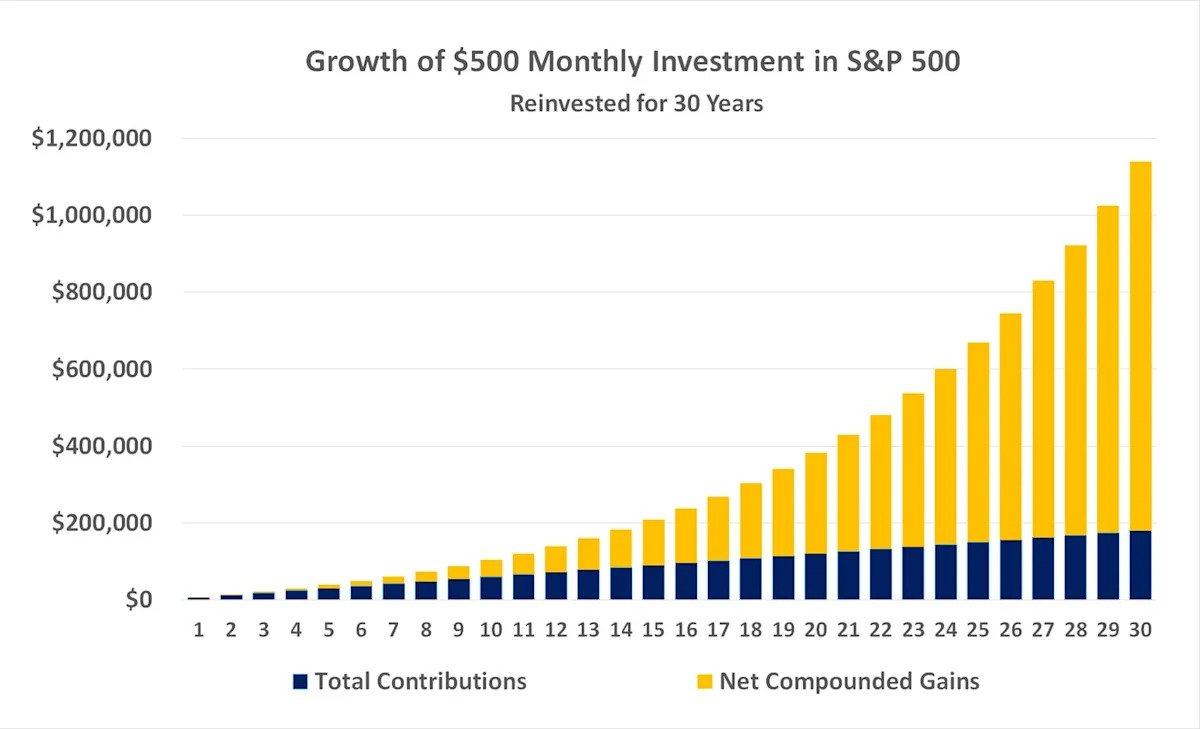
The thing is, given enough time, this hands-off approach works! As the graphic below illustrates, despite the slow start, assuming the S&P 500 continues to produce average annual net gains of 10%, after 30 years a steady monthly investment of $500 in an index-based instrument like the SPDR S&P 500 ETF Trust (NYSEMKT:SPY) or the Vanguard S&P 500 ETF (NYSEMKT:VOO) will be worth just over $1.1 million.
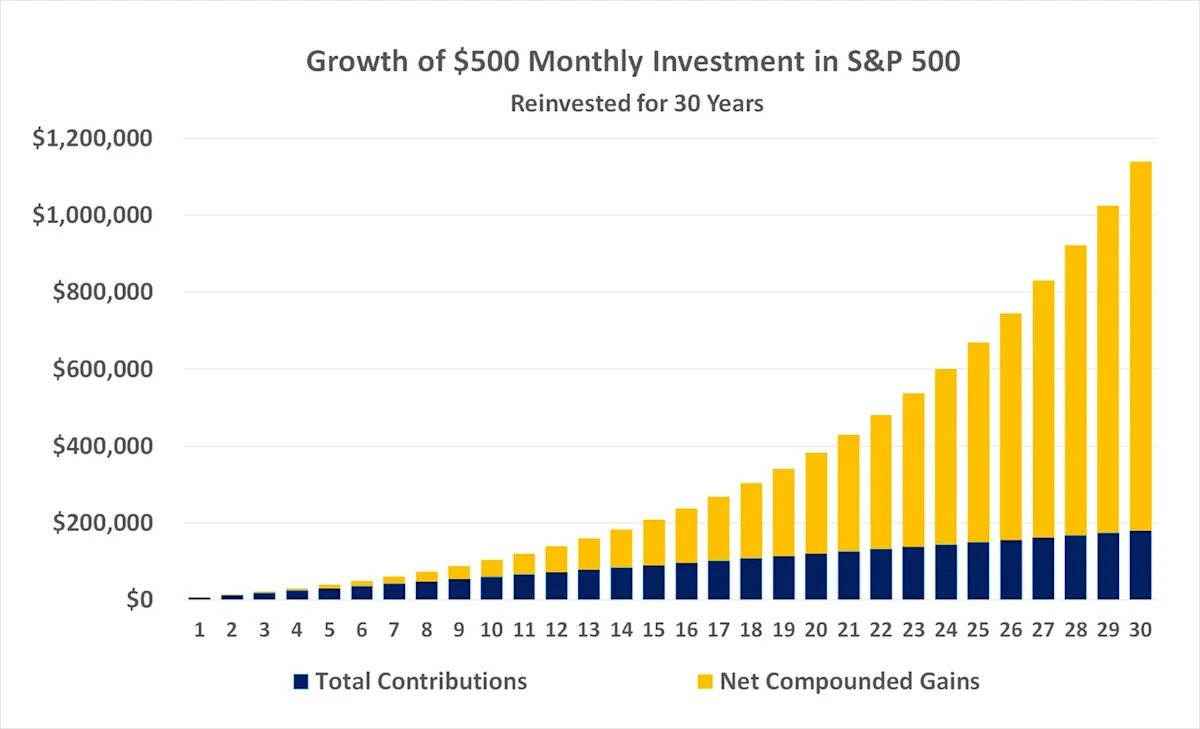
Image source: Chart by author. Data source: Calculator.net.
There’s one thing to know about the hypothetical dollar cost-averaged investment illustrated above. That is, while the math is right, the smooth, predictable pace of this portfolio’s growth isn’t realistic. Your results should end up in about the same place, but because the market ebbs and flows every year, you won’t get there in a straight line. Your portfolio will ebb and flow, too. Just remain patient.
Nevertheless, the approach couldn’t be much easier. The only effort required on your end is giving your bank and broker the instructions needed to make this recurring deposit and this recurring monthly investment. Once that’s done, you won’t need to do anything other than let time do the bulk of the heavy lifting.
The added bonus? This approach actually circumvents much of the trading temptation that often does more harm than good.
Should you buy stock in S&P 500 Index right now?
Before you buy stock in S&P 500 Index, consider this:
The Motley Fool Stock Advisor analyst team just identified what they believe are the 10 best stocks for investors to buy now… and S&P 500 Index wasn’t one of them. The 10 stocks that made the cut could produce monster returns in the coming years.