Analysis of S&P 500 historical returns shows: the stock market often delivers above-average returns right after its biggest declines.
By Ben Gran –
Key Points
-
Capital Group research found that the S&P 500 delivered more than 18% average annualized returns in the five years immediately following the market’s biggest declines.
-
Based on the rule of 72, this 18% rate of return implies a doubling in four years — your money could double if you invest right after a bear market.
-
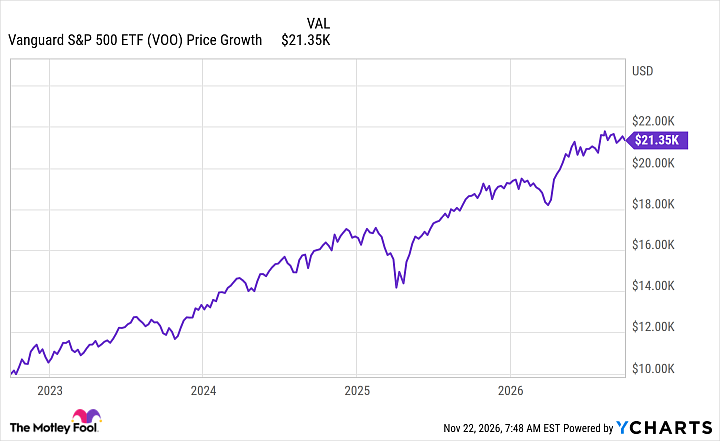
The Vanguard S&P 500 ETF (VOO) delivered 20.22% annualized returns in the four years since the lowest month of the last bear market in 2022.
It’s a natural human emotion to feel nervous, worried, or afraid when the S&P 500 index (^GSPC +1.60%) goes through a correction, as it did in November. When stock prices are going down, you might feel like you’re losing money and falling behind on your long-term goals. You might worry that the economy will suffer for years to come and that the stock market will never return to its former high levels.
But investors need to set aside those negative feelings and instead hold on to a cautiously optimistic vision of the future grounded in facts. The stock market has always bounced back from big downturns throughout history. Stocks can crash. The market can go sideways with slow growth for years in a row. But most of the time, within a few years, the S&P 500 recovers rapidly with impressive annual returns.
Here’s a powerful lesson from historical S&P 500 returns that demonstrates just how fast your money can grow after a bad stock market crash. Let’s see why this fundamental math from stock market history can help you navigate an S&P 500 correction.

Image source: Getty Images.
History shows: The S&P 500 can double in four years after a big decline
Researchers at Capital Group examined historical S&P 500 returns to see what happened to the stock market in the aftermath of the 18 largest stock market declines since the Great Depression. They found that the stock market returns after a big crash were exceptionally strong. According to their analysis, the S&P 500 has delivered average annual returns of more than 18% in the next five years following those 18 biggest declines.
An 18% average annual return is impressive — much better than the S&P 500 long-term average annual return of 9.98%. This means that right after a big stock market decline might be a better time than average to buy stocks. You might be likely to get bigger returns by buying stocks when prices are lower.
Today’s Change
Index Level
7,297.49
If your money can grow at 18% per year, that means your money can double fast. According to the rule of 72, if you take the number 72 divided by an investment’s annual rate of growth, you get the number of years that it takes for that investment to double in size.
So, if we take 72 divided by 18, we get 4: four years for an amount of money invested to double at 18% growth. That means the S&P 500 has, on average, doubled in value within the first four years after the 18 biggest stock market declines.
How fast the S&P 500 recovered from the 2022 bear market
You don’t have to look too far back in history to see how fast the stock market can recover from a bear market. In 2022, the S&P 500 dropped by more than 19%. But if you had invested at the lowest monthly level of that bear market in September 2022, your money would be worth a lot more today.
According to calculations from OfDollarsandData, between September 2022 and October 2026, the S&P 500 delivered an annualized total return of 20.22% (including reinvested dividends). It’s not quite the same five-year window to compare, but it’s an even better annualized rate of return than the 18% the S&P 500 delivered after the 18 biggest declines analyzed by Capital Group.
For example, $10,000 invested in the Vanguard S&P 500 ETF (VOO +1.66%) at the end of September 2022 would be worth more than $21,000 four years later. If you had invested near the lowest point of the most recent bear market, your money would have more than doubled in four years.
How to invest for this S&P 500 correction
There’s no guarantee of quick results or any future returns in the stock market. We don’t know whether the past month’s correction in the S&P 500 will keep going or hit a bottom soon. We could be on the verge of a new long bear market in tech stocks, as after the dot-com bust in 2000, or we could see a quick “V-shaped” recovery, as in 2020 during the COVID pandemic.
But buying low-cost index funds like the Vanguard S&P 500 ETF is often a good choice if you’re a patient investor in it for the long haul. The S&P 500 tends to recover from short-term losses and deliver strong gains in the long run.
There’s reason to be hopeful even while stock prices might be plummeting today. Looking at stock market history can help investors have confidence in the future.
Where to invest $1,000 right now
When our analyst team has a stock tip, it can pay to listen. After all, Stock Advisor’s total average return is 777%* — a market-crushing outperformance compared to 199% for the S&P 500.
They just revealed what they believe are the 10 best stocks for investors to buy right now, available when you join Stock Advisor.
*Stock Advisor returns as of November 28, 2026.