I. Star Wars: Martians Versus Venutians
We still think the post-midterm correction in the stock market (which we first anticipated on September 15) is a buying opportunity, like the one after the 2018 midterm election. If the correction turns into a bear market, it should be relatively short and shallow, like the 2022 version, which was also a buying opportunity. In both cases, recession fears proved to be misguided.
We lowered our year-end 2026 S&P 500 target from 8,400 to 7,900 on September 15, when we advised readers to proceed with caution until after the midterms. We cut it again on Saturday, November 21, to 7,500. Two days later, on Monday, the market rebounded on news that Jensen Huang was reinstated as Nvidia’s CEO. That evening, we concluded that “the S&P 500 may have bottomed on Friday at 6,910.39. Yet another V-shaped rebound is also possible.” However, we stuck with our new 7,500 year-end target because we weren’t, and aren’t, convinced that his return would end the AI Panic Attack. In any event, we concluded that the bull market that started on October 12, 2022, is intact, and we reiterated our 10,000 S&P 500 target for the end of 2029.
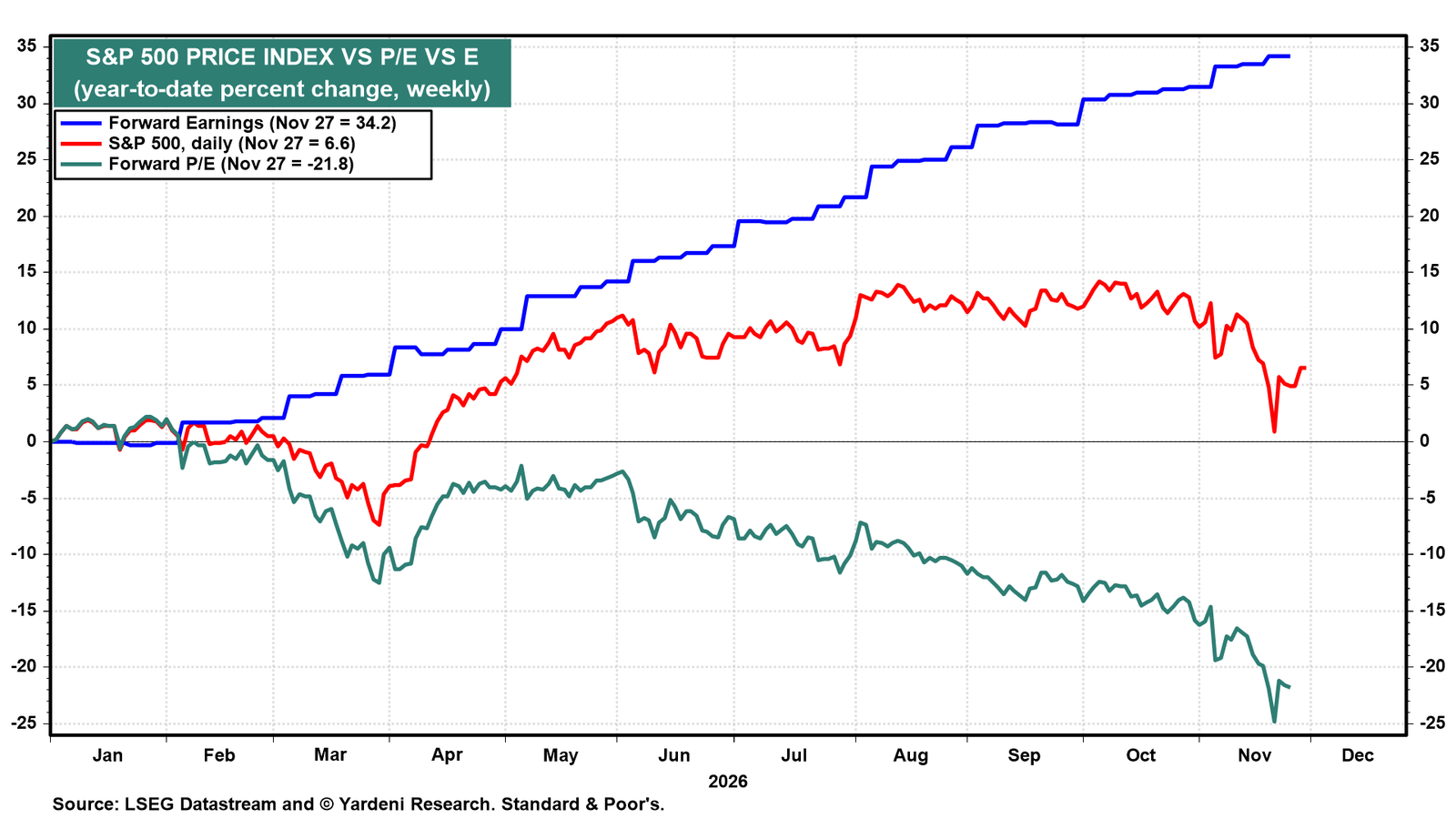
The stock market is in the middle of a tug-of-war between investors and industry analysts. Usually, valuation multiples run relatively higher during economic booms, when corporate earnings climb to new highs. This time has been different.
The S&P 500’s forward P/E has plunged this year even as its forward earnings have soared (chart). In the past, it declined during stock market corrections and bear markets, which tend to occur when a recession seems increasingly likely or is underway. Industry analysts are usually late to recognize recessions. As a result, when the downturns happen, the forward P/E, which is determined by investors, tends to anticipate them before earnings expectations, determined by industry analysts, start getting cut.
Investors are from Mars, while analysts are from Venus. We are betting on the Martians.
II. Performance
Since the start of the current bull market in the S&P 500, the index has had five significant V-shaped pullbacks, including the current one so far (chart). The S&P 500 equal-weight index hasn’t corrected so far, confirming our view that the economy’s strength is broad-based, not just concentrated in the AI buildout.