
Omor Ibne Ehsan
6 min read
Quick Read
-
Walmart (WMT) trades at 51 times trailing earnings versus a 32 median, and every valuation measure sits near its thirteen-year highs.
-
Costco (COST) and Walmart have drawn heavy investor inflows, but Daren Fonda says “the retailers’ stocks are no deals.”
-
Free cash flow is thinning as spending climbs, yet Walmart spent $8 billion on buybacks, more than it generated in free cash flow.
-
Read: Building a portfolio and living off one are two completely different skills, and almost nobody teaches the second. This problem is what The Definitive Guide to Retirement Income helps with, and it is free today. Read more here.
Walmart (NASDAQ:WMT) gained 18.85% in October, going up from $103.92 to $123.51. That was its best month since December 1999, when it rose 19.96%. Since 2000, the next-best month was November 2014, up 14.8%.

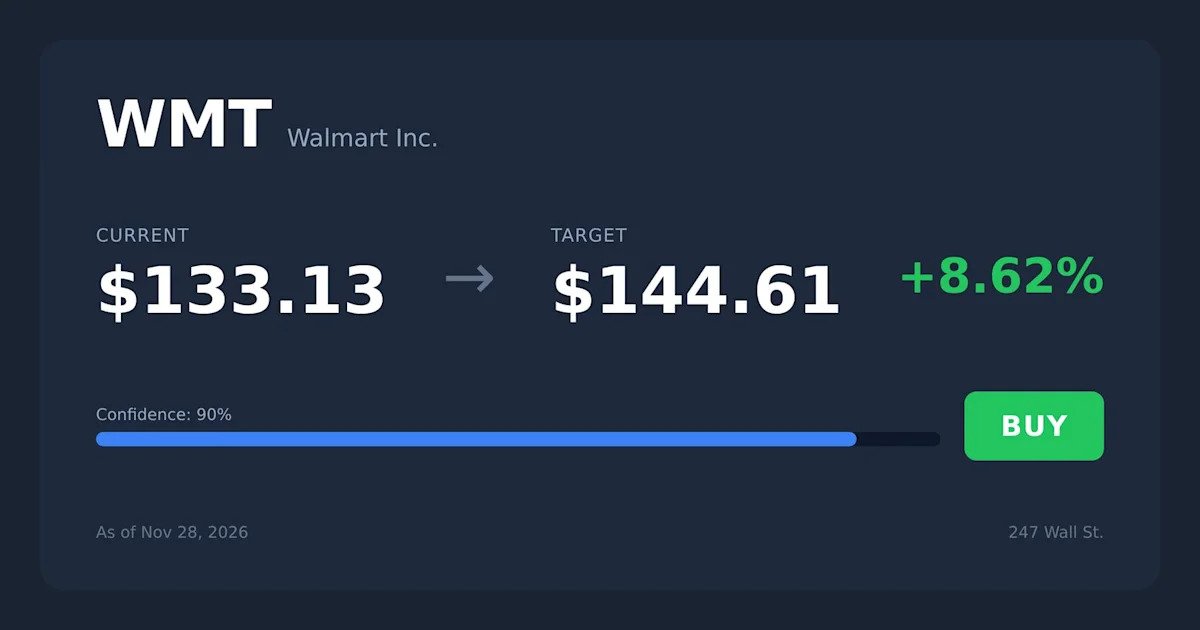
The stock kept climbing after that. November is up 7.79% with one session left. Friday’s close of $133.13 sits 0.8% below the $134.20 record set on May 19, and Walmart’s market value of $1.06 trillion makes it the 12th biggest U.S. company. It was worth $887.96 billion at the end of 2025.
On Friday, Daren Fonda wrote that investors have poured into Walmart and Costco (NASDAQ:COST). But “the retailers’ stocks are no deals.” Walmart’s own valuation history supports that view. The stock trades at 51 times trailing GAAP earnings, compared with a thirteen-year median of 32. So for holders, the question is whether the business can grow fast enough to support that multiple.
Every Valuation Measure Sits Far Above Its Median
The trailing P/E is based on diluted EPS of $2.61, and the thirteen-year high is 61. If you strip out non-recurring items, the multiple falls to 46. That is still well above its median of 26 and near its high of 53.
Price-to-sales stands at 1.43, compared with a median of 0.68 and a high of 1.51. Price-to-free-cash-flow is 82.33, while the median is 23.13.
——
Now Available: The Definitive Guide to Retirement Income
Many successful investors eventually reach the same moment. The saving is done, the portfolio is built, and the question quietly changes from how much can I grow this to how much can I take out? Get that second question wrong and decades of good investing can come apart in a handful of years.
That is exactly what The Definitive Guide to Retirement Income helps answer. It covers what your retirement could actually cost, which income sources are worth using, and the withdrawal math that decides whether the money lasts. It is free today from Fisher Investments. Read More Here ›