Warren Buffett did three things, but the final step is often the hardest in a bear market.
By Reuben Gregg Brewer –
Key Points
-
Warren Buffett looked to buy good companies while they were attractively priced.
-
Then Buffett held for the long term.
-
Holding through a bear market can be very difficult, but history shows it is a good decision.
Warren Buffett, the former CEO of Berkshire Hathaway (BRKA +0.30%)(BRKB +0.25%), broke his investment approach down into three steps: find good companies, buy when the stock is attractively priced, and then hold for the long term. That sounds easy, but it isn’t. And the hardest step of all is the one that requires you to do absolutely nothing. Here’s why holding through a bear market is still likely to be the winning move.
Every Buffett step counts, but holding is key
Warren Buffett never described his investment approach in fine detail, preferring to give broad generalizations. That’s actually good news for investors because it means his general approach can be applied across many styles, including growth, value, and income investing. But each step is still very important.

Image source: Getty Images.
The first thing is to find good companies. That sets the foundation, but you may not be able to buy the companies you like right away because good companies often carry premium price tags. Which is why waiting for an attractive price is step two. It can require patience, but tracking valuation metrics can help you keep your enthusiasm in check until mercurial Wall Street provides a buying opportunity.
Then the really hard work starts because you have to hold for the long term. This is where Buffett’s approach really shines, because his goal was to benefit from the long-term growth of the businesses he bought. It is hard to overstate how difficult it is to just do nothing as an investor. Wall Street is driven by activity, and simply sitting around can feel like you are missing out. If steps one and two are covered, you aren’t missing anything by sitting back and watching the grass grow.
The S&P 500 proves the point
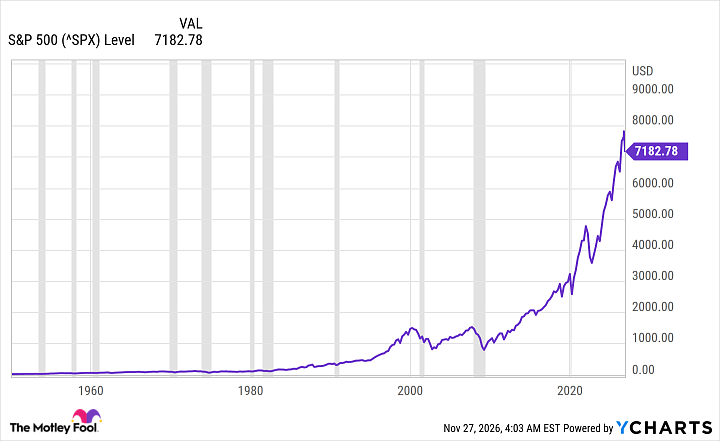
If Berkshire Hathaway’s success isn’t enough to prove the value of holding through thick and thin, then look at the S&P 500 index (^GSPC +1.60%) chart above. Notice the fairly frequent dips along the index’s long upward path. Those are bear markets, with some of the most recent occurring during the dot-com crash, the Great Recession, and the coronavirus pandemic. The S&P 500 recovered after each downturn and reached new record highs.
In fact, Buffett even suggested that people looking to make investing as simple as possible skip steps one and two and just buy an S&P 500 index fund, such as Vanguard S&P 500 ETF (VOO +1.66%). The index is designed to represent the U.S. economy and is often referred to as “the market.” So you guarantee yourself market returns by buying the S&P 500. That’s more than enough to build material wealth over the long term if, here’s the key, you hold for the long term.
BRKB Berkshire Hathaway
$580.79+$1.47 (+0.25%)
NYSE · As of 1:00 PM ET 11/27/26
Do not underestimate the difficulty of doing nothing. It is, perhaps, the hardest thing you have to do when you invest like Buffett. In bull markets, as noted, you’ll feel like you should be doing more. The “fear of missing out” (FOMO) will make you want to buy and sell. In bear markets, it gets even worse. You will watch as your wealth slips away day after day, which may even elicit physical symptoms such as sleeplessness, mental distraction, and agita. If history is any guide, selling out of fear in a bear market is a mistake.
Build your approach around Buffett’s core
Buffett’s basic approach of buying good companies when they are reasonably priced and holding for the long term is pretty universal. You can apply these basic premises to your own personal investment preferences. But the third step, holding, is likely to be the most important. It is hard to do nothing in bull markets, but even harder in bear markets. Which is why you should mentally prepare yourself now for the next downturn. Nobody knows when, but another bear market will show up sooner or later.
Where to invest $1,000 right now
When our analyst team has a stock tip, it can pay to listen. After all, Stock Advisor’s total average return is 792%* — a market-crushing outperformance compared to 202% for the S&P 500.
They just revealed what they believe are the 10 best stocks for investors to buy right now, available when you join Stock Advisor.
*Stock Advisor returns as of November 28, 2026.