RPC (NYSE:RES) has had a rough three months with its share price down 28%. However, a closer look at its sound financials might cause you to think again. Given that fundamentals usually drive long-term market outcomes, the company is worth looking at. Particularly, we will be paying attention to RPC’s ROE today.
Return on equity or ROE is an important factor to be considered by a shareholder because it tells them how effectively their capital is being reinvested. In other words, it is a profitability ratio which measures the rate of return on the capital provided by the company’s shareholders.
View our latest analysis for RPC
How Do You Calculate Return On Equity?
ROE can be calculated by using the formula:
Return on Equity = Net Profit (from continuing operations) ÷ Shareholders’ Equity
So, based on the above formula, the ROE for RPC is:
15% = US$151m ÷ US$1.0b (Based on the trailing twelve months to March 2024).
The ‘return’ is the amount earned after tax over the last twelve months. So, this means that for every $1 of its shareholder’s investments, the company generates a profit of $0.15.
What Has ROE Got To Do With Earnings Growth?
We have already established that ROE serves as an efficient profit-generating gauge for a company’s future earnings. Depending on how much of these profits the company reinvests or “retains”, and how effectively it does so, we are then able to assess a company’s earnings growth potential. Assuming everything else remains unchanged, the higher the ROE and profit retention, the higher the growth rate of a company compared to companies that don’t necessarily bear these characteristics.
RPC’s Earnings Growth And 15% ROE
To begin with, RPC seems to have a respectable ROE. Even when compared to the industry average of 13% the company’s ROE looks quite decent. This probably goes some way in explaining RPC’s significant 52% net income growth over the past five years amongst other factors. We reckon that there could also be other factors at play here. For example, it is possible that the company’s management has made some good strategic decisions, or that the company has a low payout ratio.
Next, on comparing RPC’s net income growth with the industry, we found that the company’s reported growth is similar to the industry average growth rate of 45% over the last few years.
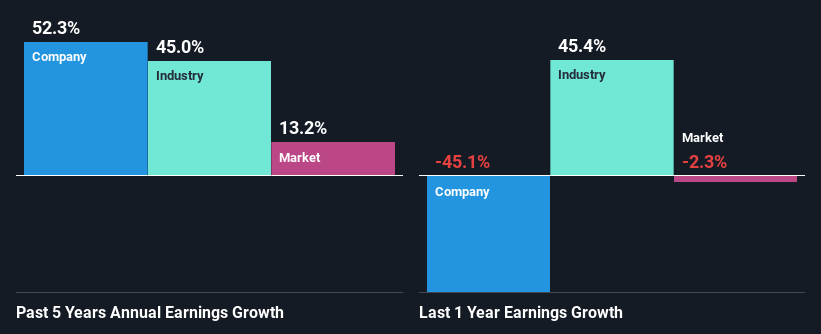
The basis for attaching value to a company is, to a great extent, tied to its earnings growth. It’s important for an investor to know whether the market has priced in the company’s expected earnings growth (or decline). Doing so will help them establish if the stock’s future looks promising or ominous. Has the market priced in the future outlook for RES? You can find out in our latest intrinsic value infographic research report.
Is RPC Using Its Retained Earnings Effectively?
RPC’s three-year median payout ratio to shareholders is 8.9%, which is quite low. This implies that the company is retaining 91% of its profits. This suggests that the management is reinvesting most of the profits to grow the business as evidenced by the growth seen by the company.
Moreover, RPC is determined to keep sharing its profits with shareholders which we infer from its long history of paying a dividend for at least ten years. Looking at the current analyst consensus data, we can see that the company’s future payout ratio is expected to rise to 12% over the next three years. Accordingly, the expected increase in the payout ratio explains the expected decline in the company’s ROE to 9.3%, over the same period.
Conclusion
Overall, we are quite pleased with RPC’s performance. Specifically, we like that the company is reinvesting a huge chunk of its profits at a high rate of return. This of course has caused the company to see substantial growth in its earnings. If the company continues to grow its earnings the way it has, that could have a positive impact on its share price given how earnings per share influence long-term share prices. Not to forget, share price outcomes are also dependent on the potential risks a company may face. So it is important for investors to be aware of the risks involved in the business. Our risks dashboard would have the 2 risks we have identified for RPC.
Valuation is complex, but we’re helping make it simple.
Find out whether RPC is potentially over or undervalued by checking out our comprehensive analysis, which includes fair value estimates, risks and warnings, dividends, insider transactions and financial health.
Have feedback on this article? Concerned about the content? Get in touch with us directly. Alternatively, email editorial-team (at) simplywallst.com.
This article by Simply Wall St is general in nature. We provide commentary based on historical data and analyst forecasts only using an unbiased methodology and our articles are not intended to be financial advice. It does not constitute a recommendation to buy or sell any stock, and does not take account of your objectives, or your financial situation. We aim to bring you long-term focused analysis driven by fundamental data. Note that our analysis may not factor in the latest price-sensitive company announcements or qualitative material. Simply Wall St has no position in any stocks mentioned.
Valuation is complex, but we’re helping make it simple.
Find out whether RPC is potentially over or undervalued by checking out our comprehensive analysis, which includes fair value estimates, risks and warnings, dividends, insider transactions and financial health.
Have feedback on this article? Concerned about the content? Get in touch with us directly. Alternatively, email editorial-team@simplywallst.com