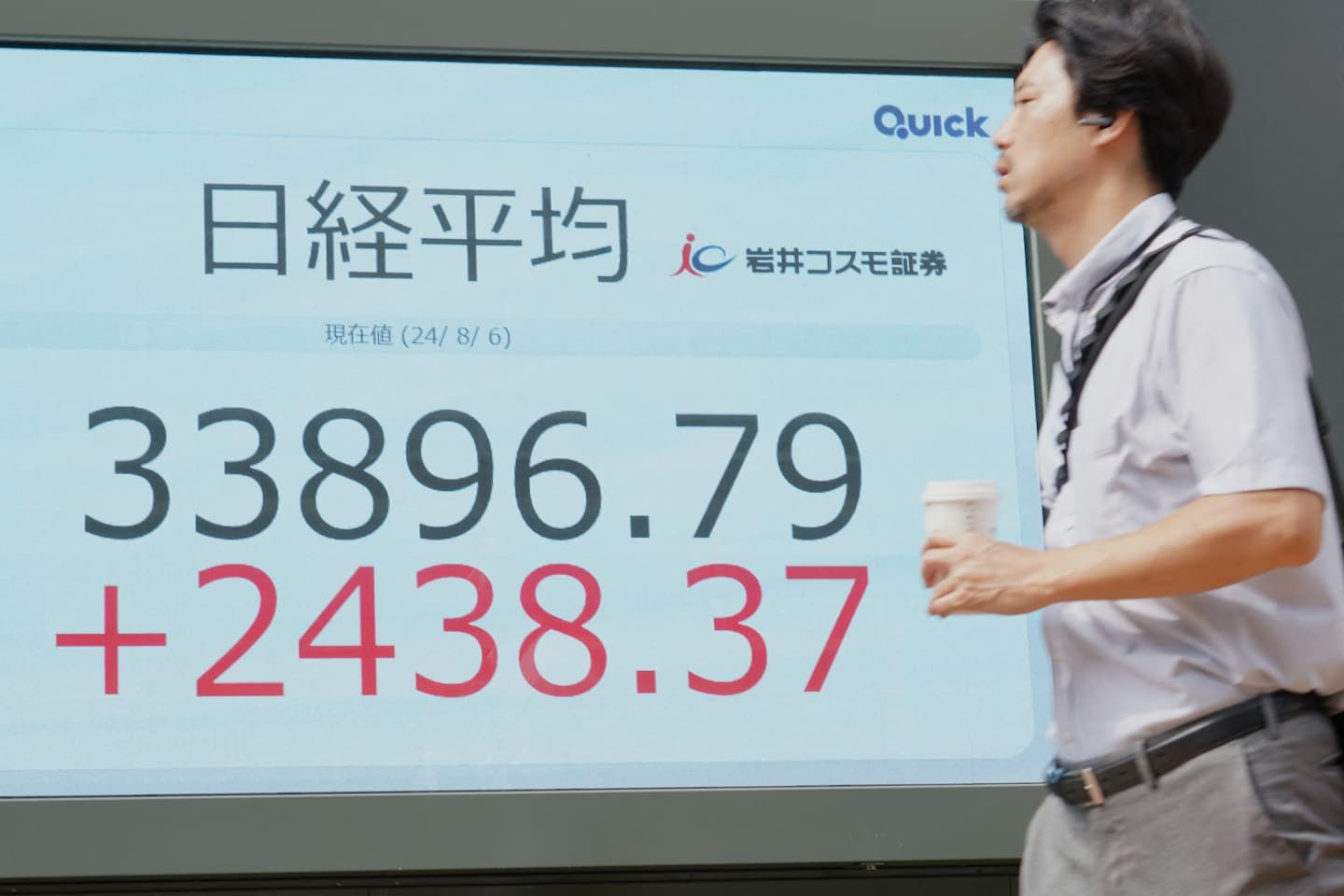
Japanese shares substantially rebounded Tuesday, recovering ground from a historic sell-off Monday and outpacing modest gains elsewhere in Asia. U.S. equity futures also climbed in early Asia trading.
Japan’s benchmark Nikkei 225 index ended the day up 10.23 percent, or 3,217.04 points, closing at 34,675.46 after recording its biggest single-day point drop on record on Monday after an interest rate hike by the Bank of Japan last week. Futures tied to the broader S&P 500 were up about 1.5 percent, and Nasdaq futures rose 1.4 percent, Reuters reported.
Elsewhere in Asia, by Tuesday’s closing, China’s Shanghai Composite stock market was up 0.23 percent; South Korea’s Kospi index was up more than 3 percent; Hong Kong’s Hang Seng Index was down 0.31 percent, compared with Monday’s 1.46 percent. In Australia, the benchmark S&P/ASX 200 closed up 0.41 percent, ahead of an interest rate decision by the country’s central bank.
European indexes, including London’s FTSE, Germany’s Dax and the continentwide Stoxx 600, also appeared to rebound slightly in early trading. All three dropped on Monday’s closing.
The market rout went global Monday, with Wall Street encountering some of the most volatile trading in years as investors weighed disappointing U.S. economic data, including a weaker than expected jobs numbers last week.
The Dow Jones Industrial Average shed nearly 1,034 points, or 2.6 percent, and closed at 38,703.27. The broader S&P 500 lost 3.0 percent, while the tech-heavy Nasdaq composite index lost 3.4 percent.
Analysts at BMI, a unit of Fitch Ratings, described the market volatility as a “perfect storm of macro and market shocks at a time when risk assets were already overbought and overstretched.”
The Japanese index reached all-time highs over 42,000 in July, but those gains have since been erased amid concerns about rising interest rates that are fueling a rise in the yen, fanning investor fears that bets based on the yen remaining weak are at risk of being unwound. A popular trading strategy in recent years has involved borrowing a weak Japanese yen at near-zero interest rates to buy high-yielding assets in other markets, including U.S. tech stocks.
The Bank of Japan’s decision to raise its short-term policy rate to 0.25 percent on July 31 led to the “unwind of the yen carry trade, which added downside pressure on risk assets which were already selling off,” the analysts said in a research note. Disappointing U.S. manufacturing and jobs data and rising geopolitical risks in the Middle East added to the uncertainty, they added.
Japanese Finance Minister Shunichi Suzuki said Tuesday that the government will continue to monitor financial markets, working closely with the country’s central bank.
“The impact of the Bank of Japan’s policy shift on interest rates, public finances and the economy must be carefully monitored,” Suzuki told a meeting of finance officials. “We will calmly assess the current situation and take all possible measures to manage the economy and finance while cooperating with the Bank of Japan.”
The turmoil began with a sudden global panic overnight Sunday, cratering the value of stocks, currencies and even cryptocurrencies, especially after a weak snapshot of the U.S. job market last week.
Data released Friday showed that U.S. employers added 114,000 jobs in July — far fewer than expected — and that the unemployment rate rose to 4.3 percent, its highest level in almost three years. The jobs report made the American economy look as though it could be on rockier footing than previously thought and sparked bets that the Federal Reserve might have to cut interest rates sooner and more aggressively.
But economists said it’s too soon to panic. The economy, by most measures, is still in solid shape. Americans are continuing to spend, the service sector is growing, and the stock market remains up for the year.
Experts said this week’s fluctuations are a sign of short-term supply and demand, and that Japan’s economy remains strong.
One reason is that stock prices have little effect on consumer wealth and spending because households invest little in stocks, said Richard Katz, economist and author of the recent book “The Contest for Japan’s Economic Future.”
“Stock prices in Japan have surprisingly little impact on the real economy,” Katz said. “That’s because companies are cash-rich and don’t need to use the stock market to finance corporate investments.”
In addition, there has been a rise in real wages in Japan for the first time in 27 months — a good sign for the country’s long-term economic growth, said Rina Oshimo, a senior strategist at Okasan Securities Co. in Tokyo. Major Japanese companies appear to be maintaining a “wait-and-see attitude for their future outlook” rather than voicing caution, Oshimo said, and many companies are feeling positive about certain indicators, like improved profit margins from price hikes in the market.
“We expect the Japanese economy to enter a period of gradual inflation from now on,” Oshimo added.
Julia Mio Inuma contributed to this report