Here are the top stories to read during Tuesday trading:
Latest Updates
Lower U.S. interest rates are surely going to help refloat a sunken manufacturing side of the economy, but maybe not until after the president election.
“Business is cooling down, and we don’t expect a rebound until after the election is over,” as one paper-manufacturing executive put it.
One big difference between Democrats and Republicans, for instance, is on energy.
Democrats want to promote the long-term investment in “green energy” like wind, solar and batteries and scale back the use of fossil fuels, ISM survey chairman Timothy Fiore pointed out.
Republicans prefer to expand production of domestically produced oil and gas in the short run, he noted.
Businesses would invest and behave differently based on which set of policies they could expect, Fiore said. They won’t be able to start making those decisions until early next year.
Tom Lee, managing partner and head of research at Fundstrat Global Advisors told CNBC’s “Squawk Box” that he thinks stocks will experience a 7% to 10% drawdown over the next two months — a “buy the dip” opportunity for investors.
“Investors should be cautious for the next eight weeks. When markets were up seven of the eight months this year, we know it’s an incredibly strong market, but we also have the September [interest-rate] cut and we have the election — things that will get people nervous,” Lee said in an interview on Tuesday morning.
Lee said this week’s August nonfarm payrolls report is expected to show “a nice rebound” in jobs growth, but “hopefully it’s not too strong, because if it’s too strong, people are going to worry the Fed might backpedal on a September cut.”
Read the full story below:
The U.S. stock market’s fear gauge jumped Tuesday, as major equities indexes kicked off September trading in the red.
The Cboe Volatility Index, often referred to by its ticker symbol VIX, surged around 20% to about 18, as investors weighed fresh economic data on U.S. manufacturing. Still the VIX remained below its long-term average of around 20.
Major U.S. stock indexes were falling sharply in early afternoon trading Tuesday, after posting monthly gains in August. September is historically the worst month for the U.S. stock market, according to Dow Jones Market Data.
The Dow Jones Industrial Average, which finished August at a record high, was trading 1.2% lower Tuesday, while the S&P 500 dropped 1.6% and the technology-heavy Nasdaq Composite sank 2.5%, according to FactSet data, at last check.
U.S. stocks were tumbling to start September trading on Tuesday, with the three equity benchmark indexes on pace for their worst daily decline since the Aug. 5 market meltdown.
The Dow Jones Industrial Average was falling 443 points, or 1.1%, to 41,117 as of 12:30 p.m. Eastern time, according to FactSet data.
The S&P 500 was losing 1.5%, to 5,564.
The Nasdaq Composite was slumping 2.5%, to 17,271.
At the sector level, the S&P 500’s information-technology and energy sectors were two of the worst-performing sectors among the large-cap index’s 11 sectors, down 3.6% and 2.3%, according to FactSet data.
But some traditional defensive sectors were eking out some gains on Tuesday early afternoon. The S&P 500’s consumer-staples sector was rising around 1%, while the utilities sector was edging up 0.3%, according to FactSet data.
Last month, the government reported that the U.S. unemployment rate increased to 4.3% in July. A stock-market selloff ensued over the following trading days. With the next set of employment data slated to come out on Friday, investors are anxious about how markets will respond.
“The last jobs report was pretty disappointing. It did show there is some concern in the labor market, which is the lifeblood of the U.S. economy,” Bret Kenwell, U.S. investment analyst at eToro, told MarketWatch. “So I think going into this one investors are maybe a little more tense than they have been previously.”
During the Jackson Hole economic symposium, Federal Reserve Chair Jerome Powell noted in his speech that the Fed was shifting some of its focus from inflation data to employment data in order to determine monetary policy. Kenwell noted that investors were shifting their focus too.
For that reason, more data that points to growing unemployment may spook investors.
“There are explanations behind the jobs market and why we’re seeing certain upticks in unemployment without it necessarily being catastrophic,” Kenwell said. “But the fact of the matter is the unemployment rate is on the rise and jobs growth has been a little bit slower.”
“Investors will be holding their breath a bit going into Friday, just on that concern.”
Nvidia is flirting with its largest one-day erasure of market cap on record.
At the deepest point of Tuesday’s intraday selloff so far, Nvidia’s market cap was off by $244.7 billion, according to Dow Jones Market Data. That would’ve been enough for the company’s biggest one-day drop in market cap ever, besting the current record of $211.8 billion, though shares have since pared losses.
Nvidia’s intraday market-cap loss now stands at $201.5 billion, which would be the seventh-worst for any U.S. company on record if it carries through to the close.
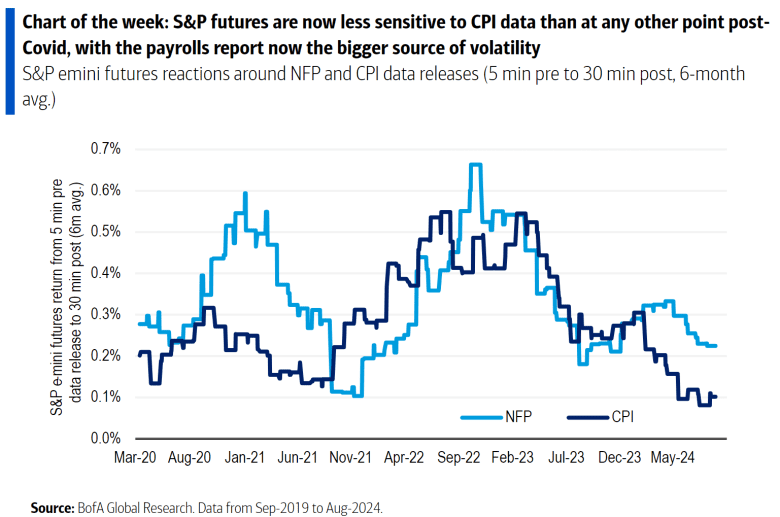
Futures contracts for the S&P 500 index have become more sensitive to U.S. jobs reports than inflation readings, according to BofA Global Research.
The nonfarm payrolls report has “regained its crown as the most important data release for stocks,” BofA analysts said in a note dated Sept. 2. “All eyes will be on the August payrolls report this week,” they said, referring to the U.S. employment report that the Bureau of Labor Statistics will release on Friday.
S&P 500 futures inflation readings from the consumer-price index “than at any other point post-Covid, with the payrolls report now the bigger source of volatility,” according to their research. With inflation having eased considerably from its 2022 peak, investors are now watching the labor market closely for signs of softening.
The BofA chart below shows the reaction of the eMini S&P 500 Future Continuous Contract since August 2019 in the five minutes before the release of nonfarm-payrolls and the consumer-price-index data, through the 30 minutes after those reports came out, based on six-month averages.
(BOFA GLOBAL RESEARCH NOTE DATED SEPT. 2, 2024)
Exchange-traded funds focused on energy stocks were posting big declines as the U.S. stock market fell Tuesday.
The Energy Select Sector SPDR Fund was down 2.4%, while the Vanguard Energy ETF dropped 2.7% and the SPDR S&P Oil & Gas Exploration & Production ETF slumped 3.5%, according to FactSet data, at last check.
The U.S. stock market was broadly falling Tuesday, with the S&P 500 index down 1.4%, according to FactSet data show, at last check.
U.S. stocks traded lower Tuesday morning following the ISM manufacturing sector report for August, which pointed towards a slowdown.
Once again, bad news means bad news for the market, Jeffrey Roach, chief economist for LPL Financial, said and reminded investors to protect themselves for bumps in the road.
“Although the manufacturing sector holds a smaller portion of the macro economy now than in previous cycles, investors should still position themselves for a broader slowdown throughout the balance of this year,” Roach wrote in an emailed statement.
Although some sectors may be facing a slowdown, Roach also noted that some sectors may still see increased spending, including real estate.
“In a separate report, residential construction spending declined in July for the first time since March. As mortgage rates will likely decline as the Fed embarks on a rate-cutting campaign, we should see renewed activity in construction spending,” he wrote.
The probability of a 50-basis-point, or half-point, rate cut by the Federal Reserve in September crept up to 39% Tuesday as fed-funds futures traders digested an Institute for Supply Management reading that pointed to a further contraction in manufacturing activity last month. The probability of a quarter-point reduction stood at 61%.
That’s up from 30% on Friday, according to the CME FedWatch Tool. Fed-funds futures traders continue to price in 100 basis points of cuts by year-end. With the Fed set to meet three times between now and the end of the year, that implies one cut would be a supersized half-point move.