Here are the top stories to read ahead of Thursday trading:
Latest Updates
(TRUIST)
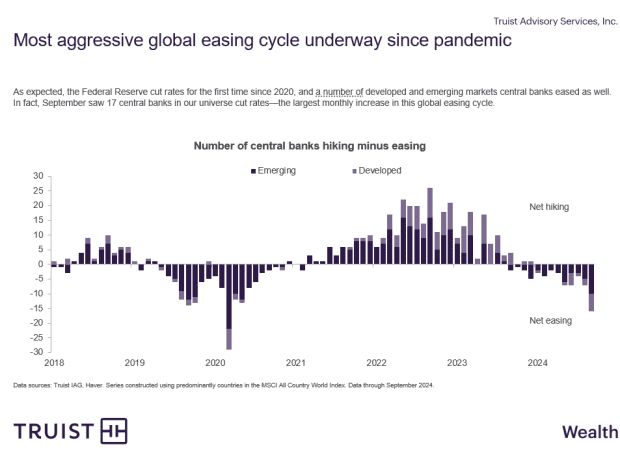
September saw 17 global central banks cut interest rates, the most in any single month since the start of the COVID-19 pandemic, according to a report from Truist.
The Federal Reserve and the ECB’s cuts received the most attention, although other developed-market central banks, including the Swiss National Bank and Sweden’s Riksbank, also moved to ease monetary policy.
They were joined by a number of emerging-market central banks, including the Bank of Mexico and, perhaps most notably, the People’s Bank of China, which announced plans to ease requirements governing how much money banks must hold in reserve, while also lowering several key lending rates.
Truist’s Keith Lerner said the beginning of the most aggressive global easing cycle since the pandemic would likely help push global stocks higher. He noted that several key benchmarks are already at notable highs.
“Two old adages on Wall Street are don’t fight the trend and don’t fight the Federal Reserve…These remain among two key pillars for today’s equity market,” Lerner said in a report shared with MarketWatch.
For much of the past two years, market watchers have worried about whether the U.S. stock-market rally could survive without the Magnificent Seven.
Now, after a sometimes-rocky third quarter, they finally have an answer: the S&P 500 index has recently charged to fresh record highs, and it didn’t wait around for Big Tech to catch up.
“Over the last few months, a few myths have been busted,” said Michael Arone, chief investment strategist for State Street Global Advisors, during an interview with MarketWatch on Wednesday. “One is that without a rally in the ‘Mag Seven,’ that ultimately market returns were doomed.”
“In fact, over the past three months, the S&P 500 is up more than 4.5%,” he said.
Stocks making notable moves in Thursday’s premarket action:
Levi Strauss & Co. shares are down 11% after the jeans maker tempered its full-year sales forecast and said it was weighing a possible sale of its struggling Dockers business.
Wolfspeed shares are down more than 4% after the silicon carbide technologies company, was downgraded to underperform from neutral at Mizuho and the price target was reduced from $17 to $8.
Hims & Hers Health shares are slipping more than 8% after the Food and Drug Administration said there were no longer shortages of Eli Lilly’s obesity and diabetes drugs Zepbound and Mounjaro.
Stellantis stock is down nearly 4% after the maker of Jeep, Chrysler and Fiat received a share price downgrade from overweight to equal weight by Barclays.
Here are some of the potential market catalysts due Thursday for traders to consider:
Constellation Brands will release earnings before the U.S. stock market opens.
8:30 a.m. Eastern. U.S. weekly initial jobless claims.
9:45 a.m. S&P final U.S. services PMI for September.
10:00 a.m. U.S. ISM services for September.
10:00 a.m. U.S. factory orders for August.
10:40 a.m. Minneapolis Fed President Neel Kashkari moderates discussion with Atlanta Fed President Raphael Bostic on inclusivity and the economy.
How are stock-index futures trading:
S&P 500 futures are down 0.4%.
Dow Jones Industrial Average futures are falling 0.4%.
Nasdaq 100 futures are slipping 0.6%.
On Wednesday, the Dow Jones Industrial Average rose 40 points, or 0.09%, to 42,197, the S&P 500 increased 1 point, or 0.01%, to 5,710, and the Nasdaq Composite gained 15 points, or 0.08%, to 17,925.
Futures indicate a lower start for stocks at Wall Street’s opening bell, with investors cautious as Middle East tensions remain elevated.
Traders are also wary about taking bold bets ahead of a batch of U.S. economic data in the next few days, notably Thursday’s release of the weekly initial jobless claims, and the nonfarm payrolls report, due Friday.
Mark Newton, head of technical strategy at Fundstrat, implied that wariness about febrile October markets may also be a factor damping risk appetite.
“October volatility is no surprise, this month has historically been 34% more volatile than the average of the remaining 11 months of the year,” said Newton.
He added that he was unsure whether stocks had bottomed after Tuesday’s 0.9% retreat.” I suspect that until SPX [the S&P 500] can reclaim 5730, SPX might still prove vulnerable to a bit more selling into tomorrow [Thursday] and/or Friday before bottoming.”