Latest Updates
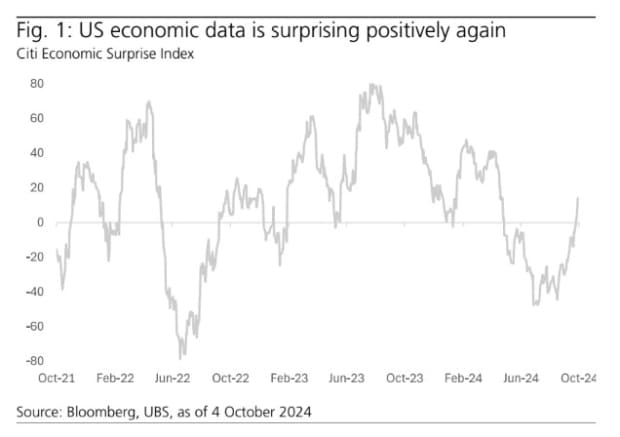
Economic data kept coming in weaker than expected in the spring and summer, but now it seems that trend has reversed. (UBS)
Friday’s jobs report provided a better-than-expected surprise about the state of the U.S. labor market. The stock market celebrated the news that day, with the S&P 500 closing 0.9% higher.
But the jobs report isn’t the only piece of positive economic news. UBS pointed out that recent economic data has been coming in stronger than forecast by analysts. This represents a reversal from the weaker-than-expected surprises throughout the spring and summer.
Jason Draho, UBS’s head of asset allocation and chief investment officer for the Americas, believes that this increases the chances of a “hot” economy going into 2025. He said this could benefit risk assets as long as inflation doesn’t reaccelerate.
“While investors welcomed the strong jobs report because it eased concerns about a cooling labor market, data that suggests the economy is re-accelerating will stoke fears that a hot economy is at risk of overheating. That would curtail rate cut expectations, and could even put rate hikes back on the table,” Draho wrote in a note.
While rate hikes might be unlikely, Draho says, it shows why investors may want to be cautious about the economy overheating, as well as about it cooling.
Investors are scaling back bets on further Federal Reserve rate cuts after Friday’s strong September jobs report, but prospects for another jumbo easing before year-end haven’t been entirely eliminated, argued economist Neil Dutta of Renaissance Macro Research, who had correctly called the central bank’s half-point move in September.
“While a 50 basis-point rate cut is unlikely in November, I would not rule of the idea before year-end entirely just yet,” he wrote, noting that some analysts have declared the Fed unlikely to deliver any further easing in 2024.
“I would resist that idea; they are taking too much signal from one report not unlike those that made similar claims earlier in the year after Q1 inflation data,” Dutta said.
September’s employment data were encouraging, but there isn’t much evidence labor market conditions are reaccelerating, Dutta argued. “Perhaps conditions are stabilizing but my general sense is that the labor markets continue are still gradually cool,” he said.
Energy was the best-performing sector in the S&P 500 on Monday morning, as investors weighed the risks of fighting in the Middle East that escalated over the weekend.
The S&P 500’s energy sector was rising 0.7%, according to FactSet data, at last check. The S&P 500 index was down 0.4% in morning trade, while U.S. oil prices were up around 2% at around $75.90.
U.S. stocks were modestly lower after the opening bell, with the Dow Jones Industrial Average pulling back from Friday’s record close as investors looked ahead to a busy week that includes inflation data and corporate earnings.
“Last week was a showdown between jobs market bullishness and geopolitical bearishness. This week puts the economic spotlight back on inflation, but barring any major surprises the focus will quickly shift to earnings season,” said Chris Larkin, managing director for trading and investing at E-Trade from Morgan Stanley.
The Dow fell 158 points, or 0.4%
The S&P 500 as down 18 points, or 0.3%
The Nasdaq Composite declined 55 points, or 0.3%
Traders of U.S. government debt continued to respond to Friday’s blockbuster jobs report for September, by sending one-month through 30-year yields broadly higher.
The September employment report, which showed 254,000 new jobs created, “was strong enough across the board to completely change the macro narrative in the Treasury market,” said FHN Financial strategist Will Compernolle in New York.
Among other things:
The 10-year yield is back above 4% for the first time in months after being anchored below that level.
Fed-funds futures traders are entertaining some possibility of no rate hike in November, while leaning mostly toward the idea of two 25-basis-point cuts next month and in December.
The policy-sensitive 2-year yield was leading the rise in market-based rates, and just above 4%.
The U.S. dollar has seen a sharp rise against its main rivals since the start of October, bouncing back from its summertime doldrums.
Following Friday’s stronger-than-expected U.S. payrolls report, the buck appears poised to continue climbing. But how much more ground can it regain? That’s a little less clear.
But Kit Juckes, a longtime macro strategist at Société Générale, has some thoughts. An ongoing shift in the euro-dollar 1-year interest-rate differential and a lingering short position in U.S. dollar futures suggest the ICE U.S. Dollar Index could fluctuate within a range of 100 to 107 for the foreseeable future.
“‘A bumpier road ahead’ is more likely than a clear trend in Q4,” Juckes said.
That said, the most likely near-term trend is higher. Because at this point, it’s difficult to imagine the Fed cutting interest rates more quickly than the ECB in the months ahead, given that data coming out of Europe is much weaker than that coming out of the U.S. On Monday, the latest German factory orders data showed a 3.9% decline year-over-year.
The dollar index was flat early Monday, but it continued to sit on an advance of 0.8% so far in October. The index stood at 102.50 in recent trade.
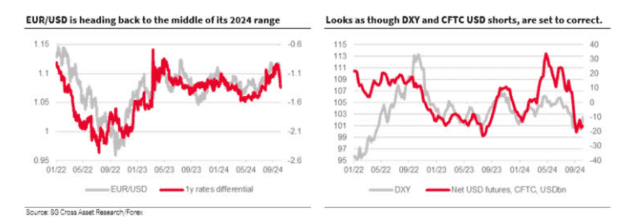
(SOCGEN)
The U.S. stock market celebrated the start of the Halloween season with treats.
A blockbuster September jobs report may have paved the way for the economy to score a soft landing as inflation has fallen, but it also forced investors to dial back bets on the Federal Reserve’s future interest-rate cuts while pondering whether the central bank made a policy mistake by lowering interest rates by a half-percentage-point last month.
That has left Wall Street seeing this Thursday’s consumer-price-index report as the next key event for the U.S. stock market. A hotter-than-expected September CPI report and potential inflation resurgence in the coming months could further restrict the pace at which the Fed may lower policy rates and, more importantly, throw a wrench into the stock rally, said analysts.
Read the full story below:
China’s recent rally could still have “more legs” if it is in any way similar to the stimulus-fueled rallies that followed the COVID-19 pandemic and the 2008 financial crash, Goldman Sachs has said.
China’s previous market rallies have in the past seen major increases in Chinese stock indexes over extended periods, in what would suggest the current rally could now continue, particularly if China follows through on policy, said Goldman Sachs analysts, led by Kinger Lau.
In the wake of the global financial crisis, the MSCI China Local Price index increased 147% over 277 days on the back of a ¥4 trillion stimulus package unleashed by the Chinese government on Nov. 9, 2008.
The unleashing of more stimulus measures from the People’s Bank of China during COVID-19 also saw the MSCI China Local Price Index surge another 84% across a 240-day period from March 2020 to February 2021.
The yield on the 10-year Treasury note has climbed back above the 4% mark on Monday for the first time since early August, according to FactSet data.
The yield on the 10-year note has been rising lately despite the Federal Reserve delivering a jumbo cut to its policy interest-rate target last month. It touched its lowest level of 2024 on Sept. 11, when it traded as low as 3.58%, according to FactSet data.
Bond-market experts have ascribed these moves to investors’ growing confidence that the Fed will succeed in guiding the U.S. economy toward a soft landing, albeit one where inflation could remain above the Fed’s 2% target rate for some time.
The yield on the 10-year note was up 2 basis points at 4.00% in recent trade, FactSet data showed. Bond yields move inversely to prices, rising as prices fall, and vice versa.
Barnes Group Inc.’s stock rose 2.7% early Monday, after the provider of engineered products and industrial technologies said it has reached an agreement to be acquired by funds of private-equity firm Apollo Global Management for $3.6 billion in cash.
Under the terms of the deal, Barnes shareholders will receive $47.50 per share in cash, equal to a premium of about 22% over the company’s undisturbed closing share price on June 25, 2024, and about 28% over the volume-weighted average price for the 90 days that ended on June 25.
The deal is expected to close before the end of the first quarter of 2025. The Barnes board has voted unanimously in favor of the deal and encourages its shareholders to do the same.