
Latest Updates
Gold prices lost more than 2% in Monday dealings and touched their lowest level in about four weeks, pressured by the U.S. dollar’s recovery as “markets anticipate potential fiscal policy measures” by President-elect Donald Trump, said Rania Gule, senior market analyst at XS.com.
“Markets are looking toward large-scale government spending programs and tax reforms that may boost U.S. economic growth,” she said in market commentary. “This optimism drives investors towards U.S. assets, enhancing the dollar’s value, which weighs on gold, given its nature as a non-yielding asset.”
Gold for December delivery lost $63.80, or 2.4%, to $2,631 an ounce on Comex, after trading as low as $2,623.90 — the lowest intraday level for a most-active contract since Oct. 10, FactSet data show.
Small-cap stocks were rising sharply Monday morning, surpassing the S&P 500 as they extended their post-election rally.
The Russell 2000, a U.S. small-cap equities index, was up 1.3% in morning trading, according to FactSet data, at last check. The S&P 500 was rising by a modest 0.2% on Monday morning.
Last week the Russell 2000 rallied 8.6%, exceeding the S&P 500’s 4.7% rise over the same period.
The Dow Jones Industrial Average’s opening gains are putting it on track to achieve another milestone level in Monday’s session.
The Dow was up almost 400 points, at around 44,385, during New York morning trading and appeared to be on pace to close above the 44,000 level for the first time ever. Goldman Sachs has added more than 500 points to the Dow’s gain since the index hit 43,000, making it the biggest contributor, according to Dow Jones Market Data.
Stocks opened with solid gains Monday, building on last week’s post-election run to records. The S&P 500 opened above the 6,000 level after trading briefly above the milestone on Friday as equities saw their best week of 2024.
“With the election and another rate cut in the rear-view mirror, the question is whether bulls can keep pushing the market to new highs… Aside from any potential profit-taking after such a strong surge, this week’s inflation data may determine whether the market pads its gains,” said Chris Larkin, managing director of trading and investing at E-Trade from Morgan Stanley, in emailed comments. The October consumer price index is due Wednesday followed by the producer price index on Thursday.
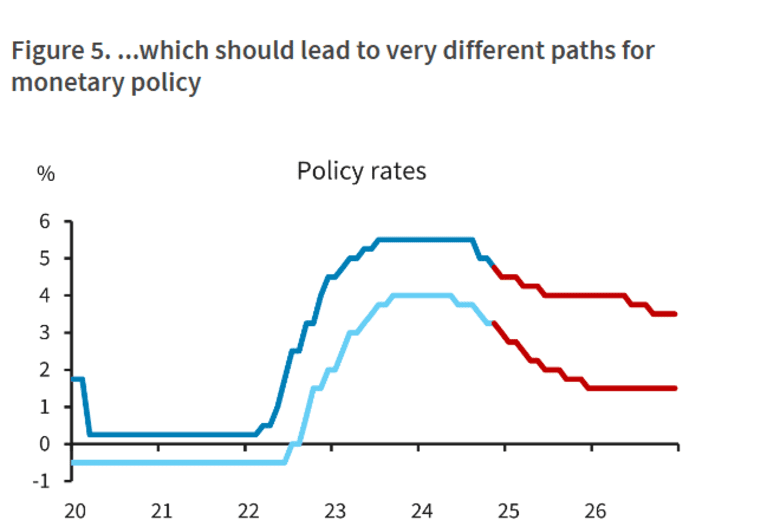
Tariff plans for China and the rest of the world could keep U.S. policy rates in the 4% range, according to Barclays. (Federal Reserve, ECB, Haver Analytics, Barclays Research)
Investors should get comfortable with the idea of a Federal Reserve policy rate of about 4%, according to Barclays Research.
“We are taking Trump seriously, but not literally,” a Barclays product-management team led by Ben McLannahan wrote in a Monday client note, adding that they expect half the tariffs he campaigned on to be put into force next year, including 30% on China’s goods and services and 5% on imports from the rest of the world.
Investors should have plenty of reasons to celebrate during the second Trump administration, according to one prominent professor at the University of Pennsylvania’s Wharton School, the former president’s alma mater.
“President-elect Trump is the most pro-stock-market president we have had in our history,” Jeremy Siegel, a finance professor at Wharton, said during a Monday appearance on CNBC’s “Squawk Box.”
“He measured his success in his first term by how well the stock market did. You know, it seems to me very unlikely he’s going to implement policies that are going to be bad for the stock market,” Siegel added.
Trump regularly tweeted about the Dow Jones Industrial Average during his first term, and many of his advisers said then that he viewed the stock market as a barometer of his performance.
Regarding Trump’s expected policies, Siegel cited the anticipated extension of his 2017 tax cuts as a “slam dunk” for stocks.
(BNY)
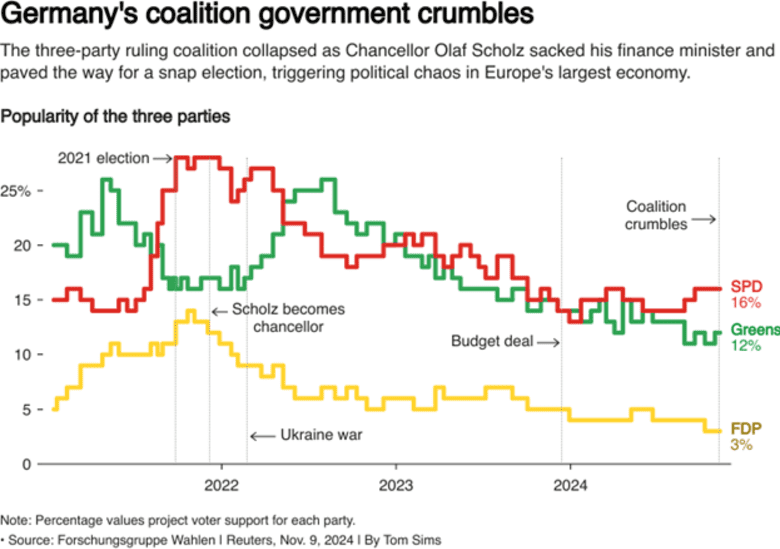
The euro is trading at its lowest since April. A broadly stronger dollar is part of the story, but investors also can’t ignore political ructions in Germany, the largest economy in the eurozone. German Chancellor Olaf Scholz’s ruling coalition collapsed last week, paving the way for a snap election whose timing has yet to be determined.
Otherwise, so-called Trump trades remain in focus following Donald Trump’s election victory. They’re defined as equities up, particularly U.S.- focused companies, U.S. dollar up particularly against big trading partners and bitcoin up, noted Bob Savage, head of markets strategy and insights at BNY.
“The bond markets remain the confusion and that may have to wait for the official House vote counts and the actual budget plans of the new government,” he said. “Until then markets are content to polish their brass and wait for another election – the next big one being Germany with the coalition splintering causing the EUR to trade at 4 ½ month lows.”
A key gauge of the dollar’s strength hit its highest level in four months on Monday as many of the greenback’s rivals weakened.
The ICE U.S. Dollar Index, a popular gauge of the buck’s value against a basket of rivals, touched its highest level since July 3, according to FactSet data. It has now erased nearly all of its third-quarter slump.
Weakness among the dollar’s rivals was broad-based: the euro was off by 0.6% at $1.06, the Japanese yen was off by 0.8% at 153.93 yen to the dollar. The Mexican peso was still facing heavy pressure; it was off by 1.9% at 20.54 to the dollar in recent trade.
The Chinese yuan was off by 0.4% at 7.21 to the buck.
The dollar has been rising in recent months, buoyed by rising Treasury yields and the expectation that former President Donald Trump had the upper hand in the race for the White House. Wall Street widely views Trump’s proposed policies, including tax cuts and tariffs, as helping to boost the greenback.
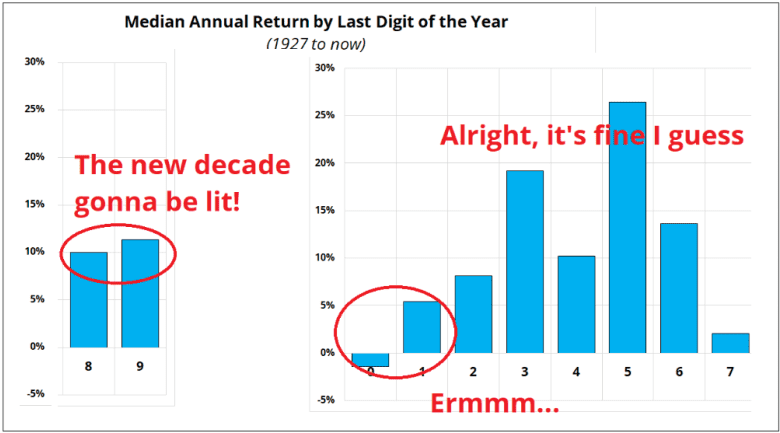
There’s good news for equity investors as we approach the end of 2024. Years that end in 5 tend to be very good for markets.
So says Brent Donnelly of Spectra Markets, who has examined the psychology behind what he terms the decennial cycle in stocks.
Investors, he explains, often feel more optimistic because a new year is coming. Even though they know it’s arbitrary, they feel optimism that maybe next year will be better than the last.
“Then, once the new year gets going, you return to baseline because you see that the arbitrary turn of the calendar did not actually change much, and things are kind of like they were before,” he says.
The same trend can be applied to decades, reckons Donnelly. Hence, the decennial cycle.
“People are optimistic as the decade ends (1989 Berlin Wall fell, 1999 dotcom bubble, 2009 end of GFC, etc.) but then are disappointed in the new decade (2000 dot bomb, 2010 Eurozone Crisis, 2020 COVID, etc.) Once the dust settles after the start of the decade disappointment, stocks can rally again.” he says.
And so we get the charts below, showing the median annual return by last digit of the year. Still, Donnelly emphasizes: “This is not the kind of theory I would present in an institutional finance writeup…Anyway, years ending 5 are particularly good over the past 100 years.”
“This is dumb. But it’s kind of neat. But it’s dumb. I think,” he admits.
(Spectra Markets)
Oppenheimer has become the latest Wall Street firm to raise its year-end price target for the S&P 500.
Chief Market Strategist John Stoltzfus said in a report shared with MarketWatch on Monday that Oppenheimer Asset Management now sees the S&P 500 finishing 2024 at 6,200, up from its previous forecast of 5,900.
That’s about 3.4% above the S&P 500’s closing level from Friday, 5,995.54. Interestingly, Stoltzfus and his team haven’t raised their earnings forecasts, suggesting they expect stocks’ already sky-high valuations to continue expanding.
“Economic fundamentals, earnings and revenue growth, the resilience of the consumer, along with Fed Monetary policy collectively also suggest to us that further upside in large cap stocks remains likely through year-end even as the current rally in equities appears likely to further broaden boosting the performance of mid cap and small cap stocks,” Stoltzfus and his team said.
A handful of major banks, including Goldman Sachs Group and UBS Group, raised their price targets ahead of the election in October. Last week, strategists at Evercore ISI said former President Donald Trump’s victory, coupled with Republican control of Congress, could propel the S&P 500 to 6,600 by mid-2025.
The S&P 500 has risen 25.7% year-to-date, leaving it on track to rise by more than 20% for two consecutive years, FactSet data showed.