Inside the Market’s roundup of some of today’s key analyst actions
After a “tough” 2024, BofA Securities analyst David Barden thinks Canada’s telecommunications companies are likely to face a “still-challenging” 2025.
“Robust subscriber growth was offset by falling prices, driven by in uptick in competitive intensity across both wireless and wireline as the industry adjusts to a consolidated fourth provider attempting to offset in-footprint broadband losses with wireless gains,” he said. “As growth challenges have persisted, balance sheet strength and the sustainability of capital returns to shareholders are increasingly in focus. Looking ahead to 2025, we believe investors will remain cautious on the sector and gravitate to stocks that can deliver free cash flow growth, de-lever, and sustain steady capital returns to shareholders.”
In a research report released Tuesday, Mr. Barden warned companies across the sector are going to face the need to absorb both price and volume shocks over the next 12 months and thinks asset monetizations are coming to address leverage concerns.
“At the top of this list is the reset of immigration policy, shifting it from a major tailwind to a major headwind,” he said. “Government cuts to immigration and the goal of reducing the percentage of the population who are nonpermanent residents from 7.1 per cent to 5.0 per cent by 2026 will have a meaningful negative impact on wireless providers. Achieving this government goal requires a net outflow of nonpermanent residents compared to large inflows in recent years. Assuming most of these individuals have wireless service, the industry should experience an uptick in churn in 2025/26. Gross and net additions should also be negatively impacted as population growth slows as the government resets new immigration levels downward over a two year period. Rogers is the wireless market share leader in the immigration segment and would be the most impacted, in our view.”
“Elevated leverage and slowing growth will increase focus management teams on monetizing non-core assets. This process is already underway. In 2024, RCI sold its longheld Cogeco shares and BCE announced the sale of NorthwesTel and MLSE (Maple Leaf Sports & Entertainment). RCI continues to work on selling excess real-estate and all three national providers have spoken openly about exploring tower monetization. TELUS is executing on a divestiture strategy enabled by its fiber deployment as it decommissions copper and redevelops excess central offices.”
Mr. Barden downgraded BCE Inc. (BCE-T) to “underperform” from “neutral” with a $36 target, down from $45 and below the $39.26 average on the Street, according to LSEG data..
“We are downgrading BCE to Underperform from Neutral due to 2025 growth headwinds coupled with high leverage and the dividend at over 120 per cent of free cash flow at the midpoint of 2024E guidance. We believe risks are to the downside until BCE can share a plan to address leverage and dividend concerns. In 2024, BCE announced two divestitures (NorthwesTel and MLSE), one acquisition (Ziply), paused dividend growth until YE2025, and introduced a discount on its DRIP to conserve cash. Collectively, these measures slightly improve BCE’s growth prospects but slightly increase net leverage and do not change underlying issues. Until there is clarity on lowering leverage and achieving a sustainable dividend, we see BCE shares underperforming its peers. Our C$36 price objective is based on a forward price to FCF multiple of 9.0x and implies a forward EV/EBITDA multiple of 7.0x. Our target p/fcf multiple is below the historical average reflecting risks associated with leverage and a potential dividend cut.,” he said.
He lowered Rogers Communications Inc. (RCI.B-T) to “neutral” from a “buy” recommendation with a $55 target, down from $65 and under the $57.61 average.
“We are downgrading Rogers (RCI) to Neutral from Buy to reflect 1) outsized exposure to a Government-led downward reset in immigration levels, 2) uncertainty surrounding its growing investment in Sports assets, and 3) higher than originally forecast leverage. In addition, the tailwind from Shaw merger synergy realization has largely flowed through margin results. We see increased pressure to reduce debt as, 1) margin growth slows, 2) four player wireless competitive intensity remains high, and 3) RCI’s market leading position among new Canadians becomes a growth headwind. We are lowering our price objective to C$55 from C$65 (to US$39 from US$50). The price objective is based on 10x forward free cash flow which is a discount to the historical average, but which we believe accurately reflects market uncertainty, elevated leverage, and rising sports investments,” he said.
Mr. Barden named Telus Corp. (T-T) his top pick in the space for 2025 with a $24 target, down from $25 and a “buy” rating. The average is $23.58.
“We expect TELUS to report strong free cash flows as it ramps-up copper decommissioning, executes on its real-estate monetization program, and continues to load subscribers on its fiber network while navigating changes to the immigration landscape,” he said.
=====
While RBC Dominion Securities analyst Greg Pardy thought he set-up for Canada’s oil weighted producers in 2024 was “one of the best we had seen in more than a decade,” he warns 2025 is “trickier, in large part given policy uncertainty, particularly in the U.S..
“The good news is that western Canada remains long export oil pipe given the 590,000 bbl/d [barrels per day] Trans Mountain Pipeline Expansion (TMX) moving into place last May,” he added. “Balance sheets are strong and capital discipline is holding the line. And of course, many of the oil majors in Canada are distributing 100 per cent of their free cash flow. Potential U.S. import tariffs remain an open question in our view and would prove disruptive to both sides of the border.
“We estimate that Canada’s oil sands weighted majors — Canadian Natural Resources, Suncor Energy, Cenovus Energy, and Imperial Oil — generated free funds flow (before dividends and working capital movements) of $5.2 billion in the fourth quarter (vs. $6.6 billion in the third quarter) and repurchased about $3.1 billion of their common shares, down modestly from about $3.4 billion in the third quarter.”
Ahead of the start of fourth-quarter 2024 earnings season, led by Imperial Oil Ltd. (IMO-T) on Jan. 31, Mr. Pardy said his funds from operations per share estimates for the Canadian majors are “somewhat mixed” versus the Street’s expectations, but he thinks they may move more into line as formal corporate surveys are released.
“Suncor Energy remains our favorite integrated oil in Canada, with Canadian Natural Resources our favorite producer (Global Energy Best Ideas list). MEG Energy, Cenovus Energy, Baytex Energy, and Obsidian Energy round out our Outperform roster,” he said.
In a report released Tuesday, Mr. Pardy updated his company-specific forecasts to reflect fourth-quarter commodity prices, his own price forecast, disclosed share buybacks and released 2025 budgets. That led to a series of target price adjustments to stocks in coverage universe.
His changes are:
- Baytex Energy Corp. (BTE-T, “outperform”) to $5 from $5.50. The average on the Street is $5.79, according to LSEG data.
- Canadian Natural Resources Ltd. (CNQ-T, “outperform”) to $62 from $63. Average: $56.08.
- Cenovus Energy Inc. (CVE-T, “outperform”) to $26 from $28. Average: $30.86.
- Gran Tierra Energy Inc. (GTE-T, “sector perform”) to $9 from $9.50. Average: $13.75.
- MEG Energy Corp. (MEG-T, “outperform”) to $31 from $33. Average: $32.13.
- Obsidian Energy Ltd. (OBE-T, “outperform”) to $12 from $13. Average: $14.
- Ovintiv Inc. (OVV-N/OVV-T, “sector perform”) to US$53 from US$55. Average: US$58.86.
- Strathcona Resources Ltd. (SCR-T, “sector perform”) to $35 from $36. Average: $34.88.
- Suncor Energy Inc. (SU-T, “outperform”) to $65 from $66. Average: $61.31.
=====
After its fourth-quarter production and 2025 guidance fell short of expectations and it announced a 50-per-cent reduction to its annual dividend, BofA Securities’ Lawson Winder cut B2Gold Corp. (BTO-T) to “underperform” from “buy” previously.
“While we see the dividend cut as prudent given still large capital commitments, we think investors are likely to be disappointed. BTG intends to supplement the new dividend with share repurchases of up to 5 per cent of outstanding shares from later in Q1′25. We reduce our net asset value (NAV) estimate for BTG by 30 per cent to $2.75 per share from $4.20,” he said.
His target fell to $3.90 from $5.90. The average is $5.97.
“BTG his going through a period of significant investment and in 2025 will be ramping up production at its new Goose mine, often a challenge for miners. We look for better entry points to BTG shares,” he added.
=====
After Ag Growth International Inc.’s (AFN-T) reduction to its 2025 EBITDA guidance on Monday, National Bank Financial analyst Maxim Sytchev thinks the market is “rightfully skeptical” about management remaining hopeful for a recovery over the next 12 months “as macro drivers like farmer incomes in the U.S and Canada (down 7 per cent/11 per cent year-over-year in 2024, respectively) are still expected to be below prior peak levels.”
“2025 EBITDA estimates for Deere (NYSE: DE; Not Rated) and CNH (NYSE: CNH; Not Rated) are seeing positive -per-cent /negative 11-per-cent EBITDA growth vs. 2024, respectively, implying a relative dispersion when it comes to a general ag recovery in 2025. However, as we mentioned … around an unsolicited bid having come to nought in 2024, there is a sense that any material downdraft might pave the way to revisit that dynamic.”
Before the bell, the Winnipeg-based company lowered its lowers its 2024 EBITDA guidance by 7 per cent to $260-million. Mr. Sytchev said the move implies revenue to be in the $1.405-billion range, a drop of 5 per cent from the previous management-implied projection.
Mr. Sytchev thinks Ag Growth’s “credibility will be questioned” with the move.
“When the company reported its Q3/24 numbers, management was adamant that the Commercial ramp-up pace will be sufficient to offset Farm weakness and concerns about that said inflection would be less acute as the projects were already proceeding,” he said. “[Monday] morning we get a different outcome. With several guidance cuts throughout 2024, Farm weakness was easy enough to glean from results / guidance of competitors, but Commercial pace of project execution is more opaque by definition as contracts can be larger, in far-off geographies, and have a greater engineering component. With an unsolicited bid having come to nought in 2024 , there is a sense that any material stumble might rekindle the dynamic, at least based on our conversations with investors.
“[Monday’s] press release will also put pressure on 2025E projections as skepticism around the Commercial business will naturally grow while Farm at this moment is likely to have another down year based on recent industry discussions. With AFN underperforming year-to-date Kepler (B3: KEPL3; Not Rated) at down 7 per cent vs. up 1 per cent (TSX is flat year-to-date), respectively, we could easily get to the low $40 range on a knee-jerk reaction. While we continue to believe that the Food / ag space presents an attractive risk/reward profile from an absolute perspective, AFN’s trajectory is becoming more elongated as a result.”
Pointing to ongoing weakness in its North American Farm Segment and engineering/procurement delays pushing out Brazilian Commercial work, Mr. Sytchev lowered his estimates, leading him to reduce his target for Ag Growth shares to $67 from $75 with an “outperform” rating. The average on the Street is $69.88.
“In addition to materially lowering our Q4/24E numbers to levels implied by the updated 2024 guidance, we have also lowered the magnitude of an expected recovery over 2025 and 2026, pushing a rebound further to the right,” he said. “With the effect of operating leverage becoming less pronounced, our expected EBITDA margin falls by 40 basis points through both 2025 and 2026.”
Elsewhere, ATB Capital Markets analyst Chris Murray downgraded Ag Growth to “sector perform” from “outperform” and dropped his target to $63 from $79.
“Our revised estimates reflect 9-per-cent year-over-year adj. EBITDA growth in 2025 (24 per cent previously), owing to 1) a more conservative view of North American farm, and 2) a modestly reduced outlook for international Commercial segment growth,” he said. “Alongside lower estimates, we reduce our price target by 20 per cent to $63.00 ($79.00 previously). While AFN shares were down roughly 13 per cent following the announcement and there remains an attractive 55-per-cent upside to our price target, we believe the rapid deterioration of AFN’s US Farm outlook suggests potential for further downside, while there is no clear visibility to the ultimate depth or duration of the downcycle. Further, this weakness coincides with an added layer of risk from likely tariffs on Canadian imports to the U.S. that could negatively impact AFN’s competitive position and margins in U.S. Farm. Overall, while we believe AFN’s longer-term prospects remain healthy, especially for its International Commercial platform, U.S. Farm headwinds now suggest 2025 is likely to be a year of modest growth and FCF generation. Tactically, we believe mounting uncertainty in AFN’s Farm outlook is likely to limit upside for shareholders until better visibility to growth emerges; as such, we reduce our rating.”
Others making target changes include:
* TD Cowen’s Michael Tupholme to $57 from $73 with a “buy” rating.
“The guidance cut and AFN’s cautiousness on the potential for a meaningful rebound in 2025′s results are undoubtedly disappointing. That said, we continue to like AFN’s medium to long-term outlook, and we see the stock’s valuation (6.0 times our lowered 2025E adj. EBITDA) as attractive,” he said.
* Raymond James’ Steve Hansen to $52 from $62 with a “market perform” rating.
“As previously suggested, elevated U.S. portable inventories (augers, conveyors) remain one of our central concerns, an issue likely to pressure sales (& margin) through 1H25,” he said. “While macro conditions have admittedly started to improve, and [Monday’s] sharp drop in AGI shares (down 12.6 per cent) helps price in these same headwinds, we have elected to stay on the sideline until better visibility emerges.”
* CIBC’s Krista Friesen to $61 from $72 with an “outperformer” rating.
“We have reduced our 2024 estimates to be essentially in line with guidance. We have also reduced our 2025 estimates, particularly within North America, reflecting the company’s comment that it was cautious about the potential for a meaningful rebound in overall results in 2025. We have modestly reduced our 2026 expectations noting that we do expect a rebound in the ag market by then,” she said.
=====
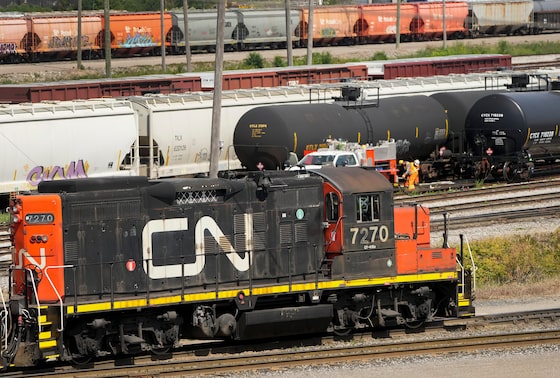
With final fourth-quarter volumes coming in weaker than anticipated, National Bank Financial analyst Cameron Doerksen lowered his forecast and target price for shares of Canadian National Railway Co. (CNR-T).
“Recall that CN was expecting to finish the year at the low end of its 3-5-per-cent guidance range for RTM [revenue ton mile] growth, which would imply that Q4 needed to show some improvement year-over-year,” he said. “However, due largely to an early winter onset as well as some derailments late in the quarter (which also added to costs), Q4 volumes were down 3.2 per cent year-over-year with volumes for the year finishing up just 1.1 per cent. Cold weather throughout western Canada hampered the company’s ability to clear the backlog of container ships that built up as a result of the strike at Canada’s west coast ports and with the prairie region particularly affected by the cold weather, CN’s Canadian grain volumes were also impacted.”
While he already lowered his fourth-quarter earnings per share in early December, Mr. Doerksen decided to make a further reduction (to $1.92 from $2.06) based on softer-than-anticipated volumes as well as the additional costs incurred in the quarter. He also trimmed his 2025 and 2026 estimates, “noting that our forecast does not assume any material volume impact from possible U.S. tariffs.”
With that change, Mr. Doerksen moved his target for CN shares to $178 from $181, keeping an “outperform” rating and emphasizing he sees its relative valuation remaining “attractive.”
“Based on our updated 2025 forecast, CN shares are trading at 18.1 times P/E, which is well-below the five-year forward average of 22.3 times for the stock and only a modest premium to the U.S. peer group at 17.5 times (CN has historically traded at a 2.0 turn premium to the U.S. peers),” he said. “CN is also trading at a material discount to CPKC shares at 21.4 times consensus 2025 estimates.”
“Investor patience with the stock is likely wearing thin following a forgettable 2024 performance from CN and tariff risk is likely to remain an overhang in the near term. We nevertheless remain hopeful for a better 2025 for CN Rail, but concede that the company will need to show better execution in the coming quarters if the stock is to move meaningfully higher.”
=====
While warning Capital Power Corp. (CPX-T) is likely to be hurt by a softer power market in Alberta this year, Desjardins Securities analyst Brent Stadler thinks Constellation Energy Corp.’s (CEG-Q) recent agreement to acquire Calpine Corp. for US$29.1-billion highlighted that there is “more value” in high-quality gas platforms than he previously projected.
“We have analyzed the Alberta power market, specifically over the past 30 days (ie since supply has come online with colder weather), including pricing (averaging $33/MWh) and facility capacity factors,” he said. “We are adjusting our estimates to reflect this analysis ahead of CPX’s guidance update at 4pm EST on January 16.
“Recalibrating our 2025 estimates. We have made a few adjustments to our model to (1) reflect expectations for lower merchant power prices in 2025 and 2026 by reducing our assumptions to $50/MWh and $55/MWh, respectively; (2) modestly trim our generation expectation; (3) modestly push the Halkirk 2 COD to April 1, 2025 (from December 2024); and (4) incorporate some modest conservatism throughout our model. Our 2025 EBITDA estimate of $1.420-billion is modestly below consensus of $1.441-billion (analyst estimates range from $1.381–1.515-billion). In our view, more extreme weather and facility outages could drive upside to our estimates; however, we are expecting lower power price volatility in 2025.”
While those changes led to a reduction to his 2025 and 2026 earnings and free cash flow projections, Mr. Stadler expressed “further confidence in the value of a high-quality gas platform,” leading him to cut his discount rate on its gas assets.
“We continue to believe that CPX has material catalysts on the horizon,” he added.
“Potential material catalysts include: (1) Partnership announcement with a technology company in Alberta and/or the U.S. to power AI/data centres; (2) recontracting gas assets in the U.S.; and (3) opportunistic U.S. gas M&A given the company is currently cashed up. It is possible we will receive an update on these catalysts on January 16.”
Reiterating his “buy” rating for Capital Power shares, Mr. Stadler increased his target by $1 to $65. The average is $63.
“In our view, CPX offers investors deep value and exposure to a balanced approach to the energy transition, and is a top way to play the AI/data centre theme,” he said.
=====
In a report released Tuesday titled The Riches Are in the Niches, Scotia Capital analyst Jonathan Goldman initiated coverage of Terravest Industries Inc. (TVK-T) with a “sector outperform” rating, seeing an attractive entry point following a sell-off that came in the wake of its fourth-quarter results.
“TerraVest is primarily an OEM of steel storage tanks and transport trailers,” he said. “Led by what we view as best-in-class operators and capital allocators, it is one of the best-executed roll-ups in Canada and best-performing stocks on the TSX, returning 35 per cent per year on average in the past 10 years. Despite the recent run up in the shares, the roll-up is still in its prime and supportive of the current valuation (if not multiple expansion), in our view. The opportunity set is much broader than investors let on and management has demonstrated an ability to venture into new niches. Given its relatively small size, TVK is still at a sweet spot where it can find ample opportunities to reinvest capital at high rates of return (more than 20-per-cent cash on cash pre-synergies) that still move the needle. With the balance sheet cashed up following the equity raise last May (only second raise since 2010), we think TVK will be active on M&A and execute on a Highland Tank-sized transaction. The sell-off post-4Q results, which we view as a seasonal anomaly, provides an attractive entry point.”
Mr. Goldman told investors to “bet on the jockey, not the horse,” noting the company’s management “boasts an impressive track record of capital allocation, closing on 22 acquisitions over the past 10 years and overseeing 20-per-cent EBITDA/ share CAGR [compound annual growth rate] in the process.”
“Management seeks out businesses in niche end-markets with defensible leadership positions and low capex, enabling quick paybacks on M&A capital and recycling of FCF into accretive M&A,” he added.
“M&A playbook: Buy cheap, make cheaper. The company aims to pay 3 times to 5 times and take off at least a turn through steel procurement synergies and pricing optimization (i.e., bringing up pricing of acquired businesses in line with peers). Management keeps an active list of more than 300 targets and has demonstrated ability to identify new niches within its core manufacturing competency. A Highland Tank-sized transaction, its largest ever at $100 million, or 4 times LTM [last 12-month] EBITDA, would still move the needle. As the company scales and pursues larger targets, multiples will creep up. But Arcosa’s sale of its tank business in 2022 for US$275 million, or 5.1 times EV/EBITDA, demonstrates that chunkier targets are still out there at attractive valuations.”
He set a target of $125, exceeding the average on the Street of $120.
“We assume the main pushback to our SO rating is our valuation multiple. TVK trades at 12 times 2025 estimated EV/EBITDA, well above historicals and a motley group of peers,” he sai. “More eyes on the story undoubtedly helped, but to us, TVK’s multiple expansion is an acknowledgment (finally) of its track record of creating shareholder value. Our valuation multiple effectively extends this view and more closely aligns with a group of Canadian SMid-cap compounders.
“Better entry point. Shares are down 10 per cent since reporting in-line 4Q results. We view the weaker organic growth in HVAC as a one-timer related to warm September weather and uncertainty around boiler regulations in the U.S. and the elections. We are ahead of consensus for 2025 and 2026 as we think the Street is overestimating potential margin compression from rising steel prices. Given the concentration of insider ownership and shareholder alignment, we think the equity raise could signal an acceleration in the pace or size of M&A.”
=====
In other analyst actions:
* Canaccord Genuity’s Zachary Weisbrod initiated coverage of Firm Capital Mortgage Investment Corp. (FC-T) with a “buy” raying and $14 target. The average is $13.50.
“Our investment thesis is based on a conservatively structured company with an attractive dividend yield, an experienced mortgage manager with risk management expertise, and industry leading profitability benchmarks,” he said.
* CIBC World Markets’ Scott Fletcher initiated coverage of FirstService Corp. (FSV-Q, FSV-T) with an “outperformer” rating and US$211 target. The average is US$208.47.
“We view FirstService as an excellent buy-and-hold business, with a proven track record of sustainable revenue growth and compounding earnings and free cash flow (FCF),” he said. “As a provider of essential outsourced property services, FirstService has a durable revenue profile, with businesses that are benefitting organically from a number of demographic and environmental trends and a repeatable, value‑creating approach to M&A. FirstService consistently trades at a premium multiple, and with the premium to peers and broader indices in line with or at a discount to historical norms, we have opted for an Outperformer rating as we expect FSV to continue to grow earnings and cash flow over the long run.”
* In a note previewing 2025 for his industrials coverage universe, Stifel’s Daryl Young lowered his targets for Colliers International Group Inc. (CIGI-Q/CIGI-T, “buy”) to US$165 from US$180 and FirstService Corp. (FSV-Q, FSV-T, “buy”) to US$215 from US$217. The averages are US$152.98 and US$208.47.
“Heading into 2025, the Canadian backdrop remains highly uncertain given the weak Canadian consumer, uncertain political climate, depressed Canadian dollar, and the threat of U.S. tariffs. As such our positioning this year is geared towards companies with a higher mix of U.S. earnings, companies with self-help prospects, and those with earnings derived from essential services versus those tied to consumer/cyclical end-markets. Our Top Picks for 2025 are Boyd Group Services Inc. (BYD-T) and FirstService Corp (FSV-T), while we think Superior Plus (SPB-T) represents a compelling smaller cap value idea,” he said.
* Raymond James’ Steve Hansen hiked his target for Methanex Corp. (MEOH-Q, MX-T) to US$60 from US$54. The average is US$58.09.
“We are increasing our target price on Methanex Corp. … to reflect rallying global methanol prices over the past several months in response to sweeping capacity outages across several key production hubs (Iran, Equatorial Guinea, Venezuela),” he said. “Contract prices have followed in tandem, creating a solid fundamental backdrop for Methanex to generate healthy (excess) free cash flow. We have bumped our estimates accordingly. Against this backdrop, we reiterate our Outperform rating based upon: 1) our constructive view of long-term global methanol fundamentals; 2) Methanex’s attractive earnings & FCF growth profile; & 3) our positive take on the company’s acquisition of OCI Global’s international methanol business.”