Latest Updates
Wall Street’s so-called fear gauge has dropped this week, as the U.S. stock market appeared relieved that Treasury yields retreated from their recent climb.
The Cboe Volatility Index was down 3.5% on Friday afternoon at 16, bringing its fall so far this week to 18%, according to FactSet data, at last check. The gauge, which trades under the ticker symbol VIX, was trading Friday below its longer-term average of around 20.
As for stocks, the S&P 500 was up sharply Friday afternoon for a gain so far this week of 3.1%, according to FactSet data, at last check. Meanwhile, the yield on the 10-year Treasury was down so far this week, at around 4.61% in Friday afternoon trading, FactSet data show.
Gold has started the year off strong, with prices having already gained 5% since the end of 2024 and taking a shot at fresh record highs.
Investors are betting on lower U.S. interest rates this year, and when rates drop, “gold should catch a bid,” said Adam Koos, president of Libertas Wealth Management Group. Global central banks are also “hoarding gold like food at the start of the apocalypse — and with geopolitical tensions and sanctions in play, the yellow metal is their go-to for security.” Meanwhile, between Middle East clashes and U.S. President-elect Donald Trump’s “unpredictable policy playbook, investors are eying gold as their trapeze net, safe-haven trade,” said Koos.
“If these drivers stick around, gold is likely to continue climbing,” he said, but if the Federal Reserve “suddenly gets hawkish … or if the dollar flexes its muscles, we could discover holes in that trapeze net.”
On Comex, February gold edged down by $2.20, or nearly 0.1%, to settle at $2,748.70 an ounce Friday. Prices still gained 1.2% for the week, according to Dow Jones Market Data. Based on the front-month contracts, prices last marked a record settlement of $2,800.80 on Oct. 30.
A gauge of the U.S. equities market that equally weights stocks in the S&P 500 index was up again Friday, as the market continued its broad rally this week.
The Invesco S&P 500 Equal Weight ETF was gaining 0.8% Friday, on pace to rise slightly more than 4% this week, according to FactSet data, at last check. The exchange-traded fund was on pace for a bigger weekly gain than the S&P 500, which has a heavy weighting in Big Tech stocks.
The S&P 500 was up a sharp 1.3% on Friday afternoon, on pace to gain slightly more than 3% this week, FactSet data show, at last check.
The S&P 500’s energy sector is on a tear lately, with an exchange-traded fund targeting stocks in that part of the market on pace for its best week since 2023.
The Energy Select Sector SPDR Fund was up 1% in early afternoon trading Friday, on pace for an eighth straight day of gains, FactSet data show, at last check. That put the energy ETF on its longest winning streak since September 2023, according to Dow Jones Market Data.
U.S. oil prices are up so far this year, with West Texas Intermediate Crude trading at around $78 dollars a barrel on Friday, FactSet data show, at last check.
U.S. stocks were trading sharply higher Friday, with all three major benchmarks on track for weekly gains amid a retreat in Treasury yields.
The Dow Jones Industrial Average was up about 432 in midday trading Friday, or 1%, at around 43,583.
The S&P 500 gained 66 points, or 1.1%, to nearly 6,004.
The Nasdaq Composite rallied 290 points, or 1.5%, to around 19,628.
For the week, the Dow was on track to climb 3.9%, the S&P 500 was on course to rise 3% and the technology-heavy Nasdaq Composite was on pace to gain 2.4%, according to FactSet data midday Friday.
In the bond market, the yield on the 10-year Treasury note has fallen so far this week, despite being up slightly in Friday’s trading session at around 4.62%, according to FactSet data, at last check.
There is one part of the interest-rate market that saw the chances of a 2025 rate hike growing over much of this week, or since last Friday’s surprisingly strong nonfarm payrolls report for December came out.
It is in options on the Secured Overnight Financing Rate, which replaced Libor. Implied probabilities based on these options suggested that there was an up to 30% possibility the Federal Reserve will need to raise interest rates this year, according to strategists at TD Securities. As of Friday, that likelihood had slipped to 19%.
“The bar for rate hikes remains very high, in our view,” the strategists wrote this week. They said that as long as inflation resumes its gradual downtrend toward the 2% objective, “the Fed will maintain an easing bias.”
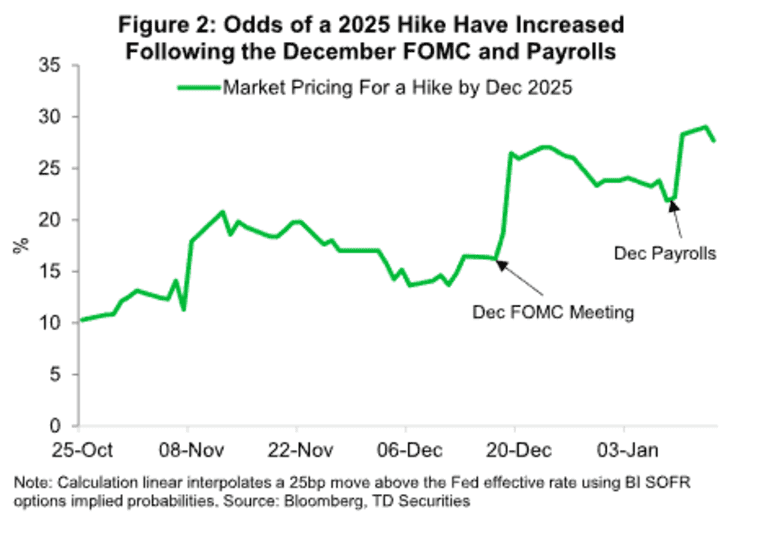
Market expectations for a 2025 rate hike, based on SOFR-options implied probabilities. (Bloomberg, TD Securities)
President Joe Biden was still in Oval Office Friday, but investors appear to have already moved on, as was becoming increasingly evident in the stock market’s bullish trading action.
Asked why stocks were up so strongly on the final trading day of Biden’s presidency, Doug Fincher, portfolio manager at Ionic Capital, told MarketWatch: “It’s Trump.”
Donald Trump, set to be sworn in for a new term in the White House on Monday, “had a call with [Chinese leader] Xi [Jinping], and the China names are ripping. The assumption is Trump is going to have an executive order on bitcoin, and bitcoin and the bitcoin names are ripping,” he said.
Trump wasn’t the only factor boosting markets this week. A softer-than-expected reading on core CPI earlier this week helped to assuage investors’ anxiety about the direction of interest rates in 2025.
But as the president-elect prepares to take the oath of office on Monday, traders are increasingly keying in on their hopes for his second term in office.
Small-cap stocks are rallying this week, after bouncing off their 200-day moving average as they attempt to recover from their slump over the past month.
The Russell 2000 index, a measure of small-cap equities, was up slightly more than 4% so far this week and on track to post five straight days of gains, according to FactSet data late morning Friday. The index is rebounding from a 3.5% loss last week and is down more than 2% over the past month based on Friday morning trading levels.
The 200-day moving average of the Russell 2000 provided a “support” level for small-cap stocks, according to a note Friday from Katie Stockton, founder of Fairlead Strategies. Fairlead expects the Russell 2000 to outperform the S&P 500 index “in the near term as part of the rotation away from megacaps,” she said.
The Russell 2000 was trading up 0.6% late morning Friday at around 2,280, rising towards its 50-day moving average of almost 2,325 and above its 200-day moving average of 2,170, FactSet data show, at a last check. The S&P 500, a gauge of large-cap U.S. equities, was up 1.1% in late-morning trade and on pace to climb around 3% this week.
The U.S. stock market will be closed on Monday in observance of Martin Luther King Jr. Day, so equity traders won’t be able to immediately react to what President-elect Donald Trump says in his inaugural address.
The bond market will also be closed.
But the global currency and commodity markets will be open for business, giving traders an opportunity to react to Trump’s speech in real time. Strategists at Macquarie expect they could make their views quickly felt across a number of markets, depending on what Trump chooses to emphasize in his remarks.
“We can’t help but think that some topics that Trump will touch upon on Monday — and what Trump says (or doesn’t say about them) could be market-moving. Of course, detailed policy details are unlikely to emit on Monday, as that might risk restricting Trump’s room for negotiations with Congress and foreign counterparts later,” said Thierry Wizman, global currency and rates strategist at Macquarie.
“But the topics that are touched upon, and the tone used, could signal near-term priorities, which could be pounced on by traders to inform market direction,” he said.
Among the many issues Trump could touch on, Wizman flagged deficits and defense spending, immigration, energy and the Russia-Ukraine war as potentially market-moving.
“There are many ways that Trump’s inaugural address and the things that it emphasizes can move yields, FX, and even commodity prices on Monday. That’s especially true with the prospect that the priorities articulated in the address can be soon ‘actualized’ via executive actions in the first few days and weeks of the administration,” he added.
Shares of DestinyTech 100 Inc., a closed-end fund that offers investors exposure to private companies such as SpaceX and OpenAI, are down 2.9% Friday following the explosion of SpaceX’s Starship spacecraft.
Starship exploded during its seventh flight test Thursday, although SpaceX CEO Elon Musk has described the incident as “barely a bump in the road” for the company’s Starship program.
SpaceX is the top holding in the DestinyTech 100 portfolio, followed by fintech company Revolut, private space company Axiom Space, and artificial-intelligence software company OpenAI.