TEHRAN, Iran (AP) — President Donald Trump on Monday expanded his threat against Iran to include all power plants and bridges as his ultimatum to make a deal ticked closer, after Tehran rejected a 45-day ceasefire proposal and said it wants a permanent end to the war.
“The entire country can be taken out in one night, and that night might be tomorrow night,” Trump said. He suggested that his Tuesday 8 p.m. ET deadline was final, saying he’d already given Iran enough extensions.
The U.S. has told Iran to open the crucial Strait of Hormuz to all shipping traffic or see power plants and bridges wiped out, sparking warnings about possible war crimes.
Israel piled on pressure by attacking a major petrochemical plant and killing the intelligence chief for the paramilitary Revolutionary Guard.
Tehran with its rejection conveyed its own, 10-point plant to end the fighting through Pakistan, a key mediator, Iran’s state-run IRNA news agency said.
“We only accept an end of the war with guarantees that we won’t be attacked again,” Mojtaba Ferdousi Pour, head of Iran’s diplomatic mission in Cairo, told The Associated Press. He said Iran no longer trusts the Trump administration after the U.S. bombed the Islamic Republic twice during previous rounds of talks.
A regional official involved in talks said efforts had not collapsed. “We are still talking to both sides,” he said, speaking on condition of anonymity to discuss closed-door diplomacy.
AP AUDIO: Israel hits Iranian petrochemical plant in massive gas field as Trump deadline approaches
AP correspondent Charles de Ledesma reports a leading Tehran university has come under attack.
And even Trump said negotiations with Iran continued.
Trump says Iranians ‘willing to suffer’ for freedom
Trump has issued ultimatums to Iran before, only to find ways to back off. But he was more explicit this time on plans to follow through.
“Every bridge in Iran will be decimated by 12 o’clock tomorrow night,” he said, and all power plants will be “burning, exploding and never to be used again.”
Asked if he was concerned about accusations of war crimes, Trump responded, “No, not at all.” He suggested that Iranians want the U.S. to carry out its threats because it could lead to the end of their current leadership.
Iranian citizens are “willing to suffer,” he said, “in order to have freedom.” But there has been no sign of an uprising in Iran as residents shelter from bombardment.
International warnings piled up against expanded strikes. “Any attack on civilian infrastructure is a violation of international law and a very clear one,” United Nations spokesperson Stephane Dujarric later told journalists.
Egyptian, Pakistani and Turkish mediators had sent Iranian Foreign Minister Abbas Araghchi and U.S. Mideast envoy Steve Witkoff a proposal calling for the ceasefire and the reopening of the Strait of Hormuz, two Mideast officials told the AP. The officials spoke on condition of anonymity to discuss the private negotiations.
Iranian and Omani officials also were working on a mechanism for administrating the strait, through which a fifth of the world’s oil is shipped in peacetime. Iran’s grip on it has shaken the world economy.
Tehran has refused to let U.S. and Israeli vessels through after they started the war on Feb. 28.
Iran’s new supreme leader makes rare statement
Israel struck a key petrochemical plant in the South Pars natural gas field, saying it was aimed at eliminating a major source of revenue for Iran. The field, the world’s largest, is shared with Qatar and is Iran’s biggest source of domestic energy for its 93 million people.
The strike appeared to be separate from Trump’s threats. An earlier Israeli attack there in March prompted Iran to target energy infrastructure in other Middle East countries, a major escalation.
Israel also killed the head of intelligence for Iran’s paramilitary Revolutionary Guard, Maj. Gen. Majid Khademi, according to Iranian state media. And Israel said it killed the leader of the Revolutionary Guard’s undercover unit in its expeditionary Quds Force, Asghar Bakeri.
“We will continue to hunt them down one by one,” Israeli Defense Minister Israel Katz said of top Iranian officials.
New Supreme Leader Mojtaba Khamenei, who still has not been seen or heard in public, issued a rare statement expressing condolences over Khademi. Israeli strikes have killed dozens of top Iranian leaders, including Khamenei’s father.
Israel’s military also said it struck three Tehran airports overnight — Bahram, Mehrabad and Azmayesh — hitting dozens of helicopters and aircraft it said belonged to the Iranian Air Force.
A Tehran resident said “constantly there is the sound of bombs, air defenses, drones,” speaking on condition of anonymity for her safety. Another detailed taking sleeping pills to get through nightly bombardments, and said people worry about power, gas and water cuts.
Airstrikes kill more than 25 across Iran
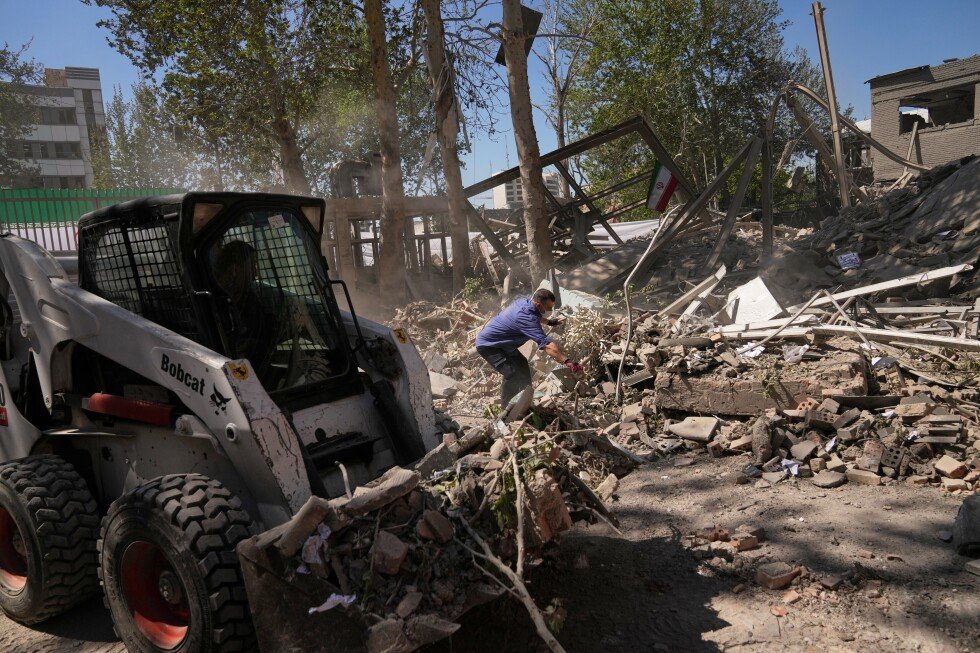
Smoke rose near Tehran’s Azadi Square after an airstrike hit the grounds of the Sharif University of Technology. Multiple countries have sanctioned the university for its work with the military, particularly on Iran’s ballistic missile program.
Authorities and Iranian state media reported at least 29 people killed across the country by strikes.
In Lebanon, where Israel has launched air attacks and a ground invasion that it says target the Iran-linked Hezbollah militia, an airstrike hit an apartment in Ain Saadeh, a predominately Christian town east of Beirut. It killed an official in the Lebanese Forces, a Christian political party strongly opposed to Hezbollah, his wife and another woman.
More than 1,900 people have been killed in Iran since the war began, but the government has not updated the toll for days.
More than 1,400 people have been killed in Lebanon and more than 1 million people have been displaced. Eleven Israeli soldiers have died there.
In Gulf Arab states and the occupied West Bank, more than two dozen people have died, while 23 have been reported dead in Israel and 13 U.S. service members have been killed.
___
Weissert reported from Washington, Magdy from Cairo and Gambrell from Dubai, United Arab Emirates. Munir Ahmed in Islamabad, Isabel DeBre in Ain Saadeh, Lebanon, Edith M. Lederer at the United Nations, Amir-Hussein Radjy in Cairo and Josh Boak and Michelle L. Price in Washington contributed to this story.



![i’m-nervous,-too!-[part-2]](https://10xwealthreport.com/wp-content/uploads/2026/03/177042-im-nervous-too-part-2-1568x784.jpg)