Be ready for a savage stock market crash

Feb 25, 2026
be-ready-for-a-savage-stock-market-crash

Some writers here at The Motley Fool have been worrying about an AI-driven stock market crash. And it seems others are waking up to the risk because an AI doomsday Substack post has gone viral this week.

The post from Citrini Research even caused a number of stocks mentioned to drop sharply on Monday (23 February). These included DoorDash, American Express, and (fittingly) Monday.com.

What did this post say? And how worried should we be?

The lengthy post in question — entitled The 2028 Global Intelligence Crisis — describes a fictional future where AI rapidly displaces human labour.

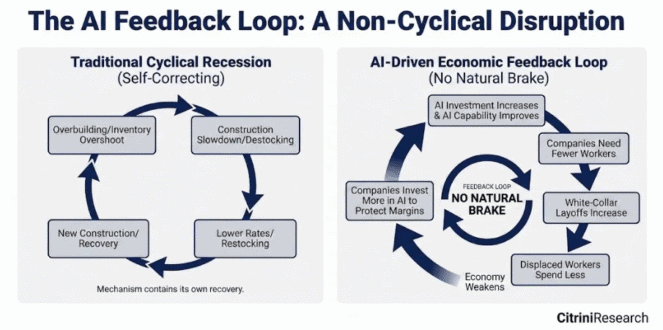
A negative feedback loop emerges where companies, facing margin pressure, replace white-collar workers with AI. This soon reduces consumer spending, leading to further layoffs.

Meanwhile, autonomous AI agents do more tasks for consumers (insurance renewals, travel booking, shopping, etc). Unlike humans, AI agents aren’t loyal to apps like Uber or Booking, so a huge amount of enterprise value is destroyed.

The S&P 500 starts crashing.

Jobs become harder to find and the crisis threatens the $13trn residential US mortgage market as white-collar incomes vanish.

The paradox here is that this scary scenario is only possible if AI truly succeeds, not fails.

<em>Source: Citrini Research</em>” height=”330″ loading=”eager” src=”https://s.yimg.com/ny/api/res/1.2/z21OQ7FyId_d8dMsNlpQog–/YXBwaWQ9aGlnaGxhbmRlcjt3PTk2MDtoPTQ3OA–/https://media.zenfs.com/en/fool.co.uk/67ff062f30dbd2030ec05db5a39c7938″ width=”663″></img></p>
</div><figcaption><em>Source: Citrini Research</em>  </figcaption></figure>
<p>As alarming as all this sounds, it’s important to remember this is just an imagined scenario/warning, not a prediction.</p>
<p>Second, the 2028 timeframe is deliberately provocative. There’s no conclusive evidence AI is causing massive layoffs, while the physical AI buildout is <span>creating</span> jobs. So the economy appears in no immediate danger.</p>
<p>Moreover, elected governments are not passive observers. If unemployment were to rapidly reach the 10%+ described in the Citrini piece, we would likely see regulatory intervention to slow the pace of AI deployment.</p>
<p>Further down the line, measures like Universal Basic Income or job-retraining programmes could be funded by AI productivity taxes.</p>
<p>Today, generative AI still hallucinates. In regulated industries (finance, law, medicine, etc), a human with the proper authority still has to sign off.</p>
<p>Finally, nobody can predict exactly <span>when</span> a crash will happen.</p>
<p>But we should at all times be ready for a big crash, whether it’s generated by AI, a pandemic, a financial crisis or something else. As I see it, there are there basic things we can do to prepare for the worst:</p>
<ul>
<li>
<p>Don’t panic</p>
</li>
<li>
<p>Build up cash to buy wonderful companies at lower prices.</p>
</li>
<li>
<p>Focus on diversification</p>
</li>
</ul>
<p>This last part is crucial. In my portfolio, I hold <strong>AstraZeneca</strong> (LSE:AZN). To my mind, the pharma giant looks more likely to benefit from the technology than be disrupted by it.</p>
</p></div>
                </div><!-- .entry-content -->


            </article><!-- #post-174062 -->

        </div>
     
            <div class=

CONNECT & FOLLOW

SPECIAL POST

Leave a comment