We use cookies to understand how you use our site and to improve your experience.
This includes personalizing content and advertising.
By pressing “Accept All” or closing out of this banner, you consent to the use of all cookies and similar technologies and the sharing of information they collect with third parties.
You can reject marketing cookies by pressing “Deny Optional,” but we still use essential, performance, and functional cookies.
In addition, whether you “Accept All,” Deny Optional,” click the X or otherwise continue to use the site, you accept our Privacy Policy and Terms of Service, revised from time to time.
You are being directed to ZacksTrade, a division of LBMZ Securities and licensed broker-dealer. ZacksTrade and Zacks.com are separate companies. The web link between the two companies is not a solicitation or offer to invest in a particular security or type of security. ZacksTrade does not endorse or adopt any particular investment strategy, any analyst opinion/rating/report or any approach to evaluating individual securities.
If you wish to go to ZacksTrade, click OK. If you do not, click Cancel.

Since Chat GPT was released to the public in November 2022, the value of artificial intelligence (AI) stocks has skyrocketed.
The best example is the story of a once relatively unknown chipmaker, NVIDIA. Valued at just over $10 billion in early 2015, the company had just crossed the threshold as a Large Cap stock. In 2025, NVIDIA became the first company to cross a market value of $5 trillion, leap-frogging tech titans like Apple and Microsoft thanks to the AI wave.
Many more companies are investing heavily into supporting AI goods and services. Last year alone, US private AI investment grew to $109.1 billion, according to Stanford University’s 2025 AI Index Report.
How to best capitalize on the growth of AI stocks? Here, we analyze and rank the best AI stocks to buy now based on our proprietary Zacks Indicator Score (to see a full list of AI stocks, visit our Artificial Intelligence thematic stock screen).
5 Best AI Stocks to Buy Today
| Company (Ticker) | 12 Week Price Change | Forward PE | Price | Proj EPS Growth (1 Year) | Projected Sales Growth (1Y) |
|---|---|---|---|---|---|
| Micron Technology (MU) | 81.25% | 12.35 | $424.00 | 307.50% | 99.65% |
| Teradyne (TER) | 76.11% | 53.44 | $322.25 | 49.27% | 28.47% |
| Intuitive Surgical (ISRG) | -13.01% | 49.80 | $499.74 | 12.33% | 14.86% |
| Lam Research (LRCX) | 53.02% | 45.15 | $241.48 | 27.00% | 20.03% |
| Trimble (TRMB) | -17.08% | 19.08 | $67.74 | 12.83% | 7.58% |
Micron Technology (MU)
$424.00 USD +6.65 (1.59%)
3-Year Stock Price Performance
- Market Cap: $463.33 B (Mega Cap)
- Projected EPS Growth:307.48%
- Last Quarter EPS Growth:61.19%
- Last EPS Surprise:22.25%
- Next EPS Report date:March 19, 2026
Our Take:
Micron delivered record revenue across dynamic random-access memory (DRAM), NAND flash and data center products, with cloud memory and core data center units reaching highs amid pricing strength. Industry demand is rising as AI center buildouts expand, while supply constraints and lead times sustain conditions. Micron is increasing spending to expand high-bandwidth memory (HBM) and advanced-node output, and projects a total addressable market (TAM) of $100 billion by 2028.
A Zacks Rank #1 (Strong Buy) reflects persistent upward estimate revisions. The Growth Score of A signals improving earnings power, while the Momentum Score of B indicates favorable price or estimate trends despite a Value Score of D. Together, these suggest investors are paying up for accelerating AI end-markets.
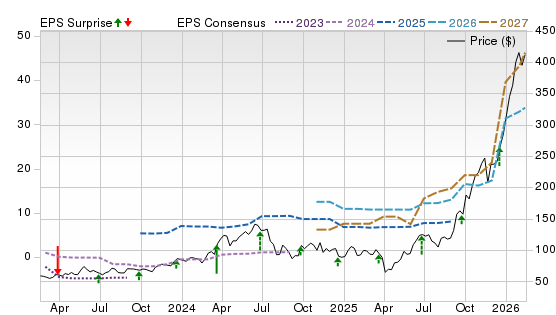
On the Price, Consensus & EPS Surprise chart, MU’s stock climbs alongside rising 2026–2027 EPS consensus, with estimate lines inflecting higher after the HBM3E ramp, evidence of estimate momentum aligning with price strength.
Teradyne (TER)
$322.25 USD +6.35 (2.01%)
3-Year Stock Price Performance
- Market Cap:$49.28 B (Large Cap)
- Projected EPS Growth:49.24%
- Last Quarter EPS Growth:111.76%
- Last EPS Surprise:32.35%
- Next EPS Report date:April 27, 2026
Our Take:
Teradyne’s semiconductor test business is increasingly aligned with AI infrastructure, with over 60% of revenue tied to AI applications and Semiconductor Test representing roughly 80% of the portfolio. The company is targeting a $12 billion to $14 billion Automated Test Equipment (ATE) market opportunity and a path toward $6 billion in revenue, supported by AI-led growth across compute, memory, photonics, and high-performance interconnect. Robotics is positioned around Physical AI, expanding its addressable market while reducing implementation complexity.
Its Zacks Rank #1 captures brisk estimate revisions. A Growth Score of A underscores earnings acceleration, while the Momentum Score of C and Value Score of F indicate a run-up that’s less about valuation and more about improving fundamentals tied to AI testing cycles.
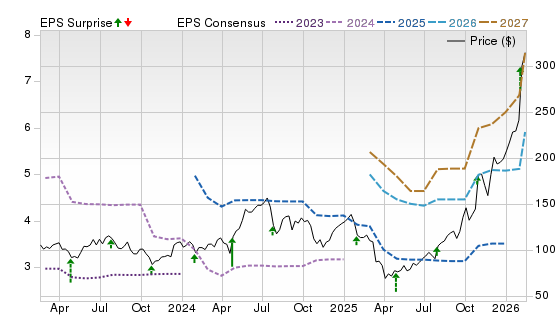
The chart shows a sharp price breakout with 2026–2027 EPS lines stair-stepping higher, supporting the view that estimate momentum, not multiple expansion alone, is driving the move.
Intuitive Surgical (ISRG)
$499.74 USD +0.21 (0.04%)
3-Year Stock Price Performance
Premium Research for ISRG
- Market Cap:$172.54 B (Large Cap)
- Projected EPS Growth:12.32%
- Last Quarter EPS Growth:7.14%
- Last EPS Surprise:12.44%
- Next EPS Report date:April 28, 2026
Our Take:
Intuitive, a global leader in minimally invasive care and a pioneer in robotic-assisted surgery, continues to see strong procedure momentum across its da Vinci and Ion platforms, alongside expanding system placements and a growing installed base, underscoring sustained adoption of its technologies worldwide. Looking ahead, the company expects continued procedure growth and anticipates maintaining solid gross margins while managing operating expenses. Management remains focused on navigating tariff impacts, supporting customers, and investing in innovation, infrastructure, and long-term capabilities to advance minimally invasive care.
A Zacks Rank #1 reflects positive estimate revisions, while Style Scores of D for Value, C for Growth, and D for Momentum indicate a mixed quantitative profile, suggesting investors may be looking past near-term valuation and price trends.
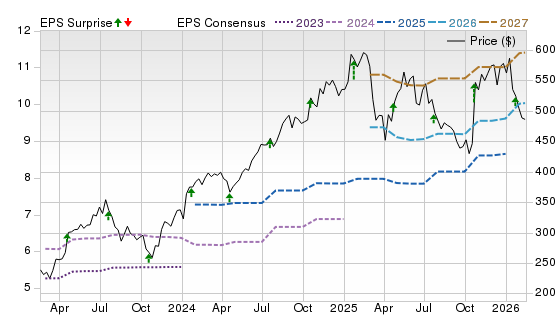
On the chart, ISRG’s shares have surged with a recent up-curve in the 2026–2027 consensus lines, suggesting the market is starting to discount contributions from da Vinci 5’s higher-compute, software-rich model.
Lam Research (LRCX)
$241.48 USD +4.09 (1.72%)
3-Year Stock Price Performance
Premium Research for LRCX
- Market Cap:$294.12 B (Mega Cap)
- Projected EPS Growth:27.05%
- Last Quarter EPS Growth:0.79%
- Last EPS Surprise:8.55%
- Next EPS Report date:April 22, 2026
Our Take:
Lam Research highlighted accelerating advanced packaging momentum driven by AI, with critical support for foundry-logic integration and transitions to next-generation high-bandwidth memory architectures. Management expects its advanced packaging business to outpace broader wafer fabrication equipment growth as industry investment strengthens. The company emphasized vertical scaling as a structural growth driver, noting that each new technology node expands opportunity. It also pointed to strong installed base expansion and share gains in wafer fabrication equipment, supported by disciplined execution and continued investment in manufacturing capacity.
A Zacks Rank #1 reflects rising estimates. While Style Scores are mixed with F for Value, C for Growth and D for Momentum, the Rank indicates analysts are revising upward as AI-led wafer-fab equipment demand stabilizes and packaging intensity increases.
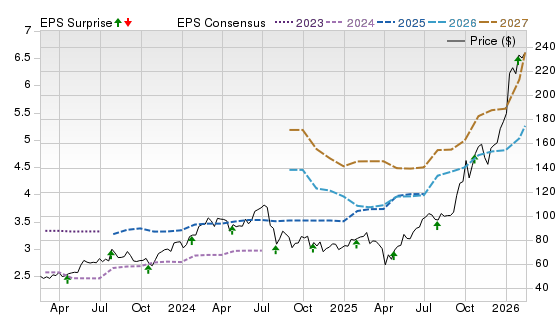
The chart features a decisive price ramp with 2026–2027 EPS consensus turning higher, signaling that upward estimate revisions are following the stock’s breakout, consistent with an AI-driven equipment upcycle.
Trimble (TRMB)
$67.74 USD +0.35 (0.52%)
3-Year Stock Price Performance
Premium Research for TRMB
- Market Cap:$15.80 B (Large Cap)
- Projected EPS Growth:12.78%
- Last Quarter EPS Growth:25.71%
- Last EPS Surprise:4.17%
- Next EPS Report date:May 6, 2026
Our Take:
Trimble is focused on connecting its different software tools so customers can manage work in one place instead of using separate systems. Its connect and scale strategy links design, construction and operations into smoother workflows, delivered increasingly through subscription offerings. Across construction, field technology and transportation businesses, Trimble is expanding software and services that work together. It is encouraging customers to use multiple products, adding subscription options and introducing AI-based tools like autonomous procurement and autonomous quotation to improve efficiency.
With a Zacks Rank #1, estimates are trending higher. Style Scores of D for Value, F for Growth and B for Momentum reflect near-term multiple pressure but improving price action as investors look to AI-enabled services and subscriptions.
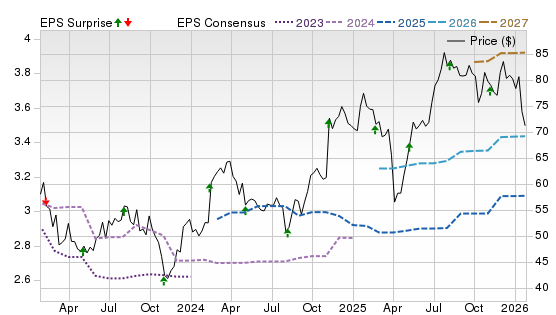
The chart shows a choppy base but improving 2026–2027 consensus and a recent price upturn, suggesting the market is beginning to discount AI-driven workflow adoption across construction and logistics.
Methodology
The Zacks Rank is a proprietary stock-rating model that uses trends in earnings estimate revisions and earnings-per-share (EPS) surprises to classify stocks into five groups: #1 (Strong Buy), #2 (Buy), #3 (Hold), #4 (Sell) and #5 (Strong Sell). The Zacks Rank is calculated through four primary factors related to earnings estimates: analysts’ consensus on earnings estimate revisions, the magnitude of revision change, the upside potential and estimate surprise (or the degree in which earnings per share deviated from the previous quarter).
Zacks builds the data from 3,000 analysts at over 150 different brokerage firms. The average yearly gain for Zacks Rank #1 (Strong Buy) stocks is +23.62% per year from January, 1988, through June 2, 2025.
Selections for Best AI Stocks are based on the current top ranking stocks based on Zacks Indicator Score. For this list, only companies that have average daily trading volumes of 100,000 shares or more and at least five analysts covering the stock were considered. All information is current as of market open, Feb. 16, 2026.
Guide to AI Stocks
The classification of “AI Stocks” is actually quite broad, ranging from companies that provide the essential hardware, companies that create the software to run Large Language Models, and a whole host of other industries and companies that are creating the Artificial Intelligence ecosystem. All stand to gain – or lose – depending on the fortunes of AI tech.
Types of AI Stocks
Hardware (GPUs, Chips) Stocks – NVIDIA, AMD, TSMC, Broadcom
The backbone of AI is raw computing power, and this comes primarily from specialized chips like graphics processing units (GPUs) and AI-focused accelerators. NVIDIA (NVDA – Free Report) is the undisputed leader in GPUs used for training large language models.
Advanced Micro Devices (AMD – Free Report) is a rising competitor, with its MI300 series targeting data center AI workloads. Taiwan Semiconductor Manufacturing Co. (TSMC – Free Report) doesn’t make its own chips but manufactures advanced nodes for nearly every big tech firm—including Apple, Nvidia, and AMD—making it critical to the global AI supply chain. Broadcom (AVGO – Free Report) has carved a niche in custom ASICs (application-specific integrated circuits) for hyperscale cloud providers, which value tailored chips that reduce energy use and maximize throughput.
These companies benefit from structural demand for more computing capacity, but they also face geopolitical risks such as U.S.-China export restrictions and cyclical swings in semiconductor demand.
AI Cloud & Infrastructure – Microsoft, Amazon, Alphabet
Building AI applications at scale requires massive computing infrastructure. Azure from Microsoft (MSFT – Free Report) has become a leader by integrating OpenAI’s models directly into its cloud offerings, giving it a first-mover advantage in AI enterprise adoption. Amazon Web Services, a subsidiary of Amazon (AMZN – Free Report) is deploying its in-house Trainium and Inferentia chips, aiming to lower costs for AI workloads while retaining dominance in cloud services. Alphabet’s (GOOG – Free Report) Google Cloud is leaning heavily on its proprietary Tensor Processing Units (TPUs) and Gemini AI models to differentiate itself.
Investing in these players is less about speculative growth and more about diversified tech giants whose AI investments bolster an already profitable core business.
Enterprise AI Software & Analytics – Palantir, C3.ai, Adobe, Snowflake
AI isn’t just about hardware; software platforms are where businesses actually apply machine intelligence. Palantir (PLTR – Free Report) powers decision-making for defense and large corporations with its Foundry and Gotham platforms. C3.ai (AI) focuses specifically on AI-driven applications across industries like energy, finance, and manufacturing. Adobe (ADBE – Free Report) has integrated AI across its creative suite (e.g., Firefly in Photoshop), while Snowflake (SNOW – Free Report) has added AI-enabled analytics to its cloud data warehousing business.
These stocks tend to have higher growth potential but also higher risk, as adoption timelines and customer budgets can vary widely.
Cybersecurity AI – CrowdStrike
The rise of AI also heightens cyber risks. CrowdStrike (CRWD – Free Report) leads in AI-powered threat detection, using machine learning to flag suspicious behavior across millions of endpoints in real time. With ransomware and nation-state attacks increasing, demand for AI-driven security remains strong. Cybersecurity names often benefit from recurring revenue models, which may help smooth out volatility compared to hardware peers.
Benefits and Risks of AI Stocks
Benefits:
- Secular Growth: AI adoption is still in early innings, with enterprise use cases expanding rapidly.
- Diversified Exposure: Investors can target infrastructure, software, or services depending on risk tolerance.
- First-Mover Advantage: Leaders like NVIDIA and Microsoft are shaping the ecosystem, creating strong economic moats.
Risks:
- Valuations: Many AI leaders are priced for perfection, leaving little margin of safety.
- Hype Cycle: Investor enthusiasm may outrun near-term fundamentals, creating bubble risk.
- Regulation: Governments are exploring AI rules around privacy, bias, and national security, which could reshape business models.
- Competition: Barriers to entry are high, but fast innovation means today’s leader can quickly lose ground.
How to Choose AI Stocks
When evaluating AI stocks, consider:
- Revenue Mix: How much of the company’s growth is truly driven by AI vs. traditional segments?
- Moat & Differentiation: Does the company control unique technology (like NVIDIA’s CUDA software ecosystem)?
- Customer Adoption: Look for companies with recurring contracts or wide adoption across industries.
- Financial Health: Strong balance sheets matter in a capital-intensive industry.
- Valuation Metrics: Compare price-to-earnings (P/E) ratio, price-to-sales (P/S) ratio, and forward growth projections to industry peers.
How to Invest in AI Stocks
There are multiple entry points depending on your goals:
- Direct Stock Picks: Best if you want concentrated exposure to specific company leaders or disruptors.
- AI Exchange-Traded Funds (ETFs): ETFs such as Global X Robotics & Artificial Intelligence ETF (BOTZ) or iShares Robotics and AI ETF (IRBO) provide diversification by investing in a broad range of companies in the AI space.
- Broad Tech ETFs: Like Invesco QQQ (QQQ) or Vanguard Information Technology ETF (VGT), offering AI exposure as part of a bigger tech basket.
- Dollar-Cost Averaging (DCA): A strategy to smooth price volatility by buying at regular intervals AI stocks or funds.
- Long-Term Holds: Since AI is a multi-decade trend, investors who can weather short-term swings may see the best results.
AI Stocks Alternatives
If you want exposure to AI without betting on a single stock:
- ETFs: Offer diversification and reduce single-company risk.
- Private Markets: Startups in robotics, generative AI, and enterprise AI could offer upside, though access is limited to accredited investors, which face income or licensing limitations (such as a net worth of $1 million, excluding primary residence, plus a high annual income – $300,000 if married.
- Picks-and-Shovels Plays: Companies supplying infrastructure, like power management (e.g., Eaton) or data center REITs (e.g., Equinix), benefit indirectly from AI growth.
Strategies for AI Stocks Moving Forward
- Barbell Approach: Combine stable mega-caps (Microsoft, Nvidia) with speculative names (Quantum Computing Inc., Credo) for balanced exposure.
- Rebalancing: Trim positions after strong rallies to lock in gains and redeploy into underweighted sectors.
- Monitor Earnings: Focus on whether AI adoption translates into sustainable revenue growth.
- Look Beyond the U.S.: Consider emerging AI leaders in Europe and Asia for diversification.
- Stay Agile: AI is evolving rapidly; reassess holdings every quarter as new winners emerge.
Frequently Asked Questions About AI Stocks
Are AI stocks overvalued?
Many AI leaders are priced at steep multiples compared to the broader market. That doesn’t mean all are bubbles, but investors should separate hype from earnings-driven growth.
What is the forecast for AI stocks?
Most analysts expect AI demand to expand through at least the next decade, with data center spending, AI-as-a-service, and AI-enabled enterprise tools driving revenue.
What metrics best signal AI efficacy?
- Growth in AI-specific revenue lines.
- Gross margin improvements tied to AI.
- Customer retention and expansion.
- Evidence of scale: Contracts, partnerships, recurring revenue.
Zacks Research is Reported On:
- MSN
- Marketwatch
- Nasdaq
- Forbes
- Investors.com
- Morningstar


This page has not been authorized, sponsored, or otherwise approved or endorsed by the companies represented herein. Each of the company logos represented herein are trademarks of Microsoft Corporation; Dow Jones & Company; Nasdaq, Inc.; Forbes Media, LLC; Investor’s Business Daily, Inc.; and Morningstar, Inc.
Copyright 2026 Zacks Investment Research 101 N Wacker Drive, Floor 15, Chicago, IL 60606
At the center of everything we do is a strong commitment to independent research and sharing its profitable discoveries with investors. This dedication to giving investors a trading advantage led to the creation of our proven Zacks Rank stock-rating system. Since 1988 it has more than doubled the S&P 500 with an average gain of +23.86% per year. These returns cover a period from January 1, 1988 through February 2, 2026. Zacks Rank stock-rating system returns are computed monthly based on the beginning of the month and end of the month Zacks Rank stock prices plus any dividends received during that particular month. A simple, equally-weighted average return of all Zacks Rank stocks is calculated to determine the monthly return. The monthly returns are then compounded to arrive at the annual return. Only Zacks Rank stocks included in Zacks hypothetical portfolios at the beginning of each month are included in the return calculations. Zacks Ranks stocks can, and often do, change throughout the month. Certain Zacks Rank stocks for which no month-end price was available, pricing information was not collected, or for certain other reasons have been excluded from these return calculations. Zacks may license the Zacks Mutual Fund rating provided herein to third parties, including but not limited to the issuer.
Visit Performance Disclosure for information about the performance numbers displayed above.
Visit www.zacksdata.com to get our data and content for your mobile app or website.
Real time prices by BATS. Delayed quotes by Sungard.
NYSE and AMEX data is at least 20 minutes delayed. NASDAQ data is at least 15 minutes delayed.
This site is protected by reCAPTCHA and the Google Privacy Policy, DMCA Policy and Terms of Service apply.






![i’m-nervous,-too!-[part-2]](https://10xwealthreport.com/wp-content/uploads/2026/03/177042-im-nervous-too-part-2-1568x784.jpg)