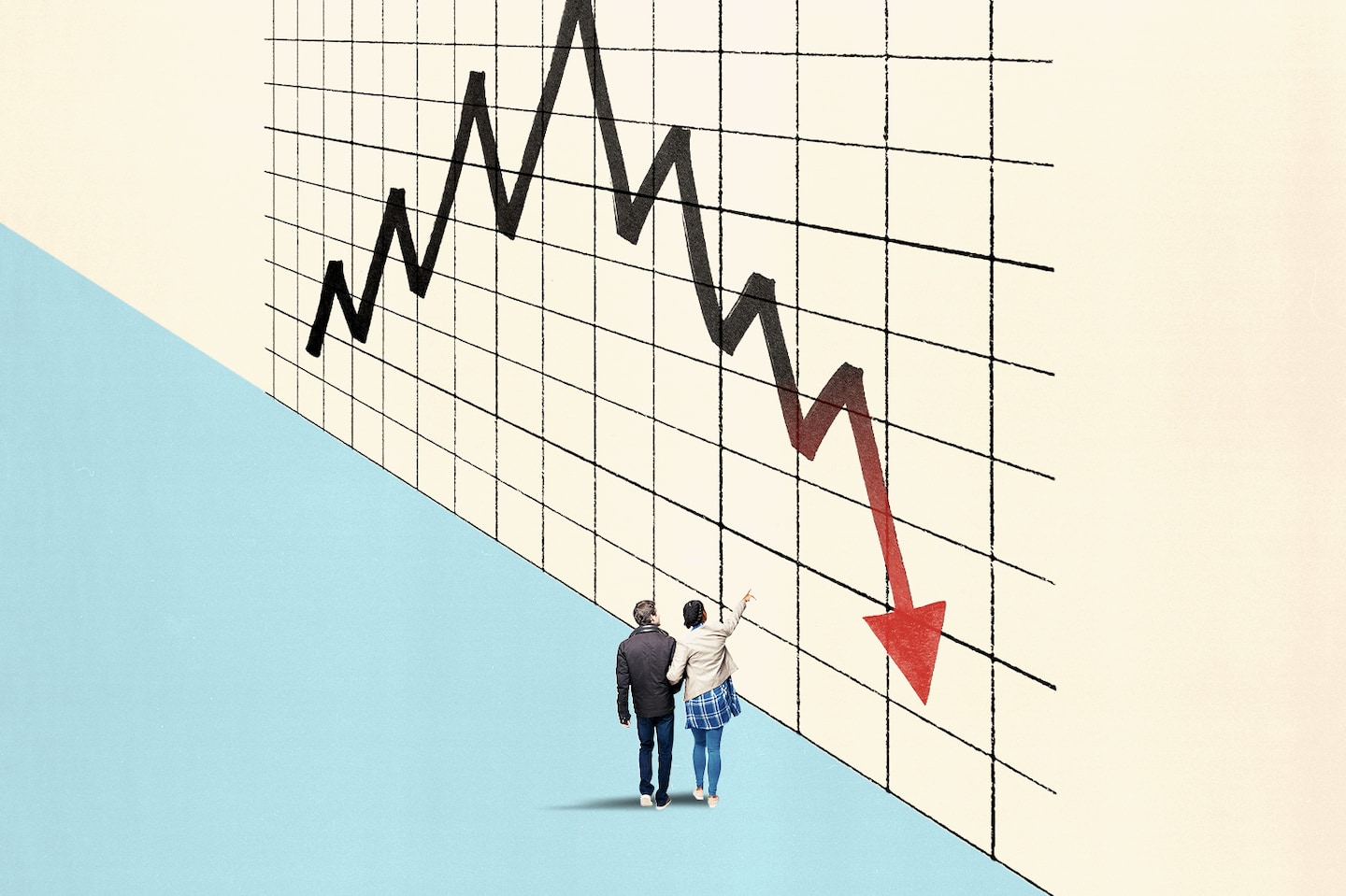
I won’t tell you not to panic when the stock market has a significant decline, as it did recently.
I’d rather advise you to look at your investment portfolio’s one-year return. Then review what it’s done over the past three, five and 10 years.
It will help put things in perspective.
Year over year, the return on my retirement savings is still up 20 percent despite the pounding U.S. stocks took the first three trading days of August. On Monday, the Dow shed more than 1,000 points after Japan’s benchmark index, the Nikkei 225, had its largest single-day drop on record, rattling global markets. My stock-heavy portfolio has annualized returns of a comfortable 7 percent over three years, 14 percent over five years, and 12 percent over a decade.
I haven’t lost money, but would have had I sold in a panic rather than sticking to my investment plan.
I’m not minimizing your concern, but as a long-term investor, you have to learn to stomach these storms.
“Knee-jerk reactions to a fear of decline can cause more long-term damage than the decline itself,” said Dan Egan, vice president of behavioral finance and investing for Betterment, a digital investment advisory firm.
Looking at the index closings from Monday, here’s some additional perspective from Callie Cox, chief market strategist for Ritholtz Wealth Management. Year-to-date performances:
- S&P 500: Up 8.7 percent.
- Dow: Up 2.7 percent
- Nasdaq 100: Up 6.4 percent
“Not spectacular, but not as bad as the past week would have you think,” Cox said.
Plus, as we know, the winds shift constantly. On Tuesday, stocks snapped a three-day losing streak and the Dow closed up almost 300 points.
I asked Egan and Cox to address the anxiety anyone with a 401(k) or other investments may have during these types of trading days. Here’s what they said.
How should regular investors interpret what’s happening?
Cox: Tensions were already high after Friday’s lukewarm jobs report. Then, Japan’s market imploded on a deluge of selling and portfolio changes, and Warren Buffett unveiled that he sold part of his Apple position to raise cash.
We’re in a danger zone for the economy, but nothing is broken yet — even though markets may be telling you otherwise. In the background, profits are growing, S&P 500 companies are delivering solid earnings results, companies are hiring and layoffs are low.
These are gut-wrenching market moves, but we need to keep in mind that it’s all happening on vibes and positioning, not fundamental weakness.
Egan: You may be surprised how little things have changed. For example, if you were in a 50/50 portfolio getting close to retirement, bonds are up, and even stocks are up on the year. Your retirement may be in fine shape.
With all the news about market sell-offs, what should investors do?
Cox: You can’t hide from the headlines, but you can try to be laser-focused on what matters to you and your own situation. This differs from person to person, but for many long-term investors, what matters most to their financial success is how much money they’re making, how much money they’re stashing away for the future, and what big-picture trends we’re seeing in the economy and corporate America.
Your energy is best spent focusing on these three areas. On the economic front, it’s not time to panic, and this sell-off seems to be just another blip on the radar.
Egan: Clear your mind, take a deep breath and think: Does this matter for my future?
Does this actually knock any of my goals off track? What would I want to do in a period of coolheadedness?
What should people do if they are nearing retirement, or retired?
Cox: No matter where you are in your investing journey, it’s smart to create a plan for the worst-case scenario.
You don’t need to execute on it, but have steps in mind in case you get unexpectedly bad news about your own finances or the economy. If you’re close to retirement, factor your income needs and withdrawals into that plan. Planning helps you stay sane on days like these.
Egan: Those in retirement should have a healthy allocation to bonds and lower-risk assets, decreasing how scary this is.
Both stocks and bonds are still up so far this year. Even a retiree’s stock allocation is for 10-plus years out, and shouldn’t be considered the short-term part of the portfolio.
Having ‘buckets’ to manage short-term needs — two years — helps you to care less about drawdowns. A short-term bucket with cash and bonds would be just fine.
What lessons can people learn from past panic attacks over stock declines?
Cox: History has told us over and over that stocks follow the economy and corporate earnings over time. Knowing that can help you tune out the noise and focus on what matters most.
Challenging days like these are just the heartbeat of the stock market. They’re the risk you take on for that eventual return.
Egan: Remember that when volatility is elevated, things can swing back up after an overreaction as much as anything else.



![i’m-nervous,-too!-[part-2]](https://10xwealthreport.com/wp-content/uploads/2026/03/177042-im-nervous-too-part-2-1568x784.jpg)