
Gujarat State Petronet (NSE:GSPL) has had a rough three months with its share price down 24%. However, the company’s fundamentals look pretty decent, and long-term financials are usually aligned with future market price movements. Specifically, we decided to study Gujarat State Petronet’s ROE in this article.
Return on Equity or ROE is a test of how effectively a company is growing its value and managing investors’ money. In short, ROE shows the profit each dollar generates with respect to its shareholder investments.
See our latest analysis for Gujarat State Petronet
How To Calculate Return On Equity?
The formula for ROE is:
Return on Equity = Net Profit (from continuing operations) ÷ Shareholders’ Equity
So, based on the above formula, the ROE for Gujarat State Petronet is:
15% = ₹22b ÷ ₹144b (Based on the trailing twelve months to March 2024).
The ‘return’ is the yearly profit. Another way to think of that is that for every ₹1 worth of equity, the company was able to earn ₹0.15 in profit.
What Is The Relationship Between ROE And Earnings Growth?
So far, we’ve learned that ROE is a measure of a company’s profitability. Depending on how much of these profits the company reinvests or “retains”, and how effectively it does so, we are then able to assess a company’s earnings growth potential. Assuming all else is equal, companies that have both a higher return on equity and higher profit retention are usually the ones that have a higher growth rate when compared to companies that don’t have the same features.
Gujarat State Petronet’s Earnings Growth And 15% ROE
At first glance, Gujarat State Petronet seems to have a decent ROE. Even when compared to the industry average of 15% the company’s ROE looks quite decent. Despite the moderate return on equity, Gujarat State Petronet has posted a net income growth of 3.7% over the past five years. So, there could be some other factors at play that could be impacting the company’s growth. For instance, the company pays out a huge portion of its earnings as dividends, or is faced with competitive pressures.
We then compared Gujarat State Petronet’s net income growth with the industry and found that the company’s growth figure is lower than the average industry growth rate of 13% in the same 5-year period, which is a bit concerning.
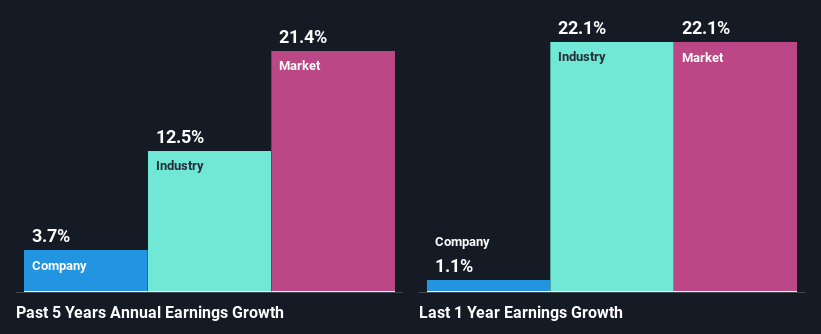
Earnings growth is an important metric to consider when valuing a stock. It’s important for an investor to know whether the market has priced in the company’s expected earnings growth (or decline). This then helps them determine if the stock is placed for a bright or bleak future. If you’re wondering about Gujarat State Petronet’s’s valuation, check out this gauge of its price-to-earnings ratio, as compared to its industry.
Is Gujarat State Petronet Using Its Retained Earnings Effectively?
Gujarat State Petronet’s low three-year median payout ratio of 7.0% (or a retention ratio of 93%) should mean that the company is retaining most of its earnings to fuel its growth. This should be reflected in its earnings growth number, but that’s not the case. So there could be some other explanation in that regard. For instance, the company’s business may be deteriorating.
Moreover, Gujarat State Petronet has been paying dividends for at least ten years or more suggesting that management must have perceived that the shareholders prefer dividends over earnings growth. Our latest analyst data shows that the future payout ratio of the company is expected to rise to 27% over the next three years. Accordingly, the expected increase in the payout ratio explains the expected decline in the company’s ROE to 7.9%, over the same period.
Summary
On the whole, we do feel that Gujarat State Petronet has some positive attributes. However, given the high ROE and high profit retention, we would expect the company to be delivering strong earnings growth, but that isn’t the case here. This suggests that there might be some external threat to the business, that’s hampering its growth. With that said, on studying the latest analyst forecasts, we found that while the company has seen growth in its past earnings, analysts expect its future earnings to shrink. To know more about the latest analysts predictions for the company, check out this visualization of analyst forecasts for the company.
Valuation is complex, but we’re helping make it simple.
Find out whether Gujarat State Petronet is potentially over or undervalued by checking out our comprehensive analysis, which includes fair value estimates, risks and warnings, dividends, insider transactions and financial health.
Have feedback on this article? Concerned about the content? Get in touch with us directly. Alternatively, email editorial-team (at) simplywallst.com.
This article by Simply Wall St is general in nature. We provide commentary based on historical data and analyst forecasts only using an unbiased methodology and our articles are not intended to be financial advice. It does not constitute a recommendation to buy or sell any stock, and does not take account of your objectives, or your financial situation. We aim to bring you long-term focused analysis driven by fundamental data. Note that our analysis may not factor in the latest price-sensitive company announcements or qualitative material. Simply Wall St has no position in any stocks mentioned.




![i’m-nervous,-too!-[part-2]](https://10xwealthreport.com/wp-content/uploads/2026/03/177042-im-nervous-too-part-2-1568x784.jpg)